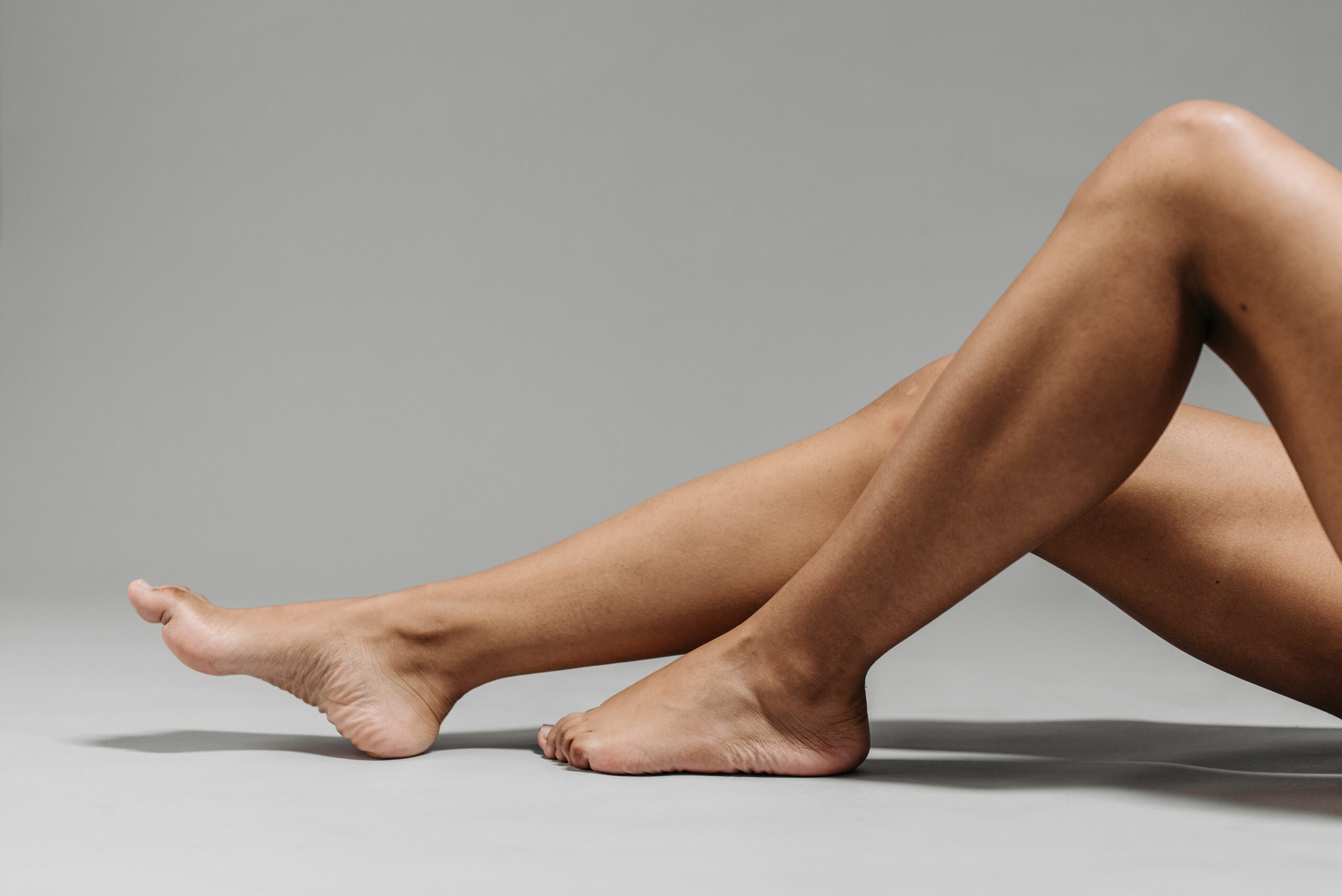
Leg liposuction: reshaping thighs, calves and ankles
While liposuction is most often associated with the upper body (the abdomen or the hips in particular), it can also be performed on the legs. In that case, it can be used to reshape the thighs, calves and/or ankles in order to slim down and harmonise the body contour. What exactly do these procedures involve? Who are they intended for? What results can you expect, and what is recovery like? Everything you need to know about leg liposuction.
Contents
Why have leg liposuction?
Liposuction of the thighs and calves involves removing a certain amount of excess fat, whether evenly distributed or not, from the legs using thin cannulas. It aims to permanently get rid of the deep fat cells located beneath the skin, which are resistant to dieting and regular physical exercise. It is the most effective technique for treating fatty deposits on the legs, as the skin in this area is too firm for other non-invasive procedures such as cryolipolysis, for example.
Indications and the origin of leg fat
When it is not the result of overall excess body weight, leg fat most often stems from genetic factors, as it is frequently passed down from generation to generation, particularly in women. In this specific case, even a balanced diet will not produce legs that are slim and harmonious in proportion to the rest of the body, which is often a source of self-consciousness for those affected. Women who experience it often avoid wearing dresses or skirts that reveal their legs. Liposuction (or lipoaspiration, simply a matter of terminology) is then the ideal solution to put an end to this everyday discomfort.
Legs perceived as too large may also stem from a hormonal imbalance or from water retention. In that case, liposuction cannot be effective. When leg volume is linked to lipedema (a pathological, most often symmetrical, accumulation of fat), a gentle liposuction adapted to the treatment of lipedema can however be considered within a specific framework.
The goals of leg liposuction
Leg liposuction can aim to correct various features perceived as unaesthetic and a source of self-consciousness for the patients concerned. These include, in particular:
- overall slimming of the body contour to harmonise the upper and lower body and put an end to the so-called « tree-trunk legs » complex;
- reducing the bulky appearance of the ankles and calves and redefining them to better mark the separation between shapes;
- slimming the diameter of the thighs to achieve a more slender body contour;
- emphasising the difference in volume between the thighs and calves.

How the different leg-reshaping procedures are performed
The 3 procedures (thighs, calves, ankles) can be carried out together when this is what the patient wants, with a view to fully slimming the legs. They can also be considered separately when the problematic volume is confined to a specific area, most often the calves. The inner side of the knee, often the site of a small unsightly fatty deposit, is also frequently treated at the same time as the inner thigh in order to extend the leg-lengthening effect.
Thigh liposuction
Thigh liposuction corrects an excess of fat on the thighs, where fatty deposits tend to build up. It is performed in the vast majority of cases on women and involves removing the excess fatty tissue on the thighs in order to slim the appearance of the hips and achieve a more slender body contour. It can also address chafing between the thighs when they sit too close together: this is the request often expressed under the term inner-thigh liposuction, which targets the inner side to restore a little space between the two legs.
The different areas that can be treated
It is therefore possible to treat up to 4 distinct areas depending on the assessment made by the surgeon, namely:
- the outer thigh, regularly associated with what are known as « saddlebags », which is the area that delivers the most noticeable results;
- the inner thigh, where the skin is particularly thin and where the inner side of the knee is often treated at the same time;
- the back of the thigh, often a storage site for fat cells and skin slackening, where cellulite and an orange-peel appearance form;
- the front of the thigh, the treatment of which often extends down to the knee (above the kneecap), where fatty deposits also regularly build up.
When the procedure addresses all of these areas, it is referred to as circumferential thigh liposuction, during which the surgeon works on the entire circumference of the thigh.
Before the procedure
Before the operation, the surgeon listens to the patient’s wishes and assesses her body shape. He evaluates the amount of fat that can be removed and makes sure that the volume of the thigh is not essentially muscular in origin. He also checks the skin’s ability to retract after liposuction. A blood test is carried out to confirm the absence of contraindications. An appointment with the anaesthetist must be scheduled no later than 48 hours before the liposuction.
How the procedure is performed
Liposuction is a procedure of moderate intensity. It can therefore be performed under general anaesthesia, but also under local or epidural anaesthesia if the area to be treated is small. It takes place on an outpatient basis, with the patient most often leaving the hospital the same evening. It can last 1 to 2 hours depending on the amount of fat to be removed.
It begins with micro-incisions on the targeted sides of the thighs, into which thin foam cannulas with rounded, perforated tips are inserted to suction the fat using steady back-and-forth movements. The smallest cannulas are used on the back and inner side of the thighs, where the thin skin can cause waviness to appear if suction is too strong or too fast.
The amount of fat removed will depend on the degree of skin laxity of the thighs. When this is very pronounced, a moderate liposuction will be performed so as not to make this laxity too visible. The surgeon must also ensure a symmetrical result between each thigh and between the different sides for a harmonious result.
At the end of the suction, the incisions are closed with absorbable threads. A dressing is finally applied over these incisions.
Because of the thinness of the thigh skin and its tendency to slacken, liposuction must often be combined with a thigh lift, or cruroplasty, consisting of redraping and re-tightening the skin to restore a smooth, toned appearance. Thigh liposuction can also be replaced by the J-Plasma Renuvion procedure for thigh cellulite (or even combined with it when there is a large amount of fat), which uses radiofrequency combined with the delivery of helium gas to treat skin laxity of the thighs. Micro-incisions are then made on the thighs to release the helium gas and the radiofrequency, producing a dual thermal effect that results in near-immediate skin retraction of the thighs (plasma effect).
Results and recovery after thigh liposuction
The results of thigh liposuction are generally striking and long-lasting, provided that a stable weight is maintained. Thigh reshaping often allows a redefinition of the body contour, a reharmonising of the shapes and a highlighting of the curves. The scars are practically invisible. Wearing a compression garment day and night is recommended for 3 weeks to a month to help the swelling go down.
Anticoagulants are also administered for about ten days to prevent the risk of phlebitis. The pain is relatively moderate and it is possible to resume walking gently the day after the procedure. Returning to work most often requires only a few days, as bruising is easily concealed under clothing. Sports can be resumed after a month. The final result can be seen 3 to 6 months after the procedure, once the swelling has completely gone down.
Calf and ankle liposuction
Calf liposuction slims calves perceived as too bulky because of excess fat. Bulky calves lead to a lack of clear definition with the ankle, which is also seen as too thick. This is why these 2 parts of the leg are very often treated together.
Before the procedure
Before the procedure, the surgeon confirms the presence of excess fat on the calves to be certain of the cause of the disproportion. Pre-operative tests (a blood test) are carried out to confirm the absence of contraindications. Photos and simulations can be made to preview the after-effect of the procedure.
How the procedure is performed
Calf liposuction lasts 1 hour to 1 hour 30 depending on the amount of fat to be removed and the size of the area to be treated. It is almost always performed under general anaesthesia given its relative invasiveness. Leaving the hospital is, however, generally planned for the same evening (on an outpatient basis). Spinal anaesthesia, which numbs only the lower limbs, is sometimes possible.
Calf liposuction begins with fine incisions of 3 to 5 millimetres made in the areas planned by the surgeon (most often in the natural folds behind the knee and the ankle) so that very fine suction cannulas with a rounded tip can be inserted. Suction is then carried out over the entire circumference of the calf, working from the calf muscles down to the Achilles tendons (in order to bring out the ankle bones) by way of the front of the shins.
The procedure requires experience and dexterity on the surgeon’s part. It is indeed an area that is relatively sensitive to lymphatic trauma despite the thickness of the skin. Precision is also essential in order to avoid any irregularity in the appearance of the skin that could prove unsightly. Symmetry between the twin (gastrocnemius) muscles is also very important.
It is therefore a genuine sculpting task aimed at harmonising the proportions (particularly in relation to the thighs and knees) and bringing out the muscular contours of the calves. The deep and superficial fat is removed by creating a network of tunnels that spare the blood vessels and nerves. Once the fat has been suctioned, the surgeon carries out a skin smoothing to ensure there are no irregularities on the calf. The operation ends with the closure of the incisions.

Recovery after calf and ankle liposuction
After the procedure, the patient must wear a compression garment all day for 2 to 3 weeks. Wearing a compression garment is particularly important here: as the calves and ankles are an area richly supplied with blood and drained by the lymphatic system, well-managed compression limits swelling and supports skin retraction. Recovery lasts about 1 to 2 weeks, during which it can be difficult to walk properly; elevating the legs when resting during the first few days helps reduce swelling. Sports can be resumed about 2 months after the procedure.
What results can you expect?
The result is not visible immediately because of the strong blood supply to the area, which causes swelling that takes a relatively long time to disappear. It can therefore be definitively seen after 6 months. The scars, for their part, fade after about a year. The contusions and bruising of the first few days disappear on their own after a few days.
The lower part of the leg is then redrawn and sculpted harmoniously (a tapered leg) in keeping with the rest of the leg, revealing more prominent curves at the muscles and more visible bones at the ankle. The fat cells removed during liposuction do not regenerate in the treated area: this is what makes the reshaping long-lasting, provided a stable weight is maintained, as the American Society of Plastic Surgeons and the Mayo Clinic point out. In the event of subsequent weight gain, the fat will nonetheless tend to distribute itself more harmoniously over the whole body rather than concentrate again on the treated legs.
Important: when « overly large » calves have no fatty origin and result from over-developed muscle (muscles that are too long and extend towards the ankles) or from venous and lymphatic problems (water retention), liposuction cannot be performed and would have no effect anyway. Muscle exercises, lymphatic drainage or medical treatments are then to be considered where appropriate.
Good to know: while the vast majority of calf procedures involve liposuction to reduce their volume, it is also possible, for people with calves perceived as too thin, to increase their circumference, either by placing an implant or by calf lipofilling (a transfer of autologous fat harvested from another part of the body).
The price of leg liposuction and insurance coverage
The price of leg liposuction can only be established precisely during a consultation, as it depends on the number of areas treated (thighs, knees, calves, ankles), the amount of fat to be removed, the type of anaesthesia and the operating-theatre and clinic fees. As a purely indicative guide, the prices seen for this type of procedure in Paris most often fall within a range running from a few thousand euros for an isolated area (calves or knees, for example) to a higher amount for liposuction of the entire legs or circumferential thigh liposuction. These rough figures remain approximate and in no way constitute a quote: only an examination during a consultation makes it possible to draw up a personalised price proposal.
Performed for aesthetic purposes, leg liposuction is not covered by the French national health insurance. An exception exists when the procedure forms part of the treatment of a recognised medical condition, such as certain cases of lipedema: a prior-agreement request can then be assessed on a case-by-case basis. The details of the cost, the fees and the payment terms are given to you in writing during the consultation, in accordance with the regulations.
Leg liposuction: who is it for (and when to avoid it)?
Leg liposuction is primarily intended for people in good general health, with localised, clearly identified excess fat that is resistant to sport and diet, and whose skin quality allows satisfactory retraction after suction. It is not a weight-loss solution: it reshapes the body contour, it does not make you lose weight.
Conversely, the procedure is not indicated when leg volume essentially stems from developed muscle, water retention or uncontrolled venous and lymphatic disorders. Significant skin laxity may also require combining liposuction with a skin-tightening step. This is precisely the value of the preliminary consultation: to determine whether fat really is the cause of the problem and, where appropriate, to guide you towards a more suitable course of treatment.
Frequently asked questions
How is thigh liposuction performed?+
Thigh liposuction is performed on an outpatient basis, under general, local or epidural anaesthesia depending on the extent of the area. The surgeon makes micro-incisions through which thin cannulas suction the excess fat, most often on the saddlebags, the inner side, the back and the front of the thigh. The procedure generally lasts 1 to 2 hours and the incisions are closed with absorbable threads.
Is leg liposuction painful?+
The pain is generally moderate and well controlled with simple painkillers. You mainly feel a sensation of tightness and aching, more pronounced around the calves, along with bruising in the first few days. Walking can gradually resume the day after the procedure.
Does the fat come back after leg liposuction?+
The fat cells removed in the treated area do not regenerate: the reshaping is therefore long-lasting, as the American Society of Plastic Surgeons and the Mayo Clinic point out. In the event of significant weight gain after the procedure, however, the fat will tend to distribute itself over the whole body rather than concentrate again on the legs; maintaining a stable weight is the key to a lasting result.
How much does leg liposuction cost?+
The price depends on the number of areas treated (thighs, knees, calves, ankles), the amount of fat to be removed, the type of anaesthesia and the operating-theatre and clinic fees. An isolated area logically costs less than liposuction of the entire legs or circumferential thigh liposuction. These figures remain indicative: only a personalised quote, provided during the consultation, is binding.
Is leg liposuction covered by the French national health insurance?+
Performed for aesthetic purposes, leg liposuction is not covered by the French national health insurance. An exception is assessed on a case-by-case basis when the procedure forms part of the treatment of a recognised medical condition, such as certain cases of lipedema, via a prior-agreement request.
When do you see the result of calf and ankle liposuction?+
The result is not immediate: the area, which has a rich blood supply, swells and then gradually goes down. A satisfactory appearance emerges around the 3rd month, and the final result is generally seen at around 6 months, the time it takes for the swelling to subside completely. Wearing a compression garment speeds up this process.
Can overly muscular calves be treated with liposuction?+
No. Liposuction only corrects excess fat. When calf volume comes from developed muscle, water retention or venous and lymphatic disorders, suction would have no effect; other approaches (lymphatic drainage, medical treatments) are then considered. This is precisely the value of the preliminary consultation, which checks that fat really is the cause of the problem.
Book an appointment
If you are considering a procedure, book an appointment in just a few clicks: our surgeons will answer all your questions and guide you toward a tailored, personalised solution.
Book on Doctolib