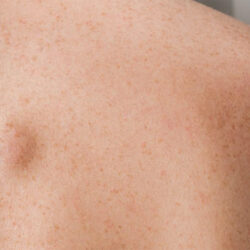
01Dermatological surgery procedures in Paris
Dermatological surgery treats skin lesions that fall outside the scope of medical treatments: bothersome benign lesions, scars, but also suspicious or cancerous lesions. Every lesion that is removed undergoes analysis under the microscope (histopathological examination), a guarantee of safety.
Diagnosis: dermoscopy
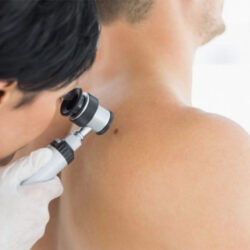
Dermoscopy examines and maps moles to identify lesions that need monitoring or removal. It is the key screening step before any surgical decision.
Benign lesions
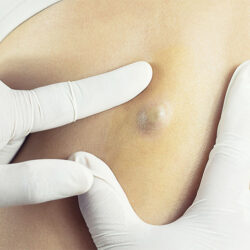
Sebaceous cyst removal, lipoma removal (a lump of fat under the skin) and mole removal of a bothersome or unsightly lesion are common procedures, performed under local anesthesia.
Suspicious or cancerous lesions
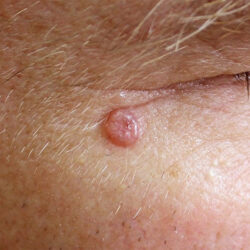
Basal cell carcinoma surgery treats the most common skin cancer, which has a very good prognosis when treated early. Any suspicious-looking lesion is removed and then analyzed to rule out a melanoma.
Scars
Scar revision improves the appearance of an old, widened or unsightly scar to make it more discreet.
02When should you see a specialist? The ABCDE rule
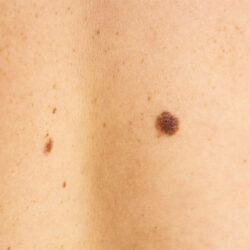
A mole that changes should be examined. A simple guide, the ABCDE rule, helps identify a suspicious lesion: Asymmetry, irregular Borders, uneven Color, Diameter greater than 6 mm, recent Evolution (size, shape, color). At the slightest doubt, a specialist opinion is essential.
03How the procedure works
After a consultation with Dr Vincent Hunsinger, in the 17th arrondissement of Paris, the removal is most often performed under local anesthesia, on an outpatient basis, in anywhere from a few minutes to half an hour. The removed lesion is systematically sent for histopathological analysis, the result of which guides any further care.
04Benign or suspicious lesion: why analysis is always carried out
The vast majority of skin lesions are benign. But only examination under the microscope of the removed lesion makes it possible to be certain and to verify that the removal is complete. That is why every excised lesion is analyzed, even when it appears harmless. In the case of an at-risk lesion, this result guides what comes next: simple monitoring, additional margins or close follow-up. This rigor, combined with regular screening of at-risk individuals (numerous moles, family history, sun exposure), is the best protection against melanoma, the most serious of skin cancers.
05Recovery, scars and insurance coverage in Paris
Recovery is straightforward: local care and removal of the stitches depending on the area. The scar is placed and oriented to remain discreet. Financially, medically justified procedures — removal of a suspicious or cancerous lesion, a symptomatic cyst or lipoma — qualify for insurance coverage by the French health insurance; the purely cosmetic removal of a benign lesion is paid for by the patient. This is reviewed during the consultation.
06Your questions
How can you recognize a suspicious mole?+
The ABCDE rule helps: asymmetry, irregular borders, uneven color, diameter > 6 mm, evolution. A mole that changes should be shown to a specialist. Dermoscopy refines the diagnosis.
Is removing a lesion covered by insurance?+
Yes, when it is medically justified (a suspicious or cancerous lesion, a symptomatic cyst or lipoma): the procedure is covered by the French health insurance. Purely cosmetic removal of a benign lesion is not.
Is the removed lesion analyzed?+
Yes, systematically. Every excised lesion is sent for histopathological analysis (under the microscope) to confirm its nature and ensure that the removal is complete.
Is basal cell carcinoma serious?+
It is the most common skin cancer and the least aggressive: it almost never metastasizes and is cured in the vast majority of cases when removed early.
Does the procedure leave a scar?+
Any removal leaves a fine scar, oriented and cared for to be as discreet as possible. A scar revision is possible if an old scar becomes bothersome.