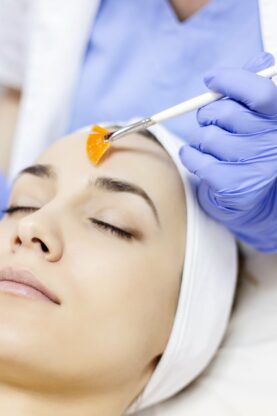
01Chemical peel for the face: how does it work?
A chemical peel applies an acid to the skin (glycolic, lactic, mandelic, salicylic, kojic, trichloroacetic…) that produces a controlled exfoliation: a limited destruction of the epidermis, or even of the superficial layers of the dermis, depending on the concentration and the application time. This controlled injury triggers peeling that forces the skin to rebuild itself: dead cells are removed and replaced by new skin, the fibroblasts are stimulated and collagen production is boosted. The result: a refined skin texture, a brighter complexion, softened wrinkles and faded imperfections. The depth of action — and therefore the result and the recovery — depends on the acid chosen, its concentration and the phototype.
02Which imperfections can a chemical peel correct?
The scope of a chemical peel is broad. Depending on its depth, it treats:
- a dull complexion, the « smoker’s complexion » and a lack of radiance;
- enlarged pores, blackheads and oily skin;
- pigment spots and melasma (pregnancy mask);
- acne-prone skin and acne scars;
- fine lines and wrinkles, loss of firmness, a crepey appearance;
- coloured under-eye circles and certain keratoses.
Gentle and superficial peels are particularly suited to younger skin (before 35), as a preventive measure or for acne and the complexion; medium peels are aimed at more mature and marked skin. The preliminary consultation establishes the indication and rules out any contraindications.
03The types of chemical peel: gentle, superficial, medium, deep
Peels are classified according to the layer of skin they reach:
The gentle, superficial peel (fruit acids — Milk Peel)
Based on fruit acids (AHAs) — glycolic acid (derived from sugar cane), lactic, mandelic — it stays within the epidermis. Mild and well tolerated, it is the most commonly performed peel: it revives the complexion, tightens the pores, smooths superficial fine lines and softens blackheads and small spots. A few sessions, with no downtime.
The medium TCA peel (Cosmo Peel / Peeling Forte)
Performed with trichloroacetic acid (TCA), it reaches the dermo-epidermal junction (superficial dermis) and durably stimulates collagen. Indicated for more marked skin (fine lines, acne scars, age spots), it often works in a single session, but causes a few days of redness and flaking.
The deep peel (phenol)
The only one to reach the deep dermis, very effective on deep wrinkles and certain scars, but with heavy recovery and significant downtime: we do not perform it at the Rive Droite Paris Étoile practice, as the risk outweighs the expected benefit.
04Which chemical peel for which skin and which indication?
The choice of peel — type of acid, concentration, number of sessions — is tailored to your indication, your phototype and the thickness of your skin. A few guidelines:
- Dull complexion, lack of radiance: superficial fruit-acid peel (glycolic, lactic, salicylic), as a course of a few sessions spaced one month apart.
- Brown spots, melasma: depigmenting peel (often combining kojic and phytic acid), over several sessions — with strict preparation and sun protection to avoid pigment rebound.
- Oily skin, acne, pores: salicylic acid peel (keratolytic and sebum-regulating), which deep-cleanses and regulates oil.
- Fine lines, acne scars, loose skin: medium TCA peel, sometimes alongside hyaluronic acid injections or botulinum toxin.
- Coloured under-eye circles: a peel adapted to the eye contour, in 1 to 2 sessions.
The phototype guides caution: olive and dark skin is more exposed to the risk of spots after a peel that is too aggressive; gentle, well-prepared peels are then preferred, or even peels dedicated to dark skin. A chemical peel can also be combined with a HydraFacial treatment or with mesotherapy to amplify the glow.
05Contraindications and the best time of year
A chemical peel is not advised on olive, tanned or recently sun-exposed skin, while taking Roaccutane, during pregnancy or breastfeeding, with an active herpes outbreak, or with an active skin condition (seborrhoeic or atopic dermatitis). The best time runs from autumn to winter: on freshly exfoliated skin, UV exposure promotes the appearance of pigment spots (post-inflammatory hyperpigmentation). SPF 50 sun protection is essential in the weeks that follow — this is the rule that determines the success and safety of the treatment.
06A chemical peel step by step, on video
@rivedroite_parisetoileThe ferulic acid peel for fresh new skin 🫧🧴#rivedroite #peeling♬ Flow – Jeff Kaale
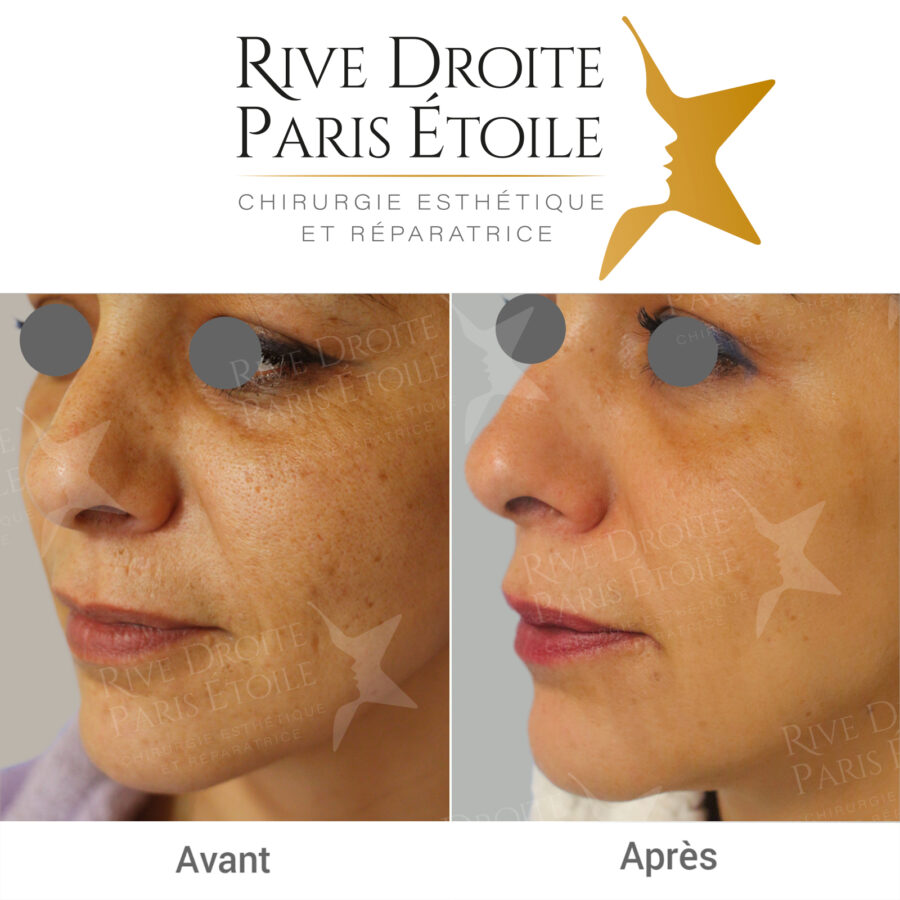
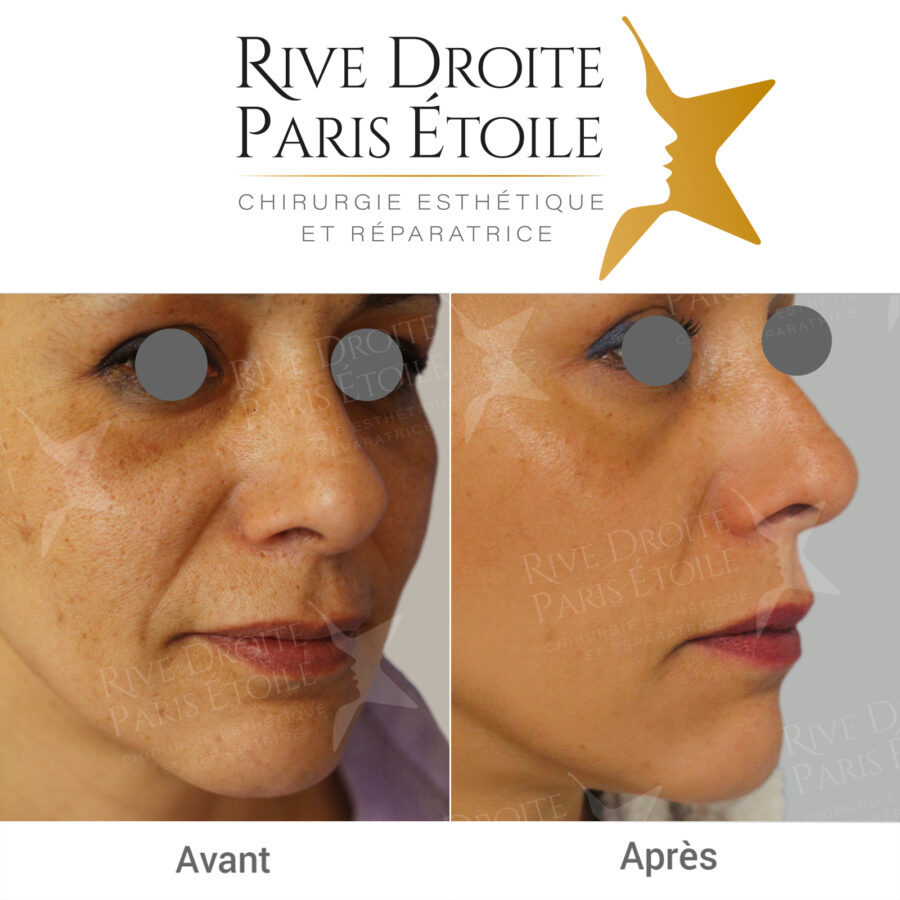
07Before / after results
08How the procedure works
Before the procedure
A consultation assesses your skin (phototype, sensitivity, imperfections) and selects the type of peel. For medium or depigmenting peels, the skin is prepared 15 days to 1 month beforehand with a cream (often based on gentle acids and brightening agents) that eases penetration and prevents pigment rebound. The session is ideally scheduled in autumn or winter, away from sun exposure; UV exposure, scrubs and harsh retinoids are avoided in the days leading up to it.
During the procedure
The session lasts 15 to 30 minutes, with no anaesthesia. After thorough make-up removal and cleansing, the doctor applies the acid solution with a brush, a compress or a cotton swab and lets it act — often from a few dozen seconds to two minutes — adjusting the number of passes according to the thickness and reaction of the skin. You feel a sensation of warmth or tingling. Once the skin turns pink, the product is rinsed off or neutralised and a soothing cream is applied.
After the procedure
Recovery depends on the depth. After a superficial peel: immediate return to activity, no downtime, at most a little redness and fine flaking. After a medium peel (TCA): the skin peels for a few days (redness, mild swelling). In every case, a repairing and soothing cream is applied for 3 to 7 days, you must not scratch or pick the peeling skin, and you protect the skin from the sun with SPF 50 for several weeks. The fresh complexion reveals itself as the skin renews; a course of several sessions (spaced 2 to 4 weeks apart) optimises and prolongs the result.
09Prices & fees in Paris
| Procedure | Aesthetic fees |
|---|---|
| Superficial fruit-acid peel | 150 – 200 € |
| Medium TCA peel | 250 – 400 € |
Indicative “from” prices, surgeon fees included. The final quote is given at the consultation, after examination, depending on the area treated and the technique chosen. Part of the procedure may be covered by French national health insurance when the medical criteria are met.
10Your questions
What is a chemical peel for the face used for?+
To revive the quality of the skin: it exfoliates the surface layer to fade a dull complexion, dark spots, blackheads and enlarged pores, smooth fine lines and acne scars, and boost collagen for firmer, brighter skin.
Superficial peel or medium peel (TCA): what is the difference?+
The superficial peel (fruit acids, Milk Peel) stays within the epidermis: it revives the complexion and tightens the pores, with no downtime, over a few sessions. The medium TCA peel (Cosmo Peel) reaches the superficial dermis: more powerful on fine lines, scars and spots, it works in a single session but causes a few days of flaking.
How much does a chemical peel for the face cost in Paris?+
Expect around €150 to €200 for a superficial fruit-acid peel and €250 to €400 for a medium TCA peel. The exact price depends on the areas and the protocol, confirmed during the consultation.
Is a chemical peel painful?+
No, it is almost painless: you mainly feel a sensation of warmth or tingling during the application, sometimes redness or a tight feeling afterwards. It is performed without anaesthesia.
What is the recovery like after a session?+
After a superficial peel, no downtime (at most a little redness). After a medium peel, the skin peels for a few days with redness and mild swelling. In both cases: do not pick the peeling skin, moisturise well and protect from the sun.
How many sessions are needed?+
The superficial peel is performed as a course of a few sessions spaced 2 to 4 weeks apart. The medium TCA peel gives a result after a single session, sometimes repeated 6 to 12 months later.
What is the best time of year for a chemical peel?+
Autumn and winter, when sunlight is weak. On freshly exfoliated skin, UV rays promote the appearance of pigment spots: SPF 50 sun protection remains essential in the weeks following the session.
Is a chemical peel for the face dangerous?+
No: the superficial and medium (TCA) peels performed at the practice are safe when carried out by a doctor, on the right indication and at the right time of year. The deep phenol peel, far riskier, is not offered here.
When are the results visible and can I wear make-up?+
The complexion is revived as soon as flaking ends (a few days to a few weeks depending on the depth). Make-up should be avoided for the first 24 hours, then is possible once the skin has settled.
Are "peeling" creams effective?+
They rely on the same principle but at far lower concentrations than medical peels: their effect is milder and slower. A peel performed at the practice, dosed and monitored, is clearly more effective.
Which chemical peel for dark spots and melasma?+
A depigmenting peel (combining acids such as kojic and phytic) fades brown spots and melasma, over several sessions. It requires skin preparation and strict sun protection to avoid pigment rebound; on olive or dark skin, caution is maintained.
Does a chemical peel treat acne?+
Yes: a salicylic acid peel deep-cleanses the pores, regulates sebum and improves oily, acne-prone skin; TCA helps fade acne scars. A course of several sessions is generally needed.
Is a chemical peel suitable for olive or dark skin?+
Yes, with caution: darker phototypes are more exposed to the risk of spots after a peel that is too aggressive. Gentle, well-prepared peels are preferred, sometimes dedicated to dark skin, together with rigorous sun protection.