- A breast lift corrects breast ptosis: it raises the breast, recentres the areola and tightens the skin, without necessarily changing the volume.
- It is intended for women whose breasts have dropped after pregnancy, breastfeeding, significant weight loss or with age, when the position of the breast matters as much as its size.
- The technique — round block, vertical or inverted T, with or without implants — depends on the grade of ptosis, the quality of the skin and the breast volume.
- The procedure takes 1h30 to 2h under general anaesthesia, with a return to work in 1 to 2 weeks and a support bra worn for 1 month.
- Scars are unavoidable and fade over 12 to 18 months. In Paris, prices start at €6,800, with no cover from the French health service unless a breast reduction is combined.
01What is a breast lift?
A breast lift, medically known as mastopexy, is the operation that raises a breast that has dropped through skin laxity, without reducing its volume. The surgeon removes the excess skin, reshapes the breast tissue to restore projection, and repositions the areola and nipple at the centre of the breast.
In practice, the procedure corrects:
- sagging breasts, most often after a pregnancy, breastfeeding or weight loss;
- marked skin laxity linked to age;
- a flat décolleté, with an emptied look in the upper pole of the breast;
- breast asymmetry caused by one breast dropping more than the other;
- a widened areola that has slipped down to the inframammary fold.
A lift on its own, however, does not increase breast volume and does not remove stretch marks on the décolleté. It can be combined with a breast augmentation or a breast reduction depending on the starting volume. The incision techniques, how the scars evolve and the price of each variant are covered on our page devoted to mastopexy.
02Sagging breasts: why does the bust drop?
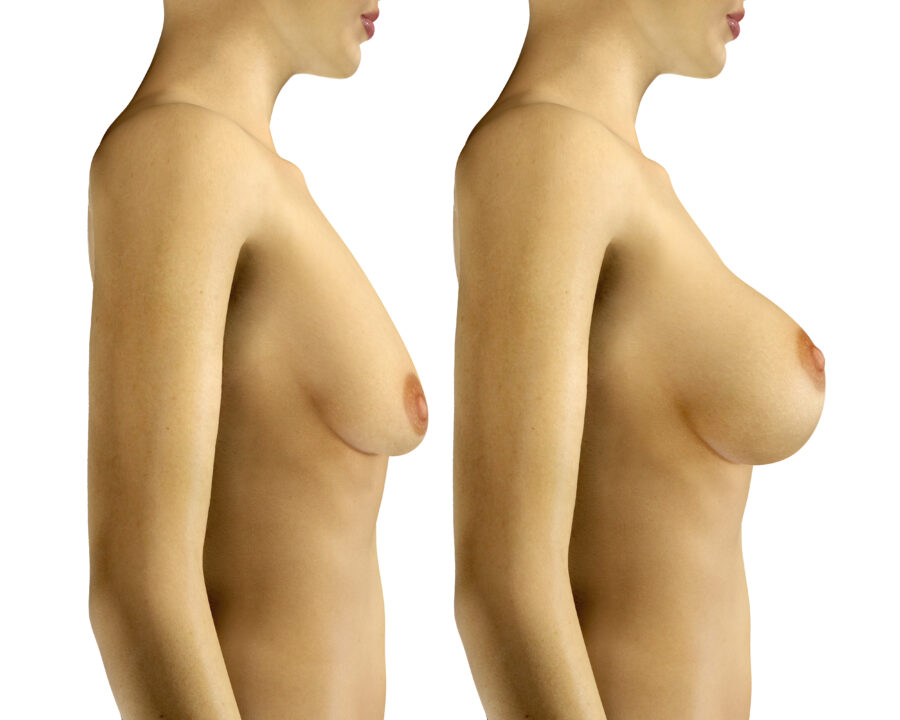
Over time, the breast tissue and the skin lose firmness and elasticity. The areola gradually moves down towards the inframammary fold, the upper part of the breast empties and the shape is lost. Several factors explain this:
- pregnancy and breastfeeding: the most common cause. When breastfeeding ends, the gland shrinks back to its usual volume, leaving a stretched skin envelope and an emptied upper pole;
- significant weight loss and weight fluctuations: repeated changes stretch the tissues, which do not return to their original position — a very common situation after bariatric surgery or a sleeve gastrectomy;
- age and skin ageing: collagen and elastin production slows, and the Cooper’s ligaments that support the breast stretch;
- genetics: ptosis can be congenital and already marked in adolescence, with no weight change at all;
- breast hypertrophy: the weight of a large bust mechanically accelerates its descent.
03How do you know if you have breast ptosis?
The diagnosis is made when the areola and nipple sit at, or below, the inframammary fold. A simple check gives a first idea at home: the pencil test. Slide a pencil into the fold under the breast — if it stays in place, the ptosis is significant; if it falls, the drop is still moderate.
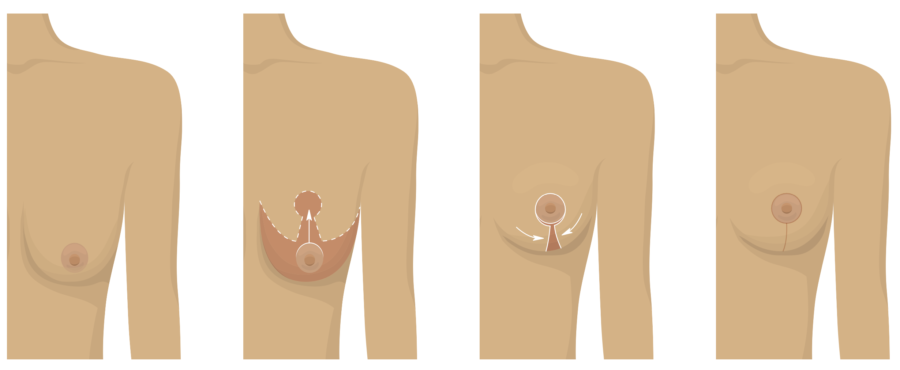
To assess severity precisely, surgeons use the Regnault classification, the international reference, which distinguishes three grades:
- Mild ptosis (grade I): the nipple sits level with the inframammary fold;
- Moderate ptosis (grade II): the nipple drops below the fold but stays above the lower pole of the breast;
- Severe ptosis (grade III): the nipple is the lowest point of the breast and points downwards.
Pseudoptosis describes a breast whose areola is still well placed but whose gland, emptied at the top, falls below the fold — a common situation after breastfeeding or weight loss. The diagnosis is made in consultation at Rive Droite Paris Étoile, in the 17th arrondissement, where the measured grade determines the technique used.
04Lift alone, with implants or with a reduction?
The procedure is adapted to the starting breast volume and to what the patient wants:
- a breast lift alone (without implants): the surgeon reshapes the gland, repositions it and tightens the skin, with nothing added. It suits patients whose breast volume is already satisfactory;
- a lift with breast augmentation: when the breast is emptied or the patient wants more fullness, the lift is combined with silicone implants or with breast fat transfer — fat harvested by liposuction. This is the option chosen for breast hypoplasia or a flat décolleté;
- a lift with breast reduction: when the ptosis stems from a bust that is too heavy, a breast reduction is combined. It relieves back pain and makes it easier to raise the breast.
05Which scars, depending on the technique?
Sagging breasts cannot be lifted durably without scars: that is the accepted trade-off of the operation. Their pattern depends directly on the grade of ptosis and on how much skin has to be removed.
- periareolar incision (round block) — mild ptosis: the scar forms a circle at the border between the areola and the breast skin, where it blends in naturally;
- vertical incision (« lollipop ») — moderate ptosis: it circles the areola then runs down to the inframammary fold, which allows genuine reshaping;
- inverted-T incision (anchor) — severe ptosis: it adds a horizontal scar in the fold, the only way to remove a large excess of skin.

Scars are red and slightly raised at first, then thin out and fade. They are considered mature between 12 and 18 months. They never disappear completely but become very discreet, and are placed so that they stay hidden by a bra or a swimsuit. Scar massage, silicone dressings and strict sun protection during the first year clearly improve their quality. How they evolve month by month, and how to optimise them, is detailed on the mastopexy page.
06What results can you expect, and how long do they last?
The breast is raised as soon as you leave theatre, but the final shape takes several months to settle: the swelling subsides, the tissues relax and the breast takes on a natural look. The shape stabilises at around 3 to 6 months, and the final result at about one year, once the scars have matured.
The result is long-lasting, but it does not stop time: the breast keeps changing with age and gravity. A later pregnancy or a significant weight change can loosen the bust again. Keeping a stable weight and not smoking are the two best guarantees of a lasting result.
In consultation, the surgeons at Rive Droite Paris Étoile show you cases comparable to your own anatomy and can produce a 3D projection of the expected result.
07What are the risks of a breast lift?
Complications after a breast lift are rare, but they should be understood before going ahead:
- in the first hours: a haematoma, which may justify going back to theatre to drain it;
- in the first month: delayed healing or wound breakdown, infection, more rarely compromised blood supply to the areola — a risk considerably increased by smoking;
- later on: altered nipple sensation, a widened scar, a hypertrophic or keloid scar, or a gradual recurrence of the ptosis.
Following the instructions — stopping smoking, wearing the support bra, protecting the scars from the sun — and choosing a qualified plastic surgeon considerably reduce these risks.
08Price of a breast lift in Paris
In Paris, a breast lift costs between €6,800 and €8,800 for a ptosis correction alone, and ranges from €8,400 to €11,800 when implants are placed at the same time. That price includes the surgeon’s and anaesthetist’s fees, theatre and hospital costs, and follow-up for one year.
The exact amount depends on the grade of ptosis, the technique used, how long the operation takes and any combined procedures. A detailed quote is given in consultation, followed by a legally required 15-day cooling-off period before the operation. The price of each variant is set out on the mastopexy page.
A breast lift performed for cosmetic reasons is not covered by the French health service. Partial cover remains possible when it is combined with a breast reduction removing at least 300 g of gland per breast, in cases of tuberous breasts or severe asymmetry: the surgeon then submits a prior-agreement request.
09How the procedure works
Before the procedure
Preparation involves two consultations at Rive Droite Paris Étoile. The surgeon takes your expectations and medical history, assesses the shape, volume and projection of the breasts, measures the grade of ptosis and decides with you on the technique and any combined procedures (breast augmentation or reduction).
You are given a detailed quote; a legally required 15-day cooling-off period must be observed before the operation. The surgeon also arranges breast imaging (mammogram or ultrasound) to rule out any pre-existing lesion, and sets out the pre-operative protocol:
- stopping smoking 2 months before the operation, and ideally for 1 month afterwards, to avoid healing problems and skin necrosis;
- stopping oral contraception if there is a thromboembolic risk;
- stopping aspirin and anti-inflammatory drugs at least 10 days before the operation;
- buying a non-underwired support bra that fastens at the front.
The anaesthetist’s consultation takes place at the latest 48 hours before going into theatre.
During the procedure
A breast lift is performed under general anaesthesia and takes on average 1h30 to 2h, slightly longer when another procedure is combined.
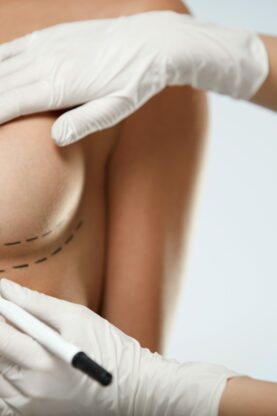
It begins with pre-operative marking done standing up, which traces the areas to be incised and the future position of the areola. The surgeon then makes the incision matching the grade of ptosis (periareolar, vertical or inverted T), removes the excess skin, then reshapes the breast tissue and repositions it higher on the chest wall.
This is the point at which an implant can be placed in the pocket created for it, or gland removed in cases of hypertrophy. The areola and nipple are finally raised and recentred, the skin redraped, and the sutures made with dissolvable stitches. A shaping dressing and a support bra are put in place at the end of the operation.
After the procedure
Patients most often spend the night under observation and go home the following day; same-day discharge (day case) remains possible in some cases, depending on the extent of the procedure and the anaesthetist’s opinion. Any drains are removed before discharge.
The dressing is replaced by a support bra, worn day and night for 1 month. Recovery is straightforward: swelling and bruising settle within a few days to a few weeks, and the discomfort — more a feeling of tightness and aching than real pain — is relieved by simple painkillers.
Recovery follows this timeline:
- days 1 to 3: rest at home, no lifting, first shower usually allowed on day 2;
- days 7 to 15: first check-up, dressings removed and return to work depending on the job;
- 1 month: bruising gone, gentle activity resumed; sport and heavy lifting are still discouraged;
- 3 months: the breast takes its shape, scar massage can begin, sport is resumed gradually;
- 1 year: healing is mature and the result is considered settled.
Regular follow-up appointments help optimise healing. Sun exposure of the scars must be avoided during the first year; failing that, SPF 50+ protection is essential, even under a swimsuit.
10Prices & fees in Paris
| Procedure | Aesthetic fees |
|---|---|
| Breast lift (breast ptosis correction) | 6 800 – 8 800 € |
| Breast lift with breast implants | 8 400 – 11 800 € |
Indicative “from” prices, surgeon fees included. The final quote is given at the consultation, after examination, depending on the area treated and the technique chosen. Part of the procedure may be covered by French national health insurance when the medical criteria are met.
11Your questions
Is a breast lift covered by the French health service?+
A breast lift performed purely for cosmetic reasons is not covered. Partial cover remains possible in three cases: when it is combined with a breast reduction removing at least 300 g of gland per breast, for tuberous breasts, or for severe breast asymmetry. The surgeon then submits a prior-agreement request to the health service.
How much does a breast lift cost in Paris?+
Prices start at €6,800 for a breast lift alone, and range from €8,400 to €11,800 when implants are placed at the same time. That price includes the surgeon’s and anaesthetist’s fees, theatre and hospital costs and one year of follow-up.
Is there such a thing as a scarless breast lift?+
Not strictly speaking. In some mild ptoses, placing an implant alone can restore fullness without tightening the skin, and the round block technique limits the scar to the edge of the areola. But as soon as the ptosis is moderate or severe, scars are unavoidable — they are then placed discreetly and fade markedly over time.
Is there a non-surgical breast lift?+
No. Non-surgical methods — lasers, radiofrequency, thread lifts, creams or exercise — do not tighten stretched skin or breast tissue and therefore cannot correct true breast ptosis. They can, however, help maintain the result after surgery.
Can you breastfeed after a breast lift?+
Yes, breastfeeding usually remains possible: the milk ducts are preserved when the areola is raised. It is nonetheless better to postpone a lift until after any planned pregnancies, since pregnancy and breastfeeding can undo the correction.
How long does the result of a breast lift last?+
The result is long-lasting and measured in years, but it stops neither natural skin ageing nor the effects of a pregnancy or a significant weight change. Keeping a stable weight and not smoking are the best ways to preserve it.
What is the difference between a breast lift and a breast reduction?+
A lift repositions the breast and tightens the skin without reducing its volume; a breast reduction removes gland and fat to lighten a bust that is too heavy. The two are often combined when the ptosis stems from breast hypertrophy.
Is a breast lift painful?+
Not very. The operation does not involve the pectoral muscle, which makes it considerably less painful than a breast augmentation. Patients mainly describe tightness and aching across the décolleté in the first few days, well controlled by simple painkillers.
Is nipple sensation altered after the operation?+
Numbness or, conversely, temporary hypersensitivity of the nipple and areola is common afterwards. Sensation returns gradually, usually within a few months. A lasting change remains possible, particularly after severe ptosis.
Is there a link between a breast lift and breast cancer?+
No. No study has shown any causal link between a breast lift and breast cancer, and the operation does not interfere with later screening. Breast imaging is routinely carried out before going into theatre.