
01What is a genioplasty? Chin abnormalities
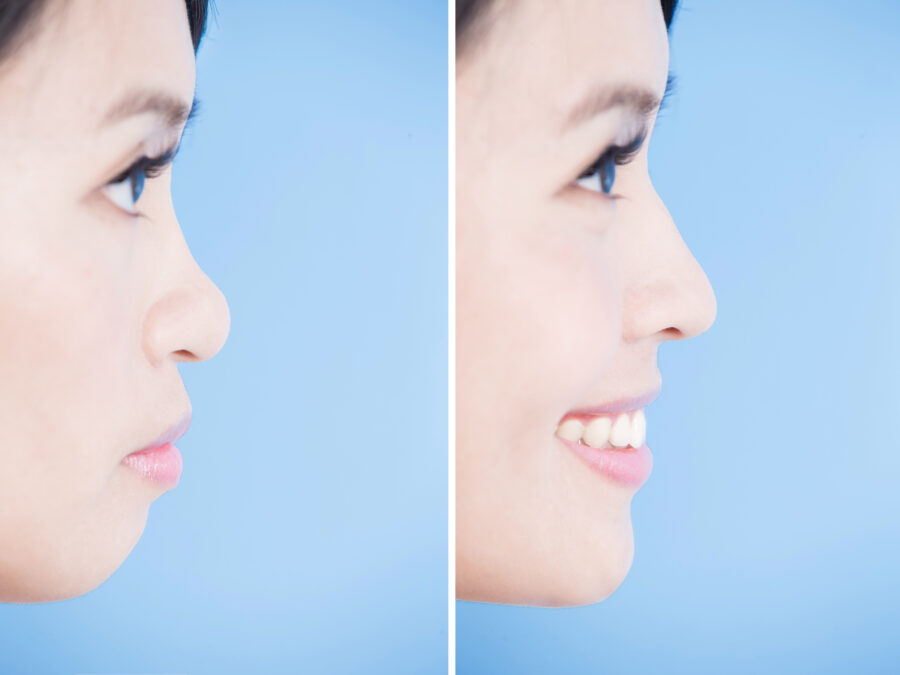
A genioplasty is intended to change the shape, height or projection of the chin. A chin is considered harmonious when, in profile, its tip aligns with a vertical reference line of the face. When the chin deviates from this line, two main abnormalities are distinguished:
- The receding chin (retruded chin, or retrogenia): the chin sits too far behind the line, often with a poorly defined neck and a double-chin appearance.
- The prominent chin (protruding chin, or progenia): the chin sits too far forward and projects beyond the line.
Other issues exist and are sometimes combined: an asymmetric (deviated) chin, a chin that is too tall (long-face syndrome) or too short (short face). Depending on the case, a genioplasty can reposition the chin bone, insert an implant against the mandibular bone, or fill the area with an injection of hyaluronic acid or fat (lipofilling).
02Why have a genioplasty?
The primary motivation is aesthetic: a well-positioned chin balances the profile, gives structure to the lower face and restores character to an area that is often a source of self-consciousness. But a genioplasty also has functional benefits:
- allow the lips to meet at rest (correcting lip incompetence);
- improve oral and dental hygiene and reduce strain on the lower gum;
- help, alongside jaw surgery, to correct a dental occlusion or breathing problem.
The chin is rarely treated on its own: it may be combined with a rhinoplasty to rebalance the nose and chin (this is known as a profiloplasty), or with neck liposuction to treat a double chin.
03Advancement or setback genioplasty: the techniques
The technique depends on the initial issue.
Advancement genioplasty (receding chin)
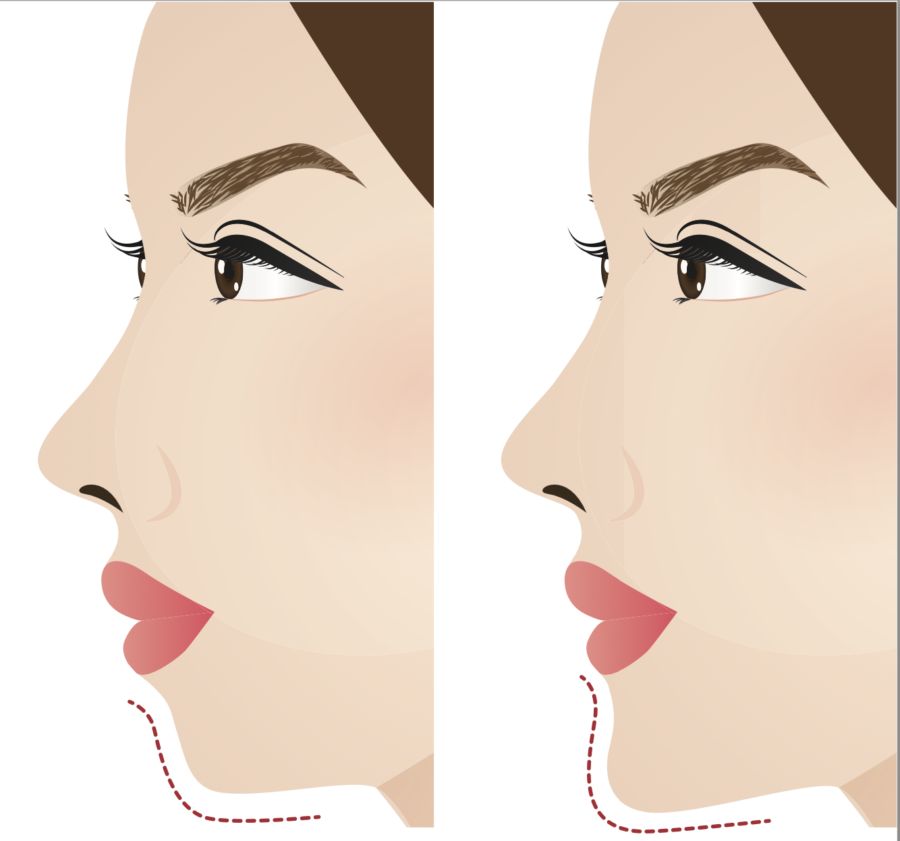
To advance a receding chin (retrogenia), three approaches are possible:
- Advancement osteotomy: the surgeon cuts the chin bone horizontally, advances it, then fixes it with a titanium mini-plate and screws. This is the most stable and adjustable solution.
- Placement of a chin implant: a custom silicone or Medpor implant is slid into a pocket against the bone — invisible because it is hidden beneath the tissues.
- Bone graft, sometimes as part of a profiloplasty.
Setback genioplasty (prominent chin)
To reduce a prominent chin (progenia), two procedures are possible:
- Bone shaving: the projection is reduced by filing down the edge of the mandibular bone.
- Setback osteotomy: an ultrasonic bone cut (piezotome) removes the excess and sets the chin back, before re-fixation with a plate and screws.
When the jaw discrepancy is significant and affects the dental occlusion, a genioplasty alone is not enough: a mandibular or bimaxillary osteotomy (orthognathic surgery) is then combined with it.
04Bony genioplasty, implant or injection: which to choose?
Hyaluronic acid injections or the placement of an implant only correct a mild receding chin, without acting on height or an asymmetry. Hyaluronic acid is non-surgical and reversible, but temporary (12 to 18 months): this is the option of non-surgical chin augmentation, using hyaluronic acid. An implant gives a long-lasting result but can, over the years, cause bone resorption beneath the implant — which is why many surgeons now favour bony genioplasty (osteotomy): it corrects the chin in every dimension (advancement, setback, height, asymmetry), remains the most stable over time, and slightly advances the insertion of the muscles of the floor of the mouth — support that can sometimes benefit breathing. The choice is made during the consultation, according to the issue and your expectations.
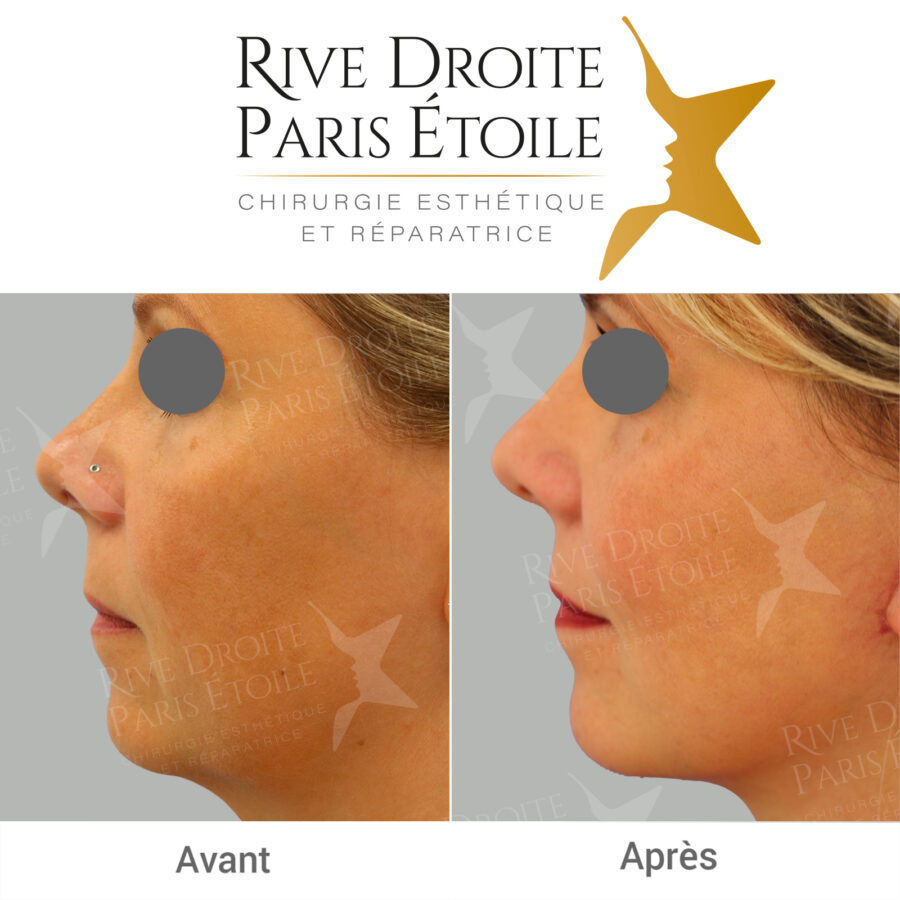
05Before / after results
06How the procedure works
Before the procedure
Two consultations precede the procedure. The surgeon analyses the characteristics of the chin and how it integrates with the rest of the face (eyes, lips, nose), both front-on and in profile, and defines the correction. An examination of the mouth and a radiological work-up (dental panoramic X-ray, sometimes a CT scan) assess the dental occlusion and the position of the nerve. Photographs and a software simulation of the result are taken. Usual instructions before the operation:
- stop smoking at least 1 month before and after;
- no aspirin or its derivatives for 10 days beforehand;
- anaesthesia consultation no later than 48 hours before.
During the procedure
A genioplasty is most often performed under general anaesthesia (sometimes local depending on the procedure), lasts about 1h to 1h30, as a day case or with one overnight stay. It leaves no visible scar: the incision is intra-oral (inside the lower lip), sometimes under the chin. Depending on the technique:
- the chin bone is cut with an ultrasonic device (piezotome), which preserves the tissues and nerves, then moved in the desired direction and fixed with a titanium plate and screws;
- or a silicone implant is placed in a custom pocket;
- or the bone is filed down to reduce the projection of a prominent chin.
The incision is closed with absorbable sutures and a shaping, compressive dressing is applied to the chin.
After the procedure
Recovery is light: the jaw moves freely again quickly and the pain, which is moderate, is relieved by simple painkillers. The shaping dressing is kept on for 5 to 8 days. Numbness or reduced sensation in the lower lip, chin or teeth is common in the first few days and resolves on its own. If the incision is inside the mouth, a blended, lukewarm or cold diet is advised for about 2 weeks, with mouth rinses after each meal for one week.
Swelling and bruising fade within about 2 weeks. A break from activity of one to two weeks is usual; sport is resumed at around 2 months. The result begins to show as soon as the swelling subsides and becomes permanent within 1.5 to 3 months.
07Prices & fees in Paris
| Procedure | Aesthetic fees |
|---|---|
| Surgical genioplasty | 3 500 – 5 500 € |
| Non-surgical chin augmentation | 800 – 1 800 € |
Indicative “from” prices, surgeon fees included. The final quote is given at the consultation, after examination, depending on the area treated and the technique chosen. Part of the procedure may be covered by French national health insurance when the medical criteria are met.
08Your questions
How much does a genioplasty cost in Paris?+
Expect roughly €3,500 to €5,500 for a surgical genioplasty; non-surgical chin augmentation (injection) ranges between €800 and €1,800. The full breakdown is given during the consultation. Partial insurance coverage from the French national health insurance is possible when the procedure addresses a functional problem.
Is a genioplasty painful?+
No: recovery is known to be only mildly painful. The discomfort comes mainly from the swelling and the dressing in the first few days; simple painkillers are usually enough.
Is a genioplasty reimbursed by the French national health insurance?+
It can be covered when it corrects a functional problem (dental occlusion, lip incompetence, jaw abnormality). If the request is purely aesthetic, it is not reimbursed.
At what age can you have a genioplasty?+
Generally from 15-16 years, once bone growth is complete. In certain functional indications (excess chin height with lips that do not close), it can be considered earlier. In adults, it can be performed at any age.
Is there a non-surgical genioplasty?+
Yes, for small corrections of a receding chin: non-surgical chin augmentation with a hyaluronic acid injection reshapes the chin without an operation, but the result is temporary (12 to 18 months). Surgery is still needed to correct the height, an asymmetry or a prominent chin.
Genioplasty or chin implant: what is the difference?+
An implant only corrects a receding chin and can, in the long term, cause resorption of the underlying bone. A bony genioplasty (osteotomy) moves the bone itself: it corrects every dimension of the chin and remains more stable over time.
Are there scars after a genioplasty?+
None visible: the incision is most often intra-oral, inside the lower lip. No scar appears on the face.
When is the result visible and permanent?+
The first effects are visible at around 10 days, as the swelling subsides. The result is permanent at about 1.5 months for a prominent chin and 3 months for a receding chin.
Are the results permanent?+
Yes: a genioplasty acts on the bony architecture of the chin, which time does not alter. The result is long-lasting.
What are the risks of a genioplasty?+
The most common is temporary numbness of the lip and chin, which resolves. Other complications (infection, haematoma, intolerance to the material, lasting sensory disturbance) are rare and common to all surgery.
What is the difference between mentoplasty and genioplasty?+
None: both terms refer to chin surgery.