
Belly liposuction: a closer look at abdominal liposuction
Despite a strict diet and dedicated exercise, it is sometimes difficult — especially with age — to get rid of stubborn fat in certain areas of the body, and most particularly in the abdominal region. Belly liposuction, also known as abdominal liposuction, is then a lasting solution for removing the resistant fat deposits around the abdominal wall. The most widely performed plastic surgery procedure in the world, body liposuction makes it possible to achieve a flat stomach and to eliminate unsightly bulges in order to refine and harmonise the figure. Indications, target candidates, procedure, techniques, risks, prices… here is everything you need to know about this very common and particularly effective procedure.
Contents
What does abdominal liposuction involve?
Belly liposuction (or abdominal liposuction) is a plastic surgery procedure that aims to permanently remove the stubborn excess fat (adipocytes) located in the abdomen. Using a technique of gentle, even suction of the abdominal fat deposits, this procedure reshapes the contour of the belly and makes the figure slimmer and more uniform.
It is not, however, comparable to any kind of slimming treatment, since it specifically targets the fat cells stored in the abdominal wall that resist physical exercise or a balanced diet. It is therefore not intended for people who are overweight and is not a miracle solution for losing weight. Belly liposuction can often be combined with liposuction of the hips or saddlebags for an even more harmonious result and a slimmer, more streamlined figure.
Liposuction, lipoaspiration or liposculpture: what’s the difference?
These three terms often cause confusion, even though they refer to the same procedure. Liposuction and lipoaspiration are strictly synonymous: both mean suctioning fat using fine cannulas. We speak of liposculpture when the goal is not only to remove volume but to reshape the figure area by area, sometimes by re-injecting some of the harvested fat (fat transfer). To fully understand the nuances, you can read our dedicated article on the difference between liposuction, lipoaspiration and liposculpture.
What causes excess fat in the abdomen?
Excess fat localised in the belly can be explained by several factors:
- it can first stem from hereditary or genetic factors;
- it is also sometimes the result of repeated pregnancies that have lastingly stretched the skin and fat cells of the abdominal wall;
- restrictive diets followed periodically can also lead to the accumulation of adipocytes in certain areas, as well as to stretched skin and loose belly skin;
- hormonal changes or ageing can finally make it harder for the body to eliminate fat, leading to greater storage of fat deposits.
It is nevertheless important to distinguish subcutaneous fat, which is superficial and can be pinched, from visceral fat, which lies deep around the organs: only the former can be treated with liposuction. Even with a healthy diet and regular exercise, liposuction of localised fat is often the only option for completely and lastingly eliminating deeply anchored fat cells.
The goals of belly liposuction
Belly liposuction aims to remove excess subcutaneous fat localised at the surface. It thus makes it possible to:
- improve your overall physical appearance with the possibility of regaining a flat stomach;
- get rid of the fat cells localised in the abdominal region and thus make unsightly bulges and love handles disappear at the belly but also around the waist and flanks;
- put an end to a psychological complex (the « spare tyre » syndrome) and thus regain a degree of self-esteem, in particular by making it possible to wear more fitted clothing;
- feel better in your body with a firmer, more toned abdominal belt, making physical exercise easier and thereby reducing strain on the lower back and back problems.
Indications for abdominal liposuction
While belly liposuction can apply to both men and women, candidates for abdominal liposuction should ideally meet certain indications to obtain the expected results and for a safe procedure:
- patients must be of legal age. Ideally, the candidate for liposuction should be between 35 and 50 years old, the skin still being elastic and the muscles relatively taut at this age;
- the fatty area should ideally be localised and not diffuse;
- the candidate’s skin should be relatively firm and have a satisfactory ability to retract, since otherwise removing fat only emphasises the apparent skin laxity. Patients with excessive skin laxity should instead consider an abdominoplasty, also known as a tummy tuck, which at the end of the procedure makes it possible to redrape the skin and produce a lifting effect;
- the candidate for abdominal liposuction should not be significantly overweight (generally no more than 20% above their ideal weight), as the procedure cannot get rid of visceral fat;
- finally, certain categories of people, such as heavy smokers, those prone to phlebitis or embolism, and women on contraceptives, are not eligible for abdominal liposuction, in order to limit the higher risk of complications in their particular cases.
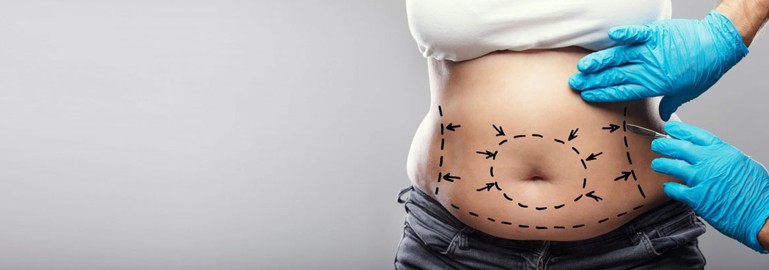
The abdominal liposuction procedure in practice
Belly liposuction is most often performed under general anaesthesia, although local anaesthesia is sometimes possible for small volumes of fat (notably in the case of gentle liposuction, performed with a micro-cannula). The procedure can be done on an outpatient basis, meaning you go home the same evening, or it may require a slightly longer hospital stay (1 to 2 nights).
Before the procedure
Belly liposculpture is preceded by a first consultation appointment with the plastic surgeon. They will review your medical history and discuss with you the reasons why you are considering this procedure. They will also assess the skin elasticity of your abdomen to make sure the belly skin will retract well after the procedure. Blood tests will also be carried out before the procedure to rule out any contraindication.
The surgeon will also give pre-operative instructions to ensure the procedure goes smoothly and to avoid complications. In particular, the patient will be forbidden to smoke or to take a contraceptive pill in the month before the procedure, as well as to take aspirin or anti-inflammatories in the 10 days before the operation.
A 15-day cooling-off period must be observed between the first consultation and the date of the procedure, so that the patient is fully aware of what the operation involves, even though liposuction is among the least risky and safest plastic surgery procedures.
Finally, an appointment with the anaesthetist must be made no later than 48 hours before the procedure, in order to decide together on the type of anaesthesia to use.
How the operation unfolds
Abdominal liposuction takes between 1 and 3 hours depending on the amount of fat to be suctioned. It begins with the application of an antiseptic product to the belly to disinfect the area to be treated.
The surgeon then makes small incisions in the natural folds of the skin to minimise the visibility of the scars, which will become almost imperceptible after a while. The incisions are generally made at the groin, the pubis or the navel, in order to introduce foam-tipped micro-cannulas with rounded ends, which then make it possible to suction the localised excess fat. The surgeon makes gentle, regular movements for even suction and to avoid any trauma to the skin.
Once the suction is complete, the incisions are sutured and a compression dressing is applied. Finally, a compression garment is used to minimise bruising and contain the swelling, so that the abdominal area adapts as quickly as possible to its new shape.
Results and recovery
The side effects of belly liposuction are relatively minimal and most often amount to fatigue and aches, depending on the amount of fat suctioned. Swelling (edema) may also develop in the treated areas, but it will subside on its own after a few days.
Recovery after belly liposuction generally takes one week to 10 days, during which rest is recommended before gradually resuming normal activities. A few days away from social activities should be expected, and you should wear the compression garment for 2 to 4 weeks to help the swelling subside. Mild pain may be felt but can be relieved with painkillers.
The results are visible after a few days but will be even more marked about 2 to 3 months after the procedure, once the swelling has resolved. They will be permanent provided you maintain a healthy, balanced diet over the long term. Post-operative follow-up consultations should be scheduled at regular intervals during the first few months.
Does the fat come back after belly liposuction?
This is one of the most frequently asked questions. Liposuction permanently removes the treated fat cells (adipocytes), which, in adulthood, do not regenerate: the American plastic surgery clinic Mayo Clinic thus points out that « liposuction permanently removes fat cells ». The result on the operated area is therefore lasting, as long as weight remains stable. On the other hand, as the American Society of Plastic Surgeons emphasises, the procedure does not protect against future weight gain: in the event of a significant calorie surplus, the remaining adipocytes — including those in untreated areas — can swell in turn. Maintaining a healthy lifestyle is therefore the key to a result that lasts over time.
Belly liposuction in men
Belly liposuction is not reserved for women: it is among the most popular plastic surgery procedures requested by men. In men, fat tends to settle preferentially on the upper abdomen, the flanks (the « love handles ») and the area below the navel, creating what is known as the « apple-shaped » figure. Liposuction makes it possible to reshape a firmer, more toned abdominal belt in patients who are often athletic but bothered by a few localised deposits resisting exercise. When the excess fat is located at the chest, however, the right option is instead gynecomastia surgery in men. The principles of the procedure, the skin-firmness indications and the recovery otherwise remain identical to those described above.
What are the risks and complications of abdominal liposuction?
Belly liposuction is among the safest and best-mastered plastic surgery procedures when performed by a qualified plastic surgeon, in an operating theatre and after a thorough pre-operative assessment. The most common after-effects remain mild and temporary:
- bruising and swelling in the treated area, which subside within a few weeks;
- a temporary loss of sensation in the belly skin;
- small surface irregularities or asymmetry, generally reduced by wearing the compression garment and by massage.
Like any surgical procedure, it carries rarer risks that should be known: hematoma, infection, delayed healing, or — exceptionally — phlebitis and complications related to anaesthesia. These risks are markedly reduced by following the pre- and post-operative instructions (stopping smoking, anticoagulant treatment if needed, wearing the compression garment). This is precisely the purpose of the prior consultation and the cooling-off period: to assess each situation individually and only operate in the absence of any contraindication.
What is the price of abdominal liposuction?
The price of belly liposuction depends on several factors, including:
- the extent of the area to be treated, the number of areas and therefore the amount of fat to be suctioned;
- the time required for the procedure;
- the type of anaesthesia used;
- the surgeon’s fees;
- the location and reputation of the clinic.
Generally speaking, the price of belly liposuction is between €4,000 and €5,000 for a single treated area. To this must be added the cost of the in-office consultation as well as the purchase of a compression garment to be worn for several weeks after the operation in order to consolidate the result. As liposuction is a procedure for aesthetic purposes, it is not covered by French national health insurance.
Frequently asked questions
Does belly liposuction hurt?+
The procedure itself is painless, as it is performed under anaesthesia (general, or local for small volumes). In the following days, patients mainly describe a feeling of aches and tightness, comparable to muscle soreness, as well as bruising. These discomforts remain moderate and are easily relieved with simple painkillers.
What is the difference between liposuction and lipoaspiration?+
None: the two terms refer to exactly the same procedure, namely suctioning fat using fine cannulas. We speak of liposculpture when the aim is more to reshape the figure, sometimes by re-injecting some of the harvested fat.
Does belly liposuction make you lose weight?+
No. Liposuction is not a weight-loss method: the loss on the scale is minimal. Its purpose is to remove localised fat that resists exercise and diets, in order to reshape the figure. It is intended for people close to their ideal weight, not for people who are significantly overweight.
Does the fat come back after belly liposuction?+
The fat cells that are removed are gone permanently and do not re-form. The result is therefore lasting as long as weight remains stable. In the event of significant weight gain, however, the remaining fat cells can swell in turn: maintaining a healthy lifestyle is essential to preserve the result over time.
What weight or BMI do you need for belly liposuction?+
There is no single threshold, but the procedure gives its best results in patients close to their ideal weight, with localised and non-diffuse excess fat. Being overweight by generally more than about 20% above your ideal weight contraindicates the operation, since liposuction does not act on deep visceral fat.
How long must the compression garment be worn?+
The compression garment is generally worn for 2 to 4 weeks after the procedure. It limits swelling and bruising and helps the abdominal skin redrape over its new shape. The exact duration is adjusted by the surgeon according to the volume treated.
Is belly liposuction covered by French national health insurance?+
No, belly liposuction is a procedure for aesthetic purposes and is not covered by the French national health insurance. A detailed quote is given at the consultation, and the legal 15-day cooling-off period must be observed before the procedure.
Book an appointment
If you are considering a procedure, book an appointment in just a few clicks: our surgeons will answer all your questions and guide you toward a tailored, personalised solution.
Book on Doctolib