Surgical treatment of pectus excavatum
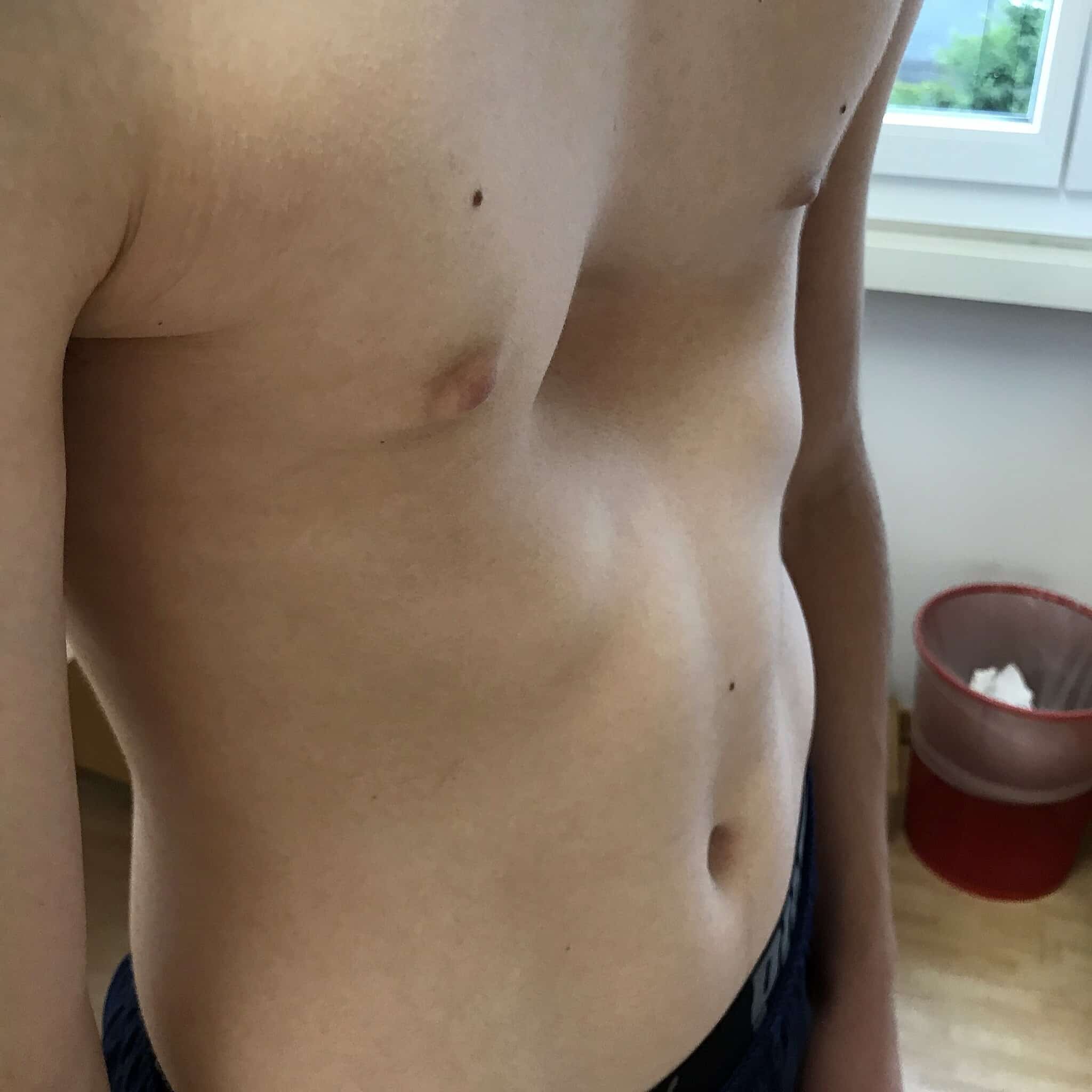
The main deformity of the chest, pectus excavatum — also known as funnel chest — is characterised by a sinking of the sternum that creates a hollow in the middle of the chest (sunken chest). While it is usually not physically disabling, it can be a source of self-consciousness, particularly in teenagers. Various more or less invasive methods exist to straighten the sternum or make the hollow less visible. This article reviews the causes, diagnosis, surgical and aesthetic treatments, their cost and insurance coverage.
Contents
What is funnel chest?
Pectus excavatum is a deformity of the chest, congenital in origin, that results in a depression of the sternum at the front of the chest. This sinking of the sternum can occur in the middle of the chest (median depression) or more laterally at the level of the ribs. It is caused by an excessive growth of the costal cartilages connecting the sternum and the ribs, which then push inward into the rib cage and form a kind of bowl or funnel. It is this impression of a hollow in the torso, or of a sunken rib cage, that most often prompts a consultation. Pectus excavatum is the opposite of pectus carinatum (pigeon chest), where the overgrown costal cartilages are instead projected forward, forming a kind of ridge.
Who is affected by pectus excavatum?
Funnel chest is a malformation that affects around 1 birth in 300, the large majority of them male (80% of cases). Present from birth, it nonetheless develops noticeably in adolescence, around puberty. While the cause is still poorly understood, heredity appears to be the main explanation for pectus excavatum, since 40% of affected individuals reportedly also have a relative who carries the anomaly within their family. It is worth noting that scoliosis is frequently associated with funnel chest, as are certain connective-tissue disorders (Marfan syndrome in particular).
The symptoms and effects of pectus excavatum
The presence of a pectus excavatum can have various consequences for an affected patient, in particular:
- a significant psychological impact: the affected person may feel ashamed of their body and uncomfortable in their own skin. They may, for example, avoid being bare-chested at the beach, at the pool or in sports changing rooms. This psychological distress is most often the primary reason for seeking treatment;
- posture problems: the sinking of the chest leads to postural compensation mechanisms (shoulders rolled forward, hunched back, etc.) that only increase the physical and psychological discomfort experienced;
- breathing problems: although not systematic, funnel chest can sometimes cause a degree of breathlessness (shortness of breath) during everyday activities;
- cardiac problems: by pushing inward into the rib cage, the sternum can compress the right ventricle, which may limit cardiac output, particularly during intense physical activity.
These functional consequences should nonetheless be put into perspective. The most recent scientific publications tend to show that, in the vast majority of cases, the heart and lungs have developed and adapted to the deformity during growth, with no real measurable cardiac or respiratory effect. For most patients, the impact therefore remains above all aesthetic and psychological, which in no way reduces how significantly it is experienced day to day.
The different types of pectus excavatum
Pectus excavatum can take different forms depending on the extent of the malformation and its degree of symmetry. A simplified classification has been established to characterise this anomaly clinically and to serve as a basis for choosing the treatment best suited to the patient’s anatomy. The Chin classification (named after its creator) defines 3 levels of malformation:
- Chin I (cup-shaped chest), with a narrow median hollow that is very localised at the centre of the sternum. The edges are symmetrical and abrupt, forming a kind of hole or bowl;
- Chin II (flared chest), with a median hollow that is shallower but wider, extending toward the pectoral muscles and giving a flattened-torso appearance. The sternal bowl is again symmetrical;
- Chin III (asymmetrical chest): the hollow is located laterally and is more pronounced on one side than the other (most often the right side). It is often accompanied by a rotation of the sternum.
Diagnosing funnel chest
In addition to the clinical Chin classification, which is based on a visual and aesthetic assessment, pectus excavatum is also identified using more advanced radiological measurements (MRI or CT scan) that make it possible to establish the degree of functional impairment. These are used in particular to determine the Haller index of the chest, which measures its transverse diameter relative to its antero-posterior diameter. The Haller index makes it possible to characterise the degree of severity of the obstruction and whether or not surgery is necessary. While a Haller index is considered normal at 2.5, pectus excavatum is regarded as severe from 3.25 onward, thereby justifying potential surgery.
A complementary stress test may also be prescribed to determine whether the compression exerted by the sternum causes excessive cardiac and respiratory impairment.
The solutions for treating a pectus excavatum
Various solutions can be considered for the treatment of pectus excavatum depending on the nature of the malformation, its degree of severity and any associated consequences.
Funnel chest surgery
Two main procedures have historically been performed to treat the sinking of the chest: the Nuss technique (still regularly performed) and the Ravitch technique (much less used today):
- minimally invasive funnel chest surgery (Nuss technique): this consists of making small incisions on the sides of the chest in order to insert a curved metal or steel bar beneath the sternum so as to gradually bring it back outward. This pectus excavatum procedure is performed in the operating theatre by thoracoscopy (video-assisted). The metal bar (or Nuss bar) must be kept in place for 2 to 3 years before being removed during a second procedure. This technique is mainly used for children or young adults;
- open pectus excavatum surgery (Ravitch technique): less used than in the past, notably because of how demanding it is, sternochondroplasty may be necessary for severe cases of funnel chest (marked asymmetry in particular) or for an overly rigid chest (for example in older people). It consists of opening the chest through a vertical or horizontal incision in order to turn over or reposition the sternum. A resection of the deformed cartilages may also be considered so that they grow back naturally in a straight position. A support plate may also be fitted to hold the sternum in place. Sternochondroplasty is considered when the Nuss method is insufficient to straighten the sternum adequately. Recovery after the procedure is, however, fairly long, and the incision leaves a relatively visible scar.
The alternatives to pectus excavatum surgery
New medical techniques have emerged and now partly replace major surgical procedures for the least severe cases of funnel chest. They draw largely on aesthetic medicine, including:
- filling methods: aesthetic medicine now makes it possible to use a custom-made silicone implant (designed in 3D according to the patient’s anatomy). This sternal implant is positioned at the level of the pectoral muscles in order to fill the hollow at the front of the chest. The torso then becomes flat again without having to straighten the sternum. Unlike a gel breast implant, this is a solid silicone rubber: with no risk of capsular contracture or rupture, the implant is considered permanent. This technique is used only in the case of psychological distress, since it does not correct the functional aspect of the malformation (a breathing disorder, for example). The filling can also be carried out through a fat transfer — that is, by reinjecting the patient’s own processed fat (autologous transfer) following a liposuction procedure on another part of the body. This autologous fat-reinjection technique, similar to the breast lipofilling performed to fill out the chest, is, however, only possible when the hollow is small and the patient has enough body fat;
- external traction, or « pectus-up »: a recent extrathoracic procedure, the pectus-up consists of screwing a plate onto the sternum to pull it upward permanently via an external screw mechanism. Its advantage is that it can correct the collapse and sinking of the sternum without entering the chest cavity (and therefore without risk to the vital organs). Recovery is also rapid, with a small incision to place the implant and little postoperative pain;
- the vacuum bell: a silicone suction cup is applied to the chest in order to gradually reduce the malformation and even out the chest. This process is intended for young patients whose rib cage is still supple and potentially malleable;
- dynamic compression, which is similar to a kind of brace worn continuously (except for sport and washing) that applies constant pressure to the chest in order to reduce the sternal protrusion. It must be worn for about 1 year on a chest that is still supple.
Pectus excavatum in women
In women, funnel chest often presents differently. The sternal hollow frequently causes a false breast asymmetry or an impression of « converging » breasts that turn inward, without the breast gland itself being at fault: it is indeed the underlying bone deformity that alters the projection of the chest. Many patients, in fact, first consult for this lack of shape rather than for the hollow itself. In these situations, correcting the chest deformity often makes it possible to restore the harmony of the chest. Depending on the case, sternal filling may be combined, in a second stage, with treatment of breast asymmetry or with a breast augmentation to restore volume to the chest, in order to achieve a natural, balanced result.
Recovery and post-operative course
Recovery depends closely on the technique used. Filling surgery with a custom-made implant or by fat transfer, being minimally invasive, remains the simplest: performed under general anaesthesia, it generally requires a hospital stay of one to two nights (sometimes as a day case for fat transfer). Postoperative pain is moderate and relieved by simple painkillers; a chest compression garment is worn for several weeks, day and night. Return to work usually occurs after one to three weeks, and return to sport after 6 weeks to 3 months depending on the intensity. The result is visible immediately and becomes permanent after a few months.
The orthopaedic techniques (Nuss, Ravitch sternochondroplasty), on the other hand, are more demanding: the hospital stay is longer, recovery is measured in weeks, and the Nuss bar requires a second procedure for its removal two to three years later. Smoking should ideally be stopped one month before and after any procedure in order to promote healing. These timeframes remain indicative: only a surgeon can specify them after an examination, depending on the technique chosen and each patient’s profile.
Which specialist should you consult for a pectus excavatum?
The choice of practitioner depends on the goal sought. When the deformity is severe and causes proven functional impairment, it is the thoracic surgeon who handles the bone-straightening techniques (Nuss, sternochondroplasty). When the request is above all aesthetic and psychological — which corresponds to the majority of cases — the plastic surgeon offers the filling techniques (custom-made implant, fat transfer) that conceal the hollow without touching the rib cage. A consultation makes it possible to assess the type of pectus excavatum, its Haller index and the patient’s expectations, then to direct them toward the most appropriate solution. At Rive Droite Paris Étoile, Dr Vincent Hunsinger sees patients to assess whether a correction by filling is appropriate.
How much does a pectus excavatum procedure cost?
The cost of a pectus excavatum procedure varies considerably depending on the treatment option chosen (surgical or not) and the degree of severity of the malformation. Surgical methods can thus range between €4,000 and €8,000. Gentler methods such as the vacuum bell are more affordable and can cost from €400 to €600.
As an indication, for treatment by filling, the surgical fees for fitting a custom-made chest implant are generally around €2,000 to €2,500, to which is added the cost of the implant itself (around €1,800 to €2,600 depending on its size), which is not usually covered by health insurance. Filling fat transfer, for its part, often falls between €1,500 and €2,000 in fees. To these amounts may be added the operating-theatre, anaesthesia and clinic costs when the procedure is not reimbursed. Only a personalised quote, provided at the consultation, can give the exact cost.
Is funnel chest surgery covered by French national health insurance?
Funnel chest surgery is most often covered by French national health insurance. To qualify, however, the procedure must be reconstructive in purpose and not purely psychological.
To determine eligibility, national health insurance relies in particular on the Haller index. Coverage is generally automatic for a Haller index of 3.25 or above. Complementary functional examinations demonstrating cardiac or pulmonary compression can also make coverage automatic.
Reimbursement may nonetheless also be requested when the patient is able to prove the psychological impact of the malformation on their daily life (for example in the case of a visible deformity affecting a teenager’s social integration and life).
A pectus excavatum procedure is generally covered (apart from specialists’ fee supplements and the daily hospital charge). Note that, even when the fees are covered, the cost of the custom-made implant most often remains payable by the patient or their private health insurance.
Crédit photo : Gzzz, CC BY-SA 4.0 <https://creativecommons.org/licenses/by-sa/4.0>, via Wikimedia Commons
Frequently asked questions
Is pectus excavatum serious?+
In the vast majority of cases, pectus excavatum is not serious: the heart and lungs have adapted to the deformity during growth, with no real functional effect. The problem is most often aesthetic and psychological. Only severe forms, with a high Haller index and proven cardiac or pulmonary compression, justify a thorough functional work-up and, possibly, straightening surgery.
Can pectus excavatum go away on its own?+
A pectus excavatum that sets in during adolescence does not correct itself spontaneously: it even tends to become more pronounced at puberty. In contrast, certain depressions present at birth may lessen, or even disappear, during the first year of life. Once growth is complete, only medical (filling) or surgical (bone straightening) treatment can correct the deformity.
Is pectus excavatum hereditary?+
Heredity is now considered the main factor involved: around 40% of affected people have a family member who also carries the malformation. Pectus excavatum is also sometimes associated with scoliosis or with certain connective-tissue disorders, such as Marfan syndrome.
From what age can a funnel chest be operated on?+
Filling techniques using a custom-made implant or fat transfer can be carried out once growth is complete, generally from the age of 15 to 17, when the deformity has stabilised. In children and young teenagers whose chest is still supple, non-invasive methods (vacuum bell, dynamic compression) are preferred first. There is no upper age limit for an aesthetic correction.
Can sport or weight training correct a pectus excavatum?+
Weight training does not correct the bone deformity itself: the sternum remains sunken. However, building up the pectoral muscles can visually soften the hollowed appearance of the chest and improve posture, which helps some patients feel more at ease with their body. It is a complement, not a treatment in its own right for marked forms.
Which technique should you choose to treat a pectus excavatum?+
The choice depends on the severity and the goal. For a primarily aesthetic concern — the majority of cases — filling techniques (custom-made chest implant, fat transfer) conceal the hollow without touching the rib cage, with a simple recovery. For severe forms with a functional effect, bone straightening (the Nuss technique in younger patients, Ravitch sternochondroplasty in rigid or highly asymmetrical cases) is considered by a thoracic surgeon. A consultation makes it possible to direct you toward the most appropriate solution.
Book an appointment
If you are considering a procedure, book an appointment in just a few clicks: our surgeons will answer all your questions and guide you toward a tailored, personalised solution.
Book on Doctolib