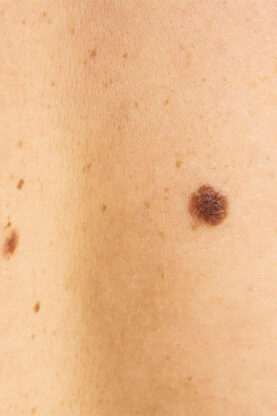
01What is a mole?
A mole is a localised cluster of melanin, the pigment naturally present in the skin: its high concentration gives the mole its brown colour. From a dermatological standpoint, moles are benign skin tumours, though their evolution sometimes needs monitoring to rule out any risk of skin cancer (melanoma).
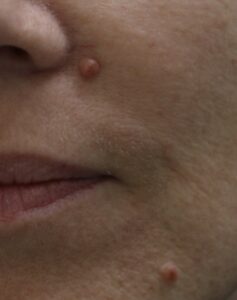
02Why have a mole removed?
Two main reasons lead to mole removal:
- an aesthetic or functional nuisance (rubbing, repeated irritation);
- the possibility of malignant change (suspicious mole).
While the first reason is self-evident, the second warrants examination by a dermatologist, with additional tests if needed. At the slightest doubt, a consultation is essential — but a simple screening method exists: the ABCDE rule. A mole is suspicious if it meets at least two of these criteria:
- Asymmetry;
- Border irregularity;
- Colour that is not uniform (several shades);
- Diameter greater than 6 mm;
- Evolution that is rapid (size, colour or shape changing within a few weeks).
At the slightest doubt, a dermoscopy examination refines the diagnosis: discover dermoscopy and mole screening in Paris. If it proves suspicious, removal makes it possible to take out the nevus and analyse it — see also basal cell carcinoma surgery.
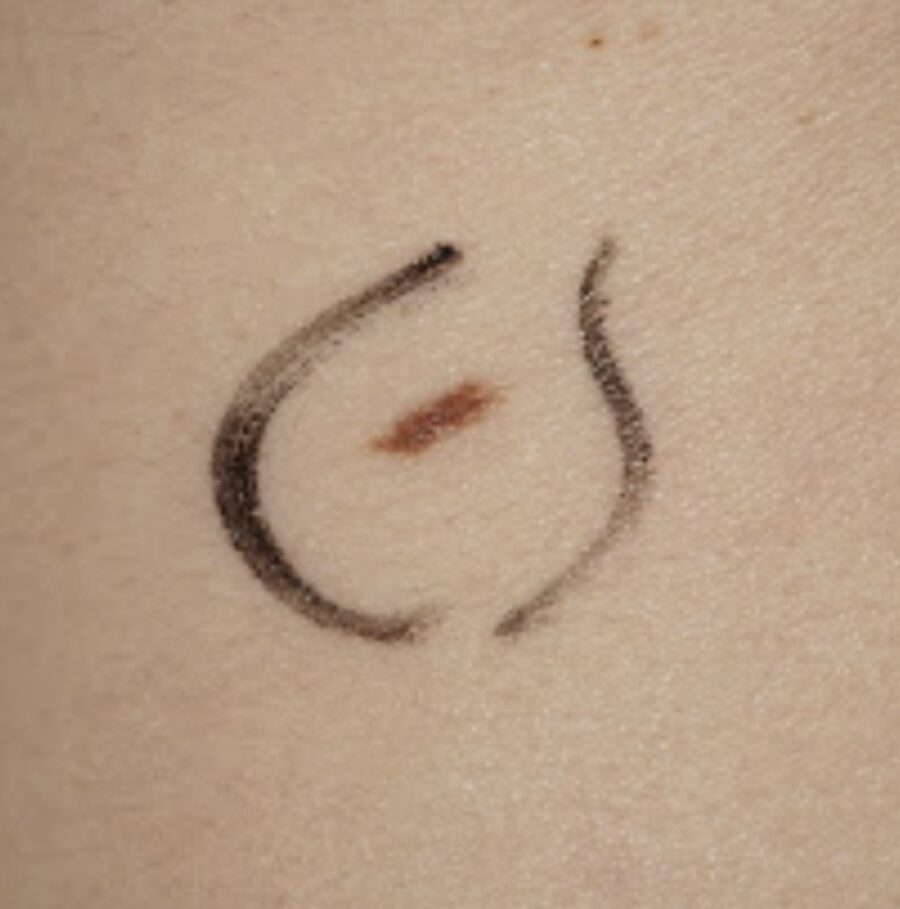
03Suspicious mole: why never use a laser?
Promises of « scarless » removal, by laser or by destruction, are everywhere. For a mole that raises the slightest doubt, this is a mistake to avoid: the laser destroys the lesion without taking a sample, which makes any microscopic analysis impossible. The visible lesion is erased without knowing what it was — and there is a risk of missing an early melanoma, or of delaying its diagnosis. This is why a suspicious nevus must be removed by complete surgical excision, which alone makes it possible to send it for analysis. A laser may, at a push, be considered for very small lesions that are definitively benign, never when there is any doubt.
04How the procedure works
Before the procedure
It all begins with a consultation. The surgeon (or the dermatologist) examines the mole or moles, using a dermatoscope if needed, decides which ones to remove and explains the procedure. At the slightest doubt about the nature of a nevus, removal for diagnostic purposes is preferred. The usual instructions apply: stopping aspirin-based medication and tobacco before the procedure. No heavy preparation is required: the procedure is short and performed in the office.
During the procedure
The procedure is quick and painless and usually lasts less than 20 minutes, on an outpatient basis. The steps: local anaesthesia of the area (xylocaine), excision of the mole (spindle-shaped incision), suturing with absorbable threads or, often, simple steri-strips, then systematically sending the nevus to the laboratory for pathological analysis (« biopsy »). Several moles can be removed during the same session.
After the procedure
Recovery is straightforward. The area remains slightly tender as the anaesthesia wears off: a simple painkiller (paracetamol) is enough. Depending on the location and the type of suture, a dressing may be necessary; it is changed every day after gentle cleansing with soap, and any non-absorbable threads are removed after a few days to two weeks. Swimming is not advised for about 15 days and the area must be protected from the sun for several weeks. The scar, kept fine thanks to the spindle-shaped incision, fades gradually; scar massage and a healing ointment improve its appearance further. The analysis results are generally available within one to three weeks.
05Prices & fees in Paris
| Procedure | With insurance coverage | Aesthetic fees |
|---|---|---|
| Mole removal | 300 € | 300 € |
Indicative “from” prices, surgeon fees included. The final quote is given at the consultation, after examination, depending on the area treated and the technique chosen. Part of the procedure may be covered by French national health insurance when the medical criteria are met.
06Your questions
Is removing a mole painful?+
No. Local anaesthesia makes the removal completely painless. As it wears off, slight tenderness may appear, well relieved by a simple painkiller (paracetamol).
How much does mole removal cost in Paris?+
At the Rive Droite Paris Étoile practice, expect from 300 € (see the price table below), depending on the number of nevi and their location. The exact price is set during the consultation.
Is mole removal reimbursed by French health insurance?+
Yes, when it has a medical purpose (suspicious mole, prevention or treatment of skin cancer, functional nuisance): insurance coverage is then possible. If the removal is purely aesthetic, it is not reimbursed.
Is the removed mole analysed? How long does it take?+
Yes, systematically: every removed nevus is sent to the laboratory for pathological analysis (« biopsy »). The results are generally available within one to three weeks.
Can several moles be removed at once?+
Yes. The prior consultation makes it possible to decide which moles to remove, and they are then taken out during the same procedure.
Does the procedure leave a scar? How can it be minimised?+
Removal leaves a fine scar, made discreet by the spindle-shaped incision, which fades over time. It is improved by scar massage, a healing ointment and, above all, strict sun protection during the first few weeks.
How long does healing take? What aftercare is needed?+
Depending on the area and the type of suture, a dressing may need changing every day after gentle cleansing with soap; non-absorbable threads are removed within a few days to two weeks. Swimming is not advised for about 15 days and the area should be protected from the sun for several weeks.
Can a mole be removed by laser, without a scar?+
Not when there is any doubt: the laser destroys the lesion and prevents any analysis, with the risk of missing a melanoma. A suspicious nevus must be removed by surgical excision, which alone makes it possible to analyse it. A laser is only an option for very small lesions that are definitively benign.