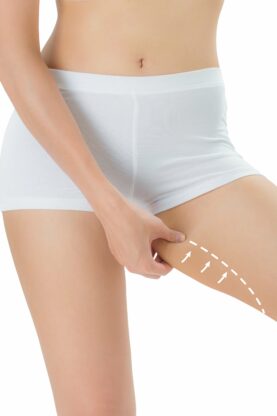
01Thigh lift: aesthetic and functional indications
A thigh lift is considered when the skin of the inner thigh no longer re-tightens, despite exercise and weight loss. The problem is then no longer fat but excess skin that hangs, chafes and causes discomfort. The motivation is as much aesthetic (slimmer thighs, a harmonious figure) as functional: chafing between the thighs causes irritation, maceration and discomfort when walking, getting dressed and exercising.
The main indications: after-effects of weight loss (following a major diet or bariatric surgery), skin ageing of the inner thigh, and, more rarely, constitutional skin laxity. Like an arm lift (brachioplasty), a thigh lift does not slim you down: liposuction alone never corrects excess skin — it would even make it worse. Note: in cases of lipedema (a fat disorder of the lower limbs), tailored liposuction is often combined with a lift to re-tighten the skin.
02Techniques and the scar
After liposuction with a fine cannula (which preserves the thinness of the skin), the path of the scar depends on how the excess skin is distributed:
- Horizontal scar (« upper » inner lift): the skin is pulled upward; the scar follows the groin crease, from the pubis to the buttock fold — very discreet, but slower to heal (a moist area). For moderate excess that is mostly in the upper part.
- Vertical scar: the skin is pulled across the width; the scar runs down the inner thigh (sometimes as far as the knee) — more visible, but necessary when there is significant excess along the whole length. This is the most common technique after major weight loss.
- Combined scar (inverted L or T): combines the two, for optimal tightening.
More rarely, an outer thigh lift treats persistent saddlebags, with a scar that extends further toward the hip.
03The scar: why the anchoring technique makes all the difference
This is the key point of a thigh lift, and what sets a good result apart. The skin of the inner thigh is thin, fragile and subject to gravity: if the scar is sutured only to the skin, it tends, over time, to migrate downward (it « slides » down the thigh) and to pull on the vulva. To prevent this, the surgeon anchors the tissues to the deep plane (Colles’ fascia / the superficial fascial system) rather than to the skin: the tension is thus transferred to a sturdy structure, the scar stays high, hidden in the crease, and the intimate area is not distorted. No non-surgical technique removes genuine excess skin; for mild laxity alone, liposuction on its own (young skin) or radiofrequency (Renuvion) tightens without a scar.
04Results: when should they be assessed?
From the moment of the procedure, the excess skin is removed and the thighs look firmer and slimmer. But the result is not set immediately: between the 3rd and 12th month, after a phase of maximum tension, the tissues may appear to relax slightly (a physiological adaptation process), while the scar slowly remodels, sometimes a little asymmetrically. You therefore need to wait around a year to judge the final result: tightened skin, a restored gap between the thighs, chafing gone. The benefit is lasting provided you keep a stable weight.
05How the procedure works
Before the procedure
Two consultations prepare for the procedure: the first clarifies your expectations, assesses skin quality and the amount of excess to treat, and defines the path of the scars; an anaesthesia consultation takes place 48 hours beforehand. Your weight must be stable for at least 6 months and your BMI reasonable (ideally < 30). Guidelines: stop smoking and stop oral contraception one month before, stop aspirin and anticoagulants 10 days before, disinfect the skin the day before and on the morning of surgery. Medical photographs and, in a post-bariatric context, preparation of the insurance coverage file.
During the procedure
A thigh lift is performed under general anaesthesia, lasts 1h30 to 3h depending on its extent, with 1 to 3 nights in hospital. The procedure runs through: liposuction of the inner thigh (fine cannula), precise assessment of the skin to be removed, excision of the excess skin using the chosen technique (horizontal in the groin, vertical, or combined), anchoring of the tissues to the deep plane (Colles’ fascia), then re-draping and re-tensioning. Drains may be placed to limit haematomas; the incisions are closed with absorbable sutures and a compression garment is put in place. A healing laser may be applied at the end of the procedure.
After the procedure
Recovery is moderate: bruising and swelling of the inner thigh for 10 to 20 days (swelling can fluctuate for up to 6-8 weeks), aches and tightness for 3-4 days (painkillers). Walking is encouraged from the day after, gently. You wear a compression garment day and night for several weeks, with anticoagulants and sometimes antibiotics (an area close to the intimate and anal flora). Practical tips: sleep on your back, legs slightly apart, avoid crossing your legs, squatting and tight clothing, which put the inner scar under tension. Baths, saunas and steam rooms should be avoided for a month (maceration). Expect 1 to 3 weeks off work, a very gradual return to sport at around 6 weeks (swimming helps the return), and sun protection for the scar for 3 months.
06Prices & fees in Paris
| Procedure | With insurance coverage | Aesthetic fees |
|---|---|---|
| Thigh lift - cruroplasty | 3 600 – 5 200 € | 6 800 – 8 800 € |
Indicative “from” prices, surgeon fees included. The final quote is given at the consultation, after examination, depending on the area treated and the technique chosen. Part of the procedure may be covered by French national health insurance when the medical criteria are met.
07Your questions
What is a thigh lift?+
It is the surgical thigh lift: a procedure that removes the excess skin from the inner thigh and re-tightens it, most often combined with liposuction. It eliminates chafing and slims the thigh, without making you lose weight.
How much does a thigh lift cost in Paris?+
Expect around €6,800 to €8,800 for an aesthetic procedure. With insurance coverage (after bariatric surgery), the out-of-pocket cost is limited to the fee supplements (in the region of €3,600 to €5,200). The quote is provided during the consultation.
Is a thigh lift covered by French national health insurance?+
It is possible in defined cases: major, disabling excess skin (maceration, chronic irritation) after significant post-bariatric weight loss. Coverage goes through prior authorisation from the medical adviser (a dedicated CCAM code). Without written approval, a thigh lift is considered aesthetic; the liposuction portion is never reimbursed.
Where is the scar and does it stay discreet?+
It depends on the technique: horizontal in the groin crease (the most discreet) or vertical on the inner thigh (for significant excess). It stays discreet if it is anchored to the deep plane (Colles’ fascia), which prevents it from sliding down over time. Pink for the first few months, it fades noticeably from one year on.
Is there a non-surgical thigh lift?+
Not for genuine excess skin: removing it requires a scar. If the skin is only slightly distended, liposuction alone (young, retractile skin) or radiofrequency (Renuvion) can tighten without an incision — but they do not remove any skin.
Is a thigh lift painful?+
Moderately: deep aches in the first few days, worse when standing or walking, well controlled by painkillers. The pain decreases noticeably after 5 to 7 days. The inner lift is a little more uncomfortable than the outer one at first.
How do you sleep and what should you avoid after a thigh lift?+
You sleep on your back, legs slightly apart (a cushion helps), not on your side at first. You avoid crossing your legs, squatting, tight clothing and chafing, which weaken the inner scar. Gentle walking and a compression garment are the rule.
How long off work and when can you return to sport?+
1 to 3 weeks off work depending on your activity; sport resumes gradually at around 6 weeks, as any wide-range thigh movement can hamper healing.
How long does the swelling last?+
It is at its peak in the first 10 days, then decreases but can fluctuate (after prolonged walking, at the end of the day) and persist for 6 to 8 weeks, sometimes longer. The compression garment limits it.
Can a thigh lift be combined with other procedures?+
Yes, with good judgement: it is often combined with an arm lift or an abdominoplasty, or forms part of a bodylift after weight loss. Combining several procedures lengthens both the operation and recovery — the decision is made case by case.
When is the result final?+
At around one year. After an initial phase of tension, the tissues adapt (slight physiological relaxation between 3 and 12 months) and the scar remodels. The result — re-tightened thighs, chafing gone — then stabilises for the long term.