01Non-surgical chin augmentation: reshaping the chin without surgery
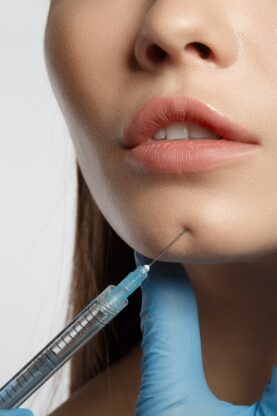
Along with the nose and lips, the chin is one of the three keys to the profile: it is what closes off the oval of the face and gives it character. When it is felt to be too recessed, too short or marked by a small hollow, a hyaluronic acid injection can reshape it in just a few minutes, with no operating room and no downtime: this is non-surgical chin augmentation (also called non-surgical mentoplasty).
Hyaluronic acid is a substance naturally present in the skin: biocompatible, non-allergenic and resorbable. Used at high density, this volumising gel projects and structures the chin where it lacks definition. The injection thus corrects :
- a mild to moderate recessed chin (retrogenia), to restore projection to the profile ;
- an overly pronounced dimple or chin crease ;
- a chin that is slightly short or asymmetrical, to be rebalanced ;
- the loss of volume and hollowing caused by ageing ;
- a chin to be strengthened or masculinised (a « jawline » effect, with a sharper jaw contour).
The chin is rarely treated on its own : the injection is most often part of a non-surgical profiloplasty, which harmonises the chin, the nose and the lips in a single session. It therefore combines readily with a non-surgical rhinoplasty to balance the whole profile.

02Who is it for? Indications for chin injection
A hyaluronic acid injection in the chin is suitable for people, women and men alike, who are bothered by a chin that looks too flat in profile but who do not want — or do not yet want — to go through surgery. It is a good indication when :
- the issue is mild to moderate and mainly concerns projection or volume ;
- the goal is to refine and structure the profile as part of a profiloplasty ;
- an immediate result with no downtime is wanted ;
- you want to try out a new chin before committing to a permanent procedure ;
- the result of a surgical genioplasty needs to be perfected or touched up.
The injection does, however, have its limits, which an honest consultation must set out : it adds volume but cannot reduce a protruding chin (prognathism) or set back a chin that juts out too far, and it does not correct a significant bony discrepancy or a dental-occlusion disorder. In those cases, only surgical genioplasty (osteotomy or implant) provides a real solution. The choice is made together, after analysing the profile.
03Chin injection or surgery: which to choose?
The two approaches meet different needs :
- Non-surgical chin augmentation (hyaluronic acid) is non-surgical, immediate and reversible, with no scar and no downtime ; in return it is temporary (12 to 18 months) and only treats moderate issues, by adding volume.
- Surgical genioplasty (bony osteotomy or chin implant) is more involved but permanent ; it corrects the chin in every dimension — advancement, setback, height, asymmetry.
The reversibility of hyaluronic acid is a genuine advantage : if the result is not what was wanted, the product can be dissolved with an injection of hyaluronidase. Many patients in fact start with the injection to visualise their future profile — a projected chin « on trial » — before choosing, or not, a permanent correction. In the chin, the hyaluronic acid is placed deep, against the bone : this is a low-mobility area, where the product generally lasts longer than in heavily used areas such as the lips.
04Contraindications
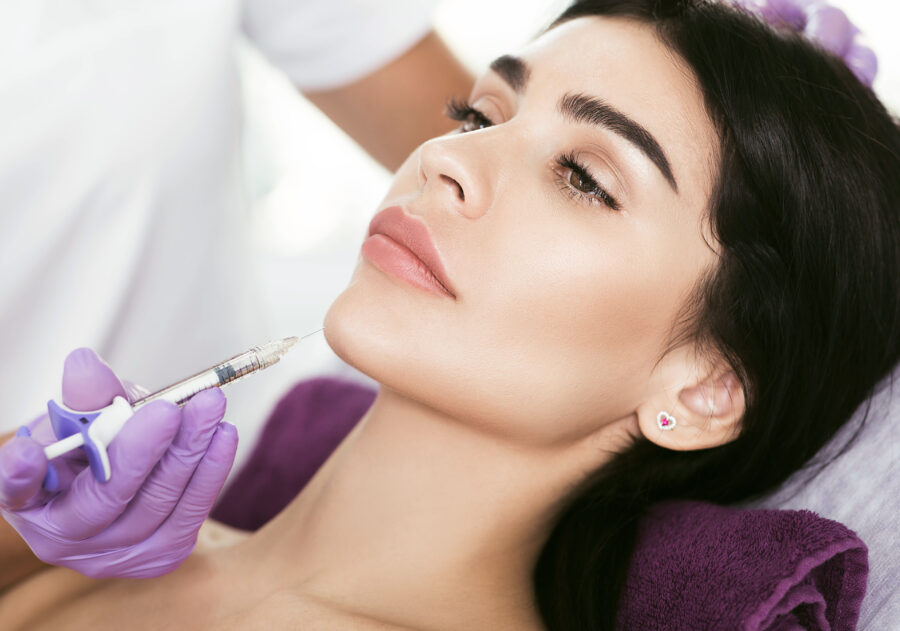
Like any injection procedure, non-surgical chin augmentation is not indicated in cases of :
- pregnancy or breastfeeding ;
- an active autoimmune disease (lupus, Crohn’s disease, etc.) ;
- an active infection or inflammation in the area to be treated (an acne flare-up, herpes) ;
- clotting disorders or anticoagulant treatment ;
- a known allergy to one of the components.
These points are systematically checked during the prior consultation, which is mandatory before any injection.
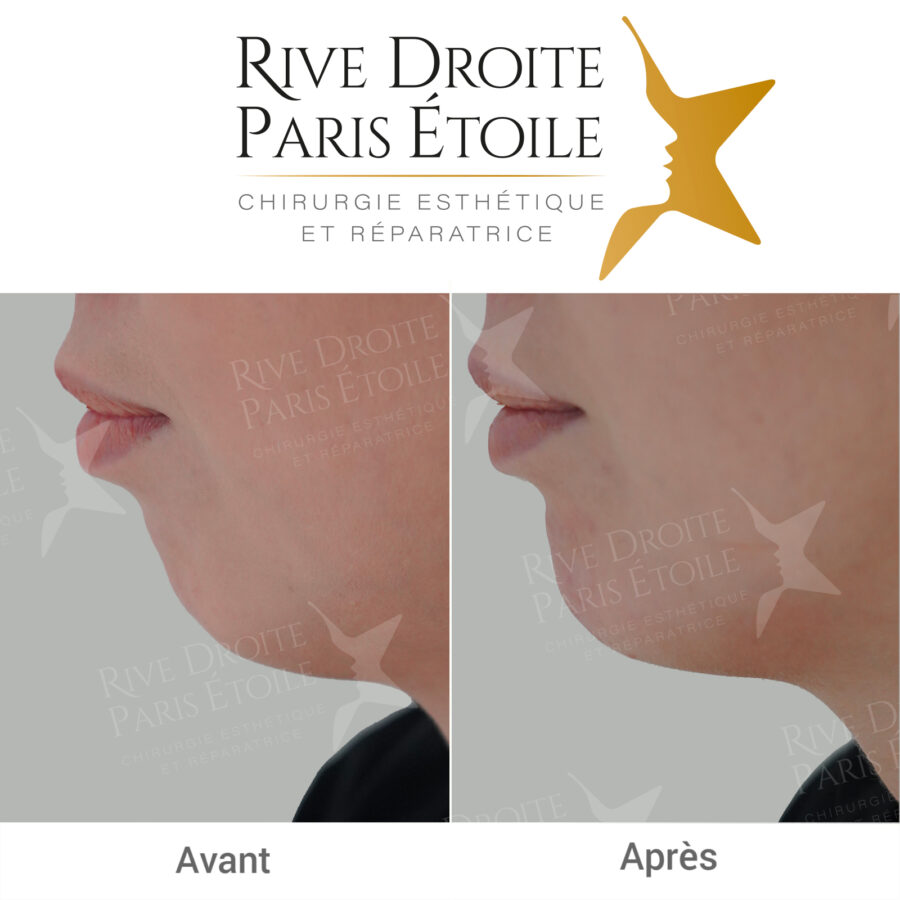
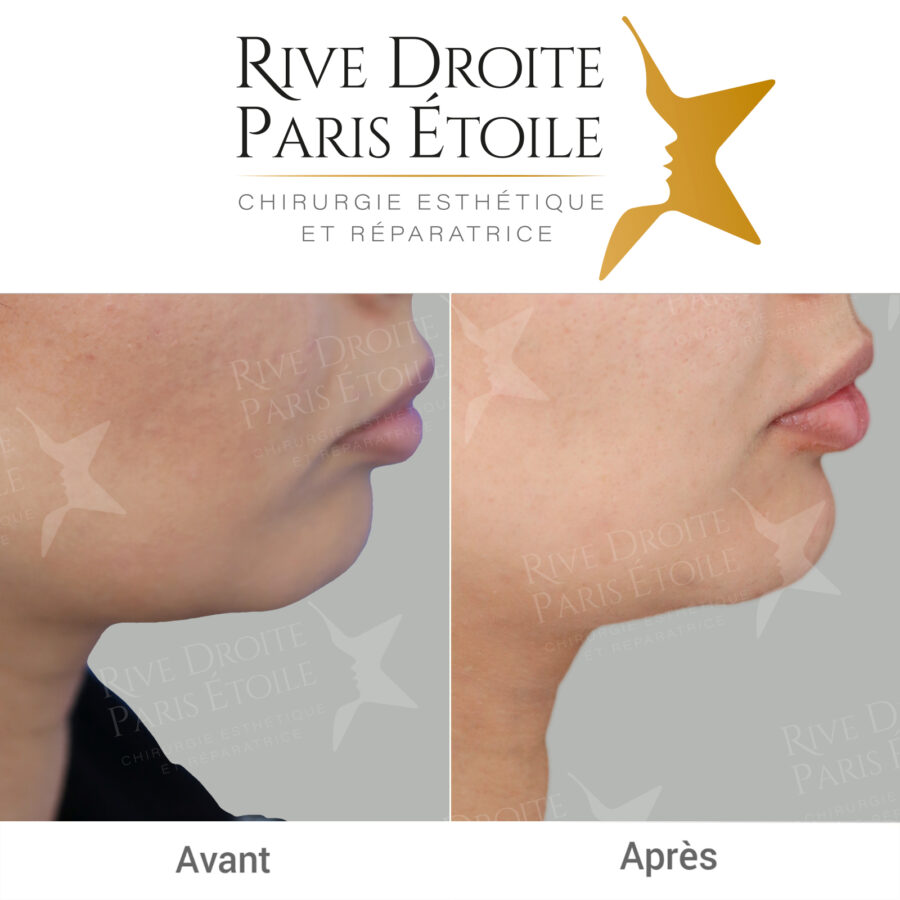
05Before / after results
06How the procedure works
Before the procedure
It all begins with a consultation at the practice: Dr Hunsinger analyses your face from the front and in profile, both static and in motion, identifies what is unbalancing the projection of the chin and checks that there is no contraindication. Photographs are taken, the realistic result is explained and a personalised quote (based on the number of syringes) is provided. In the days beforehand, you avoid aspirin and anti-inflammatories, alcohol and intense sun exposure in order to limit bruising.
During the procedure
The session lasts 15 to 30 minutes. After disinfection, the doctor injects a high-density volumising hyaluronic acid (such as Restylane Lyft), using a fine needle or a cannula, following a precise pattern of points. The gel is placed deep, against the bone, to project the tip of the chin, and is supplemented if needed with lateral injections to keep a smooth, even contour. The procedure is almost painless: the product contains lidocaine, and an anaesthetic cream can be applied beforehand. The result is visible immediately, which makes it possible to fine-tune at the end of the session.
After the procedure
There is no social downtime: you resume your activities as soon as you leave the practice. Mild redness, slight swelling or small bruises may appear; the swelling, common in this area, sometimes takes up to one or two weeks to fade completely. For 48 hours, you avoid intense sport, sauna, steam room and facial massages so as to let the product settle properly. The result is final within about a fortnight and lasts 12 to 18 months; a simple new injection can then maintain it.
07Prices & fees in Paris
| Procedure | Aesthetic fees |
|---|---|
| Non-surgical chin augmentation - hyaluronic acid | 700 – 1 600 € |
Indicative “from” prices, surgeon fees included. The final quote is given at the consultation, after examination, depending on the area treated and the technique chosen. Part of the procedure may be covered by French national health insurance when the medical criteria are met.
08Your questions
How much does a hyaluronic acid injection in the chin cost in Paris?+
The price depends on the number of syringes required, which itself depends on the volume to be corrected. Generally allow one to two syringes for the chin, i.e. a budget of around €700 to €1,600 for the session. A personalised quote is provided after the prior consultation.
How long does the result of non-surgical chin augmentation last?+
As hyaluronic acid is resorbable, the result lasts 12 to 18 months on average. In the chin — a low-mobility area where the product is placed against the bone — it often lasts longer than in heavily used areas such as the lips. A new injection can then maintain the result.
Is the chin injection painful?+
No, it is almost painless. The injected gel contains lidocaine (a local anaesthetic) and an anaesthetic cream can be applied beforehand. At most you feel slight tingling.
What are the risks of hyaluronic acid in the chin?+
The usual after-effects are minor: redness, swelling and small bruises that fade within a few days to two weeks. Serious complications (a nodule, infection, damage to a vessel) are rare and largely avoided through a rigorous technique and a thorough knowledge of the anatomy: this is why the injection must be performed by a qualified doctor. If needed, the product can still be dissolved with hyaluronidase.
Is the result reversible?+
Yes. This is one of the great advantages of hyaluronic acid: if the result is not satisfactory, the product can be dissolved with an injection of hyaluronidase. The injection therefore makes it possible to « test » a projected chin before deciding whether or not to go for a permanent correction.
Can a recessed chin be corrected without surgery?+
Yes, when it is a mild to moderate recessed chin: a hyaluronic acid injection projects the tip of the chin and restores balance to the profile. A very pronounced recessed chin, a protruding chin (to be reduced) or a bony discrepancy, however, call for surgical genioplasty.
Injection or surgical genioplasty: what is the difference?+
The injection (non-surgical chin augmentation) is non-surgical, immediate and reversible, but temporary and limited to adding volume. Surgical genioplasty (bony osteotomy or implant) is more involved but permanent and corrects the chin in every dimension (advancement, setback, height, asymmetry).
How many syringes are needed for the chin?+
Most often one to two syringes are enough to project and harmonise the chin. The exact number is determined during the consultation, depending on the volume needed and the desired effect.
When can I resume my activities after the injection?+
Immediately: there is no social downtime. You simply avoid intense sport, sauna, steam room and facial massages for 48 hours, the time the product needs to settle.
Can a hyaluronic acid chin treatment be part of a profiloplasty?+
Yes, this is even common. The chin is rarely treated on its own: the injection combines readily with work on the nose (non-surgical rhinoplasty) and the lips to harmonise the whole profile in a single session — this is the principle of a non-surgical profiloplasty.
Non-surgical mentoplasty and non-surgical chin augmentation: are they the same thing?+
Yes, they are synonyms: both refer to the non-surgical reshaping of the chin by hyaluronic acid injection.