01What is a basal cell carcinoma? Is it serious?
A basal cell carcinoma is an epithelial tumour arising from the uncontrolled growth of the basal cells of the epidermis, most often after heavy UV exposure in susceptible individuals. It is the most common form of skin cancer. Is it serious? In the vast majority of cases, no: it grows very slowly, it almost never produces metastases and its mortality is estimated at less than 1 in 1,000. Caught early, it allows complete remission after a simple removal. The concern is therefore not life-threatening but local: removed early, the damage to the tissue is limited and the repair is simpler. Early detection — through clinical examination and dermoscopy — therefore remains essential.
02How to recognise a basal cell carcinoma
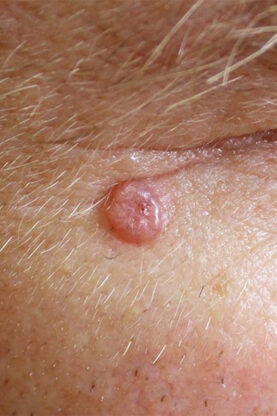
A BCC most often appears as a small « pearly » lesion: a rounded, translucent papule crossed by fine blood vessels (telangiectasia), which spreads slowly and may form a crust or a small sore that will not heal. It usually appears after the age of 45, on sun-exposed areas (face, nose, ears, scalp). Several forms are distinguished: nodular (the most common), superficial, and infiltrative or morpheaform (with less clearly defined edges, more delicate to remove). The diagnosis is made on examination, with dermoscopy if needed; where there is any suspicion, a biopsy confirms it.
03Basal cell carcinoma or melanoma?
Both are skin cancers, but they are very different. The basal cell carcinoma arises from the basal cells, stays local and almost never spreads: it is the least dangerous. The melanoma, on the other hand, arises from the melanocytes (often from a mole that changes), and can be aggressive if not caught early. Hence the importance of monitoring your moles (the ABCDE rule) and of seeking advice at the slightest doubt: see mole removal and dermoscopy.
04Which treatments? Surgery as the first-line option
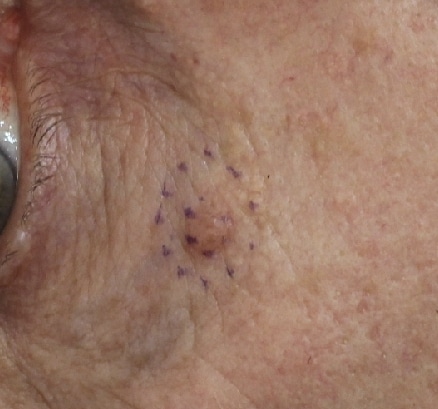
Once the diagnosis has been made, the BCC must be removed without delay. For superficial or small carcinomas, the dermatologist may suggest alternatives (curettage, cryosurgery with liquid nitrogen, photodynamic therapy). But surgery remains the best solution: it alone makes it possible to verify, on analysis, that the whole tumour has been removed. The removal is performed with safety margins (around 5 mm), sometimes using the Mohs technique (analysis of the margins during the procedure) for delicate areas of the face; the repair may involve a flap or a graft — see facial reconstructive surgery.
05Life after a basal cell carcinoma: monitoring
The prognosis is excellent: once the carcinoma has been removed in full, we speak of a cure. Life returns to normal; no heavy treatment is needed for a BCC. One point does deserve your attention, however: having had a basal cell carcinoma increases the risk of developing another one (a new BCC, elsewhere on the skin, in the following years). This is why, after removal, we recommend:
- regular dermatological follow-up (often annual), with full-body dermoscopy if needed;
- strict, lasting sun protection (the sun is the main risk factor);
- self-monitoring of your skin, to spot any new lesion that spreads, bleeds or will not heal.
Well monitored, a patient who has had a BCC leads a perfectly normal life.
06How the procedure works
Before the procedure
The process begins with a consultation: examination of the lesion, with dermoscopy if needed, and confirmation of the diagnosis by biopsy. The surgeon plans the removal and the repair, and explains the safety margins required. Depending on the case, an anaesthesia consultation is scheduled (a work-up rules out any allergy to the anaesthetic agents). The usual instructions apply: stopping smoking (it compromises healing) and stopping aspirin-based medication before the procedure.
During the procedure
The procedure begins with local anaesthesia. The surgeon removes the carcinoma taking safety margins (around 5 mm): this « oncological » removal, most often elliptical, is non-negotiable — it takes priority over any difficulty in the repair, because it is what prevents recurrence. For delicate areas, the Mohs technique (analysis of the margins during the procedure) may be used. The wound is then closed with a simple suture, a skin flap or a graft depending on the size and location. A dry dressing is applied, and the removed tissue is analysed (histopathology) to confirm complete removal and assess the margins.
After the procedure
Recovery is usually straightforward. Mild, temporary effects are possible (swelling, bruising, tightness); infection is rare (sometimes prevented with antibiotics). In the case of a graft or a flap, the healing is monitored. The scar is protected from the sun with a total sunblock and cared for (massage, ointments); its final appearance is assessed at 6 months – 2 years. Above all, regular dermatological follow-up is put in place — the margin analysis confirms the cure, and monitoring detects any new lesion early.
07Prices & fees in Paris
| Procedure | With insurance coverage | Aesthetic fees |
|---|---|---|
| Basal cell carcinoma surgery | 400 € | 400 € |
Indicative “from” prices, surgeon fees included. The final quote is given at the consultation, after examination, depending on the area treated and the technique chosen. Part of the procedure may be covered by French national health insurance when the medical criteria are met.
08Your questions
Is a basal cell carcinoma serious?+
It is the least dangerous skin cancer: it almost never spreads (metastasises) and its mortality is less than 1 in 1,000. The risk is local (spread to the surrounding tissue) — which is why it is worth removing it early. Caught in time, a cure is the rule.
Does a basal cell carcinoma always have to be operated on?+
It must always be treated, and surgery is the gold-standard solution because it makes it possible to verify, on analysis, that the whole tumour has been removed. For superficial or small forms, alternatives exist (curettage, cryosurgery, photodynamic therapy), to be discussed with the dermatologist.
How is the removal carried out? Why safety margins?+
Under local anaesthesia, the surgeon removes the tumour with a margin of healthy skin (around 5 mm) — this is the « oncological » removal. These margins are non-negotiable: they ensure that no cells are left behind and prevent recurrence. The tissue is then analysed to confirm complete removal.
What is the risk of recurrence?+
Low: the risk of recurrence does not exceed around 5% at 5 years after surgical removal, and drops to about 2% with the Mohs technique (analysis of the margins during the procedure). It depends on the subtype: lower for nodular forms, higher for infiltrative or morpheaform forms.
Does the surgery leave a scar?+
A scar is present as soon as a certain amount of tissue is removed, but suture, flap or graft techniques often allow a very good aesthetic result. It fades over time; its final appearance is assessed at 6 months – 2 years. If a scar remains bothersome, a scar revision can then improve it.
What happens afterwards? How do you live after a basal cell carcinoma?+
The prognosis is excellent and life returns to normal. Because having had a BCC increases the risk of developing another one, we put in place regular dermatological follow-up (often annual, with dermoscopy), strict sun protection and self-monitoring of the skin.
What complications are possible?+
They are rare: infection of the site (sometimes prevented with antibiotics), swelling / bleeding / oedema (mild and temporary), allergy to an anaesthetic (exceptional, ruled out by a work-up), and — in the case of a graft or a flap — a risk of tissue necrosis requiring a re-operation.
Is the removal reimbursed by the French national health insurance?+
Yes. Removing a basal cell carcinoma meets a medical necessity: it is covered up to 70% by the French national health insurance, with the remainder covered by your complementary health insurance in most cases.