Liposuction, lipoaspiration or liposculpture: what's the difference?
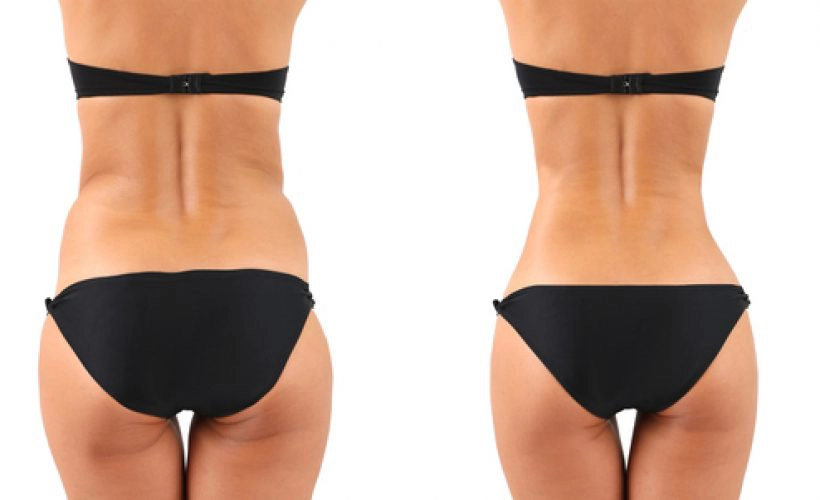
Cosmetic procedures designed to refine certain areas of the body and overall figure, in order to address features perceived as unflattering, are now widespread. Liposuction is the best-known term, but lipoaspiration and liposculpture are also among the most popular plastic surgery procedures for removing excess body fat. These different words often refer to the very same procedure, so let’s take a moment here to clarify the vocabulary and the techniques involved when we talk about liposuction, lipoaspiration and liposculpture.
Contents
Liposuction: the reference fat-aspiration technique
Invented by the French doctor Yves-Gérard Illouz in 1977, liposuction is a plastic surgery procedure that allows patients to get rid of excess fat deposits (adipocytes) in certain areas of the body by aspirating the cells using fine, round-tipped metal cannulas. These are inserted under the skin after small incisions are made.
The goal is to remove the localized, stubborn fat cells that cannot be eliminated through exercise or a balanced diet, often because of hormonal variations. The liposuction technique has improved considerably since its early days and is today the most commonly performed plastic surgery procedure in the world: every year it tops the international plastic surgery statistics. Although it has now become very common, it must still be regarded as a major procedure, with post-operative recovery that is not to be taken lightly. It must therefore be performed by an experienced surgeon following a very precise protocol, such as the liposuction performed at Dr Vincent Hunsinger’s practice in Paris.
Lipoaspiration: a different word for the same procedure
The term lipoaspiration refers to exactly the same thing as liposuction, that is, a surgical procedure intended to break down deep fat masses by aspiration using a mechanical agent, namely fine cannulas 2 to 4 mm thick. It can be performed on different areas of the body prone to storing fat, for example:
- the belly (sometimes as part of an abdominoplasty);
- the hips (love handles);
- the saddlebags;
- the buttocks;
- the thighs (see leg liposuction to reshape the thighs and calves);
- the arms;
- the knees;
- the neck (to deal with a double chin).
The aim is to rebalance the figure in order to improve one’s projected image and feel more comfortable with one’s body. Lipoaspiration can also come in variants, as is the case for example with gentle liposuction (at very low pressure) or ultrasound-assisted lipoaspiration.
Despite its merits, lipoaspiration, or liposuction, nonetheless remains a cosmetic procedure that should in no way be seen as a weight-loss treatment. Nor is it a miracle solution for treating the unflattering skin features that result from fat accumulation and a sedentary lifestyle, such as cellulite or the orange-peel look.
Liposculpture: a plastic surgery procedure aimed at reshaping
Liposculpture, although it is often similar to liposuction or lipoaspiration, can for its part target localized fat excess but with a more global perspective aimed at harmonizing volumes, shapes and contours, hence the term « sculpture ». Liposculpture is therefore a lipoaspiration carried out with a more precise aesthetic goal: no longer just to remove fat, but to redraw the body’s natural lines. The harvested fat can thus be partly reused to be transferred to areas of the body that lack volume or have insufficient volume. Most often these are:
- the breasts as part of breast lipofilling;
- the buttocks for buttock lipofilling or a Brazilian butt lift;
- or the face with facial fat transfer.
Unlike liposuction, which focuses solely on removing fatty tissue, liposculpture, also known as lipomodeling, can go further by optimizing the distribution of the body’s fat to improve overall appearance. This is referred to as autologous fat transfer, where the adipocytes are reinjected, after centrifugation, into areas lacking volume (a « 2-in-1 » effect). In this case, the amount of fat harvested must be sufficient to be reinjected into another area of the body. A loss of around 30% should indeed be expected relative to the quantity of fat harvested, in order to remove the fibrous residue.
High-definition liposculpture and VASER: sculpting muscle definition
Modern liposculpture is no longer limited to reshaping volumes: it can also aim to reveal the underlying muscle definition, what is known as high-definition liposuction (or high-definition liposculpture). This approach was formalized as early as 2007 by the surgeon Alfredo Hoyos in the journal Aesthetic Surgery Journal, under the name VASER-assisted high-definition liposculpture: it uses ultrasound energy (VASER technology, for Vibration Amplification of Sound Energy at Resonance) to selectively break up the fat around the muscle groups before it is aspirated, which makes it possible to define the contours more finely (abdominal pack, waist, pectoral line). To explore this technique further, you can read our dedicated article on high-definition liposuction and Lipo 4D.
What do liposuction and liposculpture have in common?
As you will have understood, the common ground is extensive, since it is mostly a matter of nuances between these different terms used to describe similar cosmetic procedures.
Goal and course of the procedure
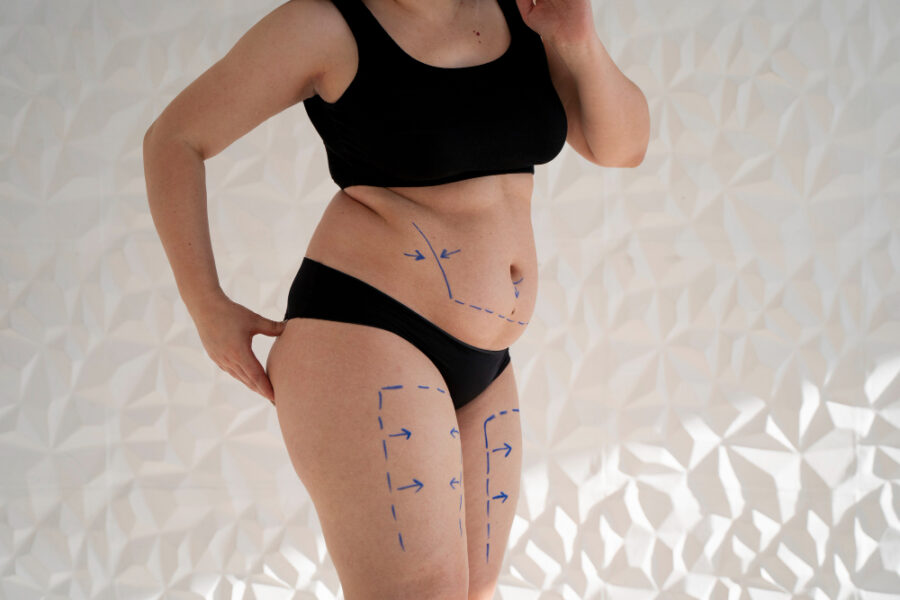
Liposuction and liposculpture procedures are performed in a hospital or specialized clinic, most often on an outpatient basis, with discharge the same evening. They are carried out under general anesthesia or local anesthesia with sedation depending on the case, on the amount of fatty tissue to be removed and on the number of areas treated.
Post-operative recovery and convalescence
The post-operative recovery and the length of convalescence after a liposculpture are, moreover, generally very similar to those experienced by patients after a liposuction. Most of them generally need to plan for at least one week off work and a limitation of their physical activity for about 2 weeks. Swelling (edema) that is sometimes significant, along with bruising, can usually be observed in the first few days and may persist for several weeks depending on the amount of fat extracted and the method used by the surgeon; you can then help the swelling subside after a liposuction. It does, however, fade naturally afterwards.
In addition, in both cases patients must wear, for several weeks after the procedure, a compression garment to reduce the swelling and thus prevent the build-up of lymphatic fluid in the empty cavities where the fat previously was: this compression garment after liposuction is an integral part of the protocol.
A purely aesthetic goal
Liposuction and liposculpture are furthermore both intended to improve the aesthetic appearance of certain localized areas of the body, and not to achieve weight loss (even if liposuction logically removes a little more fat than liposculpture).
The most suitable candidates are therefore patients who are not more than 5 kg overweight, with a stable weight. This type of patient will then see the most convincing results. The amount of fat that can be extracted is in fact limited (at most between 4 and 6 litres depending on body type). It is thus mechanically more visible on people who are only slightly overweight. These 2 procedures can moreover be requested by men and women alike, even if liposculpture is generally favoured more by women.
Finally, these procedures offer permanent results in areas where diet and sport have shown their limits, provided of course that a stable weight is maintained over time. Patient satisfaction is also high: international satisfaction surveys put the proportion of patients happy with the result at over 80%, precisely on the condition that weight remains stable after the procedure, since the remaining adipocytes can enlarge if weight gain resumes.

What are the differences between liposuction and liposculpture?
While liposuction and liposculpture are both surgical procedures that aim to sculpt the body by removing excess layers of fat to improve overall appearance, their end goals can nonetheless differ. Whereas the former consists of removing only the excess fat, the latter also aims to give the body a more harmonious shape by redrawing and sculpting the contours according to the patient’s aesthetic wishes (as far as possible) using a reinjection of fatty tissue.
It can even be used with a reconstructive goal aimed at restoring proportions, for example after a mastectomy following breast cancer (reconstructive surgery), or to revise unsightly scars, or indeed as part of surgery to repair a malformation. It can also allow an increase in volume in the desired areas in order to correct certain imperfections that are a source of self-consciousness, such as buttocks that are too flat or breast asymmetry. It may then require fat harvesting from several areas of the body.
As a result, the cost of liposculpture is generally higher than for a « simple » classic liposuction, because of the combination of different procedures. In certain cases of reconstructive surgery, such as after a mastectomy, liposculpture may qualify for insurance coverage.
Liposuction or liposculpture: how to choose?
Beyond the vocabulary, the right choice depends above all on your goal. It can be summed up as follows:
- Liposuction (or lipoaspiration) is enough when the aim is solely to remove a localized fat deposit (love handles, belly, saddlebags) in a person whose skin has good tone.
- Liposculpture is preferable when, in addition to removal, you want to redraw the contours or recreate volume elsewhere (buttocks, breasts, face) through fat transfer, or to reveal muscle definition in high definition.
That is why the surgeon chooses, together with the patient, the most suitable method in particular with regard to their body shape and after gathering their goals. A precise and detailed assessment of the amount of fatty tissue, its location and its distribution will then be necessary to estimate the volume of fat that can be aspirated and, where applicable, reused. This is decided during the pre-operative consultation, which remains the key step in determining, between liposuction and liposculpture, the technique that is genuinely relevant in your situation.
Frequently asked questions
What is the difference between liposuction and lipoaspiration?+
None: « liposuction » and « lipoaspiration » refer to exactly the same procedure. It involves aspirating, using fine cannulas, the localized fat deposits that sport and diet cannot eliminate. « Lipoaspiration » is simply the medical term, while « liposuction » is the word most commonly used in everyday language.
Liposuction or liposculpture: what is the difference?+
Liposuction only removes excess fat from a localized area. Liposculpture (or lipomodeling) goes further: it redraws the body contours and can reinject the harvested fat into an area that lacks volume (buttocks, breasts, face), through autologous fat transfer. Liposculpture is therefore a lipoaspiration carried out with a more precise reshaping goal.
What exactly is a liposculpture?+
Liposculpture is a plastic surgery technique that combines the removal of localized fat and its possible reinjection to harmonize the volumes and contours of the figure. Its most advanced form, ultrasound-assisted high-definition liposuction (VASER), makes it possible to reveal the underlying muscle definition.
How does a liposculpture work?+
The procedure is most often carried out on an outpatient basis (discharge the same evening), under general anesthesia or local anesthesia with sedation depending on the number of areas treated. The surgeon aspirates the fat through fine cannulas, then, if a transfer is planned, reinjects it after centrifugation. Recovery involves transient swelling (edema) and bruising, and wearing a compression garment for several weeks.
Why does liposculpture cost more than liposuction?+
Because it usually combines several steps: removing the fat, preparing it and then reinjecting it into one or more other areas. This combination of procedures makes liposculpture longer and more technical than a « simple » classic liposuction. Only a personalized quote drawn up during a consultation can give a precise cost for a procedure.
Are the results of a liposuction or a liposculpture permanent?+
Yes, the fat cells that are removed do not grow back. The result is nonetheless dependent on weight stability: the remaining adipocytes can enlarge in the event of significant weight gain. This is why these procedures are intended for people close to their ideal weight, and not as a weight-loss treatment.
Book an appointment
If you are considering a procedure, book an appointment in just a few clicks: our surgeons will answer all your questions and guide you toward a tailored, personalised solution.
Book on Doctolib