01Breast reconstruction after a mastectomy
In France, 30 to 40% of women who have had a mastectomy choose breast reconstruction — a personal decision that carries no added cancer risk (the fear that reconstruction might encourage a recurrence has been firmly ruled out by the health authorities).
It is intended above all for mastectomies (complete removal of the breast); more rarely for breast-conserving surgery (lumpectomy), when the asymmetry in shape or volume between the two breasts becomes too pronounced after the tumour is removed.
02Immediate or delayed reconstruction?
Reconstruction can be carried out at the same time as the removal (immediate reconstruction) or later (delayed reconstruction):
- Immediate: preferable when conditions allow. It avoids the trauma of losing the breast, preserves the skin of the chest and the inframammary fold, and spares a second procedure. It is, however, not advised if the tumour is inflammatory or in contact with the skin, in cases of large volume, in patients who smoke or have diabetes, and when radiotherapy is planned.
- Delayed: still the most common situation, as radiotherapy is often given after the mastectomy. It takes place about 6 months after chemotherapy and one year after radiotherapy, allowing time to assess the quality of the skin and muscles. Reconstruction remains possible even several years after the mastectomy.
Please note: when the tissues have been irradiated, reconstruction with autologous tissue (a flap) is generally preferred over an implant, as it is better tolerated in an irradiated area (fewer capsules and healing complications).
03Breast reconstruction techniques
There are three main techniques; the choice depends on body shape, tissue quality and the treatments received:
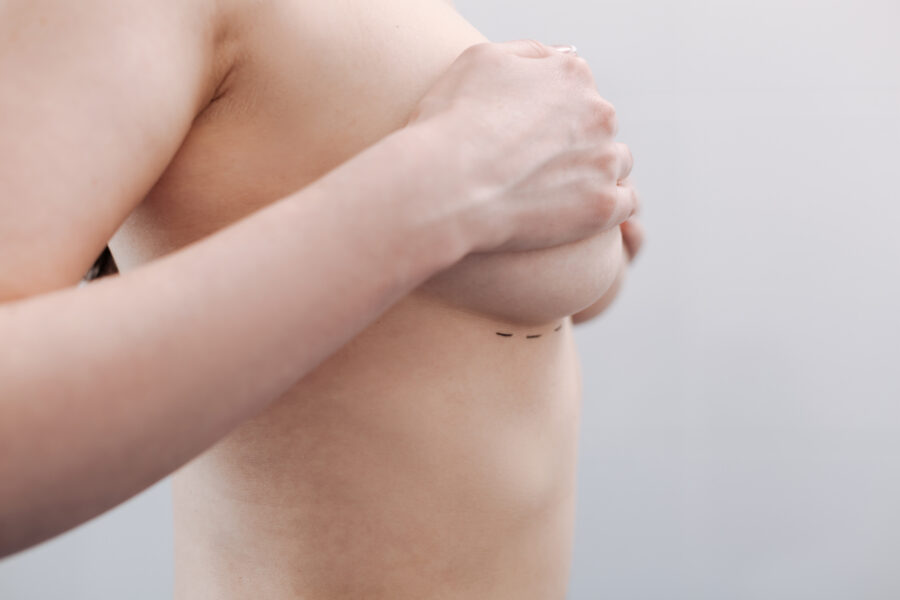
- With an implant: placement of a silicone-gel implant behind the pectoral muscle. A simpler, quicker procedure, indicated when the tissues are of good quality and the volume to reconstruct is moderate; it calls for monitoring (capsular contracture, implant wear) and a result that can feel slightly less natural to the touch.
- With an autologous flap: the volume is rebuilt using the patient’s own tissues, for a natural, long-lasting result. The DIEP (abdominal flap) is the gold standard: it harvests skin and fat while sparing the muscle, and suits all breasts; when no abdominal tissue is available, the PAP flap (lower buttock) or the latissimus dorsi is used. These techniques leave a scar at the donor site.
- With fat transfer (fat grafting): the patient’s own fat is reinjected, with no scar and no rejection, for a very natural look — on its own or to complement the other techniques. It requires a sufficient fat reserve, which can sometimes be limited after chemotherapy.
04Nipple, areola and symmetry of the two breasts
Rebuilding the volume is only one step: the whole challenge is to achieve two harmonious breasts. The opposite breast can be adjusted at the same time — with a breast lift, a breast reduction or an augmentation — to restore symmetry, a procedure that is also covered.
As a final touch, often a few months later, the surgeon reconstructs the areola and the nipple: medical tattooing (in relief), a skin graft or a graft taken from the opposite areola. This optional step rounds off a natural result.
05Prices and insurance coverage
Breast reconstruction after cancer is reconstructive surgery: it is covered at 100% by the French national health insurance (long-term illness scheme), as are the symmetrisation of the opposite breast and the reconstruction of the areola. Depending on the technique (implant, DIEP, fat transfer), the fees and duration differ — the details are set out in the price list and insurance coverage.
06How the procedure works
Before the procedure
The reconstruction plan is unique to each patient. A consultation at the Rive Droite Paris Étoile practice allows us to understand your expectations, assess the quality of the tissues and define, together with you, the most suitable technique and the schedule (immediate or delayed). Pre-operative recommendations are given — in particular stopping smoking, which is essential for good blood supply and healing. Psychological support can be offered, and the appointment with the anaesthetist is set before the procedure.
During the procedure
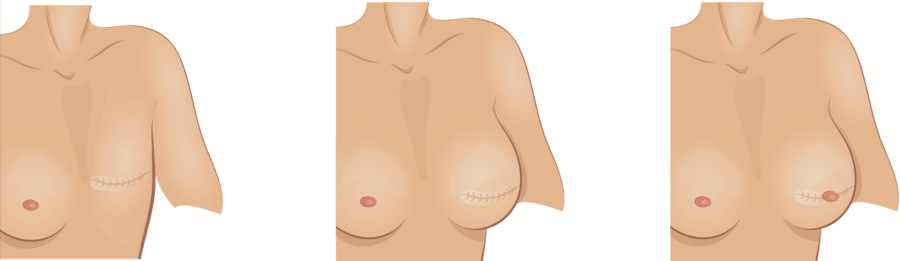
Reconstruction is performed under general anaesthesia and requires, depending on the technique, 2 to 3 surgical stages. The first stage rebuilds the volume of the breast:
- for an implant, if the skin of the chest is too tight, the surgeon first places a tissue expander that is gradually inflated over a few weeks, before fitting the permanent implant;
- for a flap or fat transfer, rebuilding is made easier by the elasticity of the tissues or of the reinjected fat.
The following stages harmonise the two breasts, then reconstruct the areola and the nipple.
After the procedure
Recovery depends on the technique:
- Implant: a 1- to 2-hour procedure, 1 to 4 days in hospital, moderate pain relieved with painkillers.
- Flap: a more involved procedure (≈ 4 h), 5 to 8 days in hospital, monitoring of the flap with a Doppler and wearing a compression garment day and night for 6 weeks.
- Fat transfer: a lighter procedure, on a day-case basis, with fine scars and discomfort mainly at the donor sites (wearing compression shorts).
In every case, rest is required during the first few days; sport and lifting heavy loads are forbidden for at least a month, with sick leave that can last up to 6 weeks. Wearing a healing bra and avoiding the sun for a month are recommended.
07Prices & fees in Paris
| Procedure | With insurance coverage | Aesthetic fees |
|---|---|---|
| Breast reconstruction after mastectomy with an implant | 3 600 – 5 600 € | 7 000 – 9 000 € |
| Breast reconstruction with DIEP (microsurgical flap) | 9 000 – 11 000 € | 14 000 – 18 000 € |
Indicative “from” prices, surgeon fees included. The final quote is given at the consultation, after examination, depending on the area treated and the technique chosen. Part of the procedure may be covered by French national health insurance when the medical criteria are met.
08Your questions
Is breast reconstruction after cancer covered by insurance?+
Yes, fully: it is reconstructive surgery covered at 100% by the French national health insurance (long-term illness scheme), including the symmetrisation of the opposite breast and the reconstruction of the areola. Any out-of-pocket fee supplements are set out in the price list.
Immediate or delayed reconstruction: which one to choose?+
Immediate reconstruction (during the mastectomy) is preferable when conditions allow; the delayed option is often necessary when radiotherapy is planned. The choice is made with the team according to the tumour, the treatments and your wishes.
Which reconstruction technique is right for me?+
It depends on your body shape, the quality of the tissues and the treatments received: an implant for a moderate volume and good tissues, an autologous flap (DIEP) for a natural autologous result, fat transfer on its own or as a complement. The surgeon guides you during the consultation.
Can you be reconstructed after radiotherapy?+
Yes. In an irradiated area, reconstruction with autologous tissue (a flap) is generally preferred over an implant, as it is better tolerated and gives better results.
Does reconstruction interfere with monitoring or encourage a recurrence?+
No. Reconstruction does not increase the risk of recurrence and does not interfere with breast cancer follow-up, as established by the health authorities.
Are the nipple and areola reconstructed too?+
Yes, if you wish: it is the final step, carried out a few months later by medical tattooing, a skin graft or a graft taken from the opposite areola.
How long does recovery take?+
It varies with the technique: a few days in hospital for an implant, 5 to 8 days for a flap, with sick leave that can reach 6 weeks and a return to sport after one month.
Can you be reconstructed long after the mastectomy?+
Yes: delayed reconstruction can be carried out several years after the mastectomy, once the treatments are over and the tissues have stabilised.