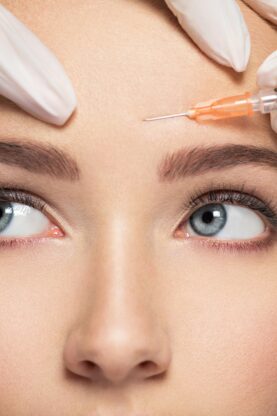
01What is Botox (botulinum toxin)?
Known for half a century, botulinum toxin (Botox) is a natural protein first used therapeutically (strabismus, facial paralysis, incontinence). In aesthetic medicine, at very low doses, it blocks the nerve signal (acetylcholine) that triggers muscle contraction: the muscle relaxes and the dynamic expression lines stop deepening. The skin becomes smooth again, without freezing the face. The effect appears around the 3rd-5th day, stabilises within 1 to 2 weeks and lasts 4 to 6 months.
02The areas treated with Botox
Botox is mainly used on the upper third of the face, where hyaluronic acid is poorly suited:
- the horizontal forehead lines;
- the frown lines (the vertical lines between the eyebrows);
- the crow’s feet at the corner of the eyes, and the eyebrow tail (an « open eye » effect);
- lower down, the marionette lines and the jaw (bruxism, teeth grinding), as well as the neck bands (platysma).
Beyond aesthetics, Botox also effectively treats hyperhidrosis (excessive sweating of the underarms, hands or feet). A treatment of the whole face is sometimes offered (« full face »), and light preventive doses in younger patients are known as « Baby Botox« .
03Contraindications
The injections are not advised:
- for women who are pregnant or breastfeeding;
- in case of neuromuscular disease (myasthenia, myopathy, amyotrophic lateral sclerosis);
- in case of allergy to type A botulinum toxin;
- while taking certain antibiotic treatments (risk of interaction).
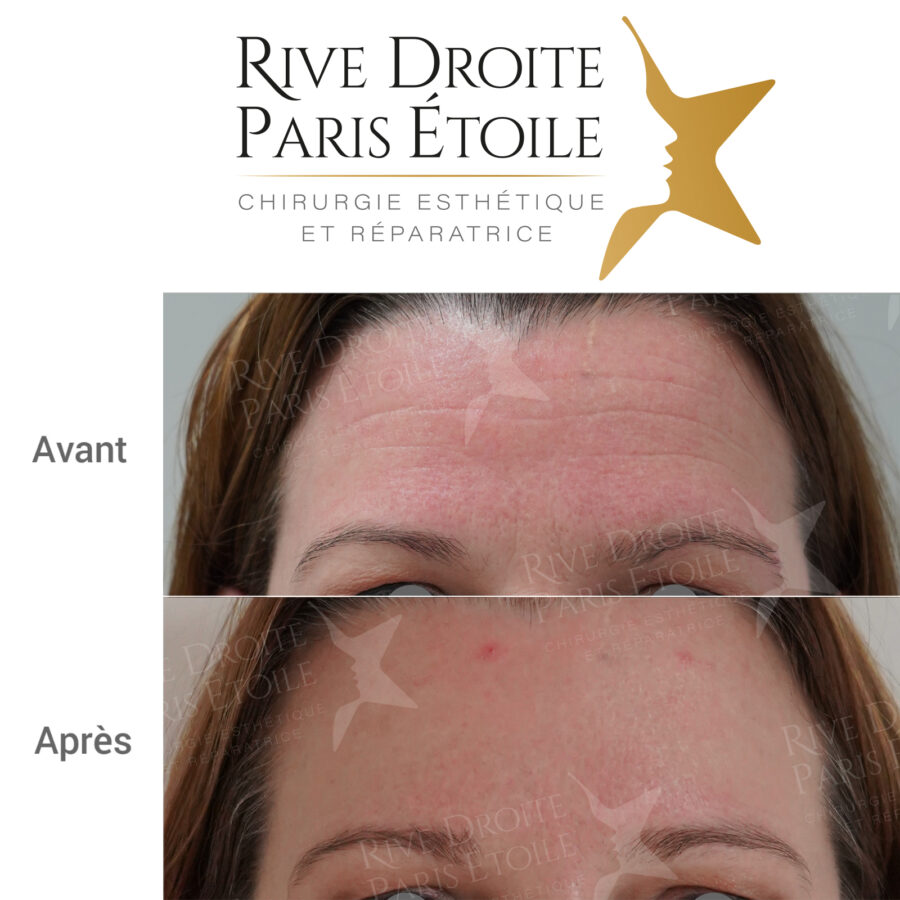
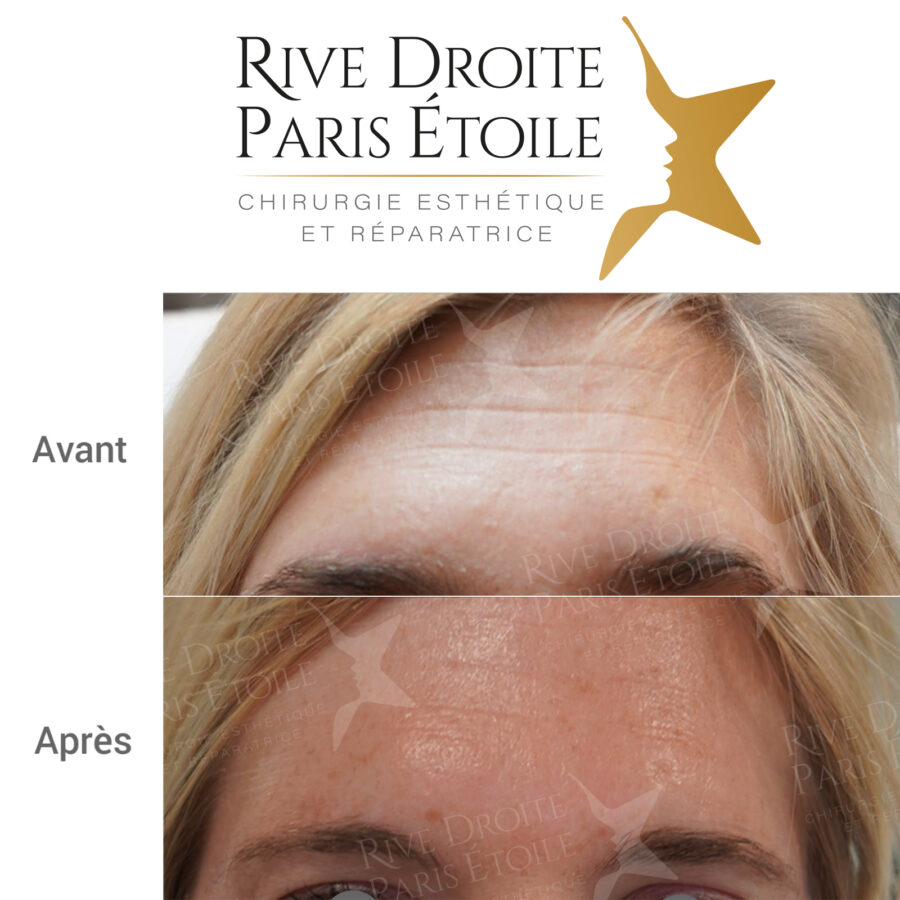
04Before / after results
05How the procedure works
Before the procedure
The session begins with a consultation at the Rive Droite Paris Étoile practice: the practitioner examines the muscle groups of the face and neck. You are asked to frown, raise your eyebrows and smile to bring out the wrinkles and to assess, at rest and in motion, the tone of the muscles responsible — in order to define the injection points precisely.
During the procedure
Once the treatment plan is agreed, the practitioner performs the injections of botulinum toxin in very small amounts, using a very fine needle, on the targeted and disinfected points. The session is quick (≈ 15 minutes) and almost painless; a numbing cream can be offered to the more sensitive patients.
Slight bumps may appear at the injection points and disappear within 30 minutes; they should not be massaged (unlike hyaluronic acid). The needle marks fade within a few hours and activities resume immediately, with no time off work.
After the procedure
The results are gradual: first effects around the 4th day, stabilised within 1 to 2 weeks, lasting 4 to 6 months — a duration that lengthens (up to 8 months) over the course of the sessions, which are spaced at least 3 months apart. A few precautions in the first few hours: no sport, do not lie down or lean your head forward, avoid sauna, steam room and UV, so as not to spread the product.
Rare bruising or slight, temporary eyelid discomfort is possible. A follow-up visit is carried out 2 to 4 weeks after the session.
06Prices & fees in Paris
| Procedure | Aesthetic fees |
|---|---|
| Botulinum toxin injection (Azzalure, Dysport, Botox) | 400 – 700 € |
Indicative “from” prices, surgeon fees included. The final quote is given at the consultation, after examination, depending on the area treated and the technique chosen. Part of the procedure may be covered by French national health insurance when the medical criteria are met.
07Your questions
What is the price of a Botox injection in Paris?+
The fee depends on the number of areas treated and the number of units: expect from 400 € at the Rive Droite Paris Étoile practice. The details are shown in the price list.
How much does forehead Botox cost?+
The forehead is one of the three « classic » areas (forehead, frown lines, crow’s feet). Its price depends on the units required; a precise quote is provided during the consultation, and a treatment of several areas is often offered at an overall price. See the price list.
How often should the injections be repeated?+
The effect lasts up to 6 months; 2 sessions per year are generally recommended for a consistent result, always leaving at least 3 months between two injections.
What is the difference between Botox and hyaluronic acid?+
These are two different products: Botox is a muscle relaxant for the upper face (expression lines), whereas hyaluronic acid is a filler product for the volumes and folds of the lower third. They are often complementary.
What is "Baby Botox" (preventive Botox)?+
Baby Botox involves injecting very low doses, often in younger patients, to discreetly soften emerging wrinkles and prevent them from setting in, while keeping a perfectly natural expression.
Can the whole face be treated ("full face")?+
Yes: a « full face » treatment combines several areas (forehead, frown lines, crow’s feet, sometimes the lower face) in a single session, for a harmonious result. The plan is defined according to your facial structure during the consultation.
Does Botox make the face swell?+
No, that is impossible: this is a confusion with poorly dosed hyaluronic acid injections. Botox relaxes the muscle; it does not fill and does not swell.
Does Botox give a "frozen" look?+
No: correctly dosed and placed, it keeps the face fully natural and the muscles able to contract. The frozen look comes from an overdose, not from the product.
When will I see the results?+
The first effects appear within a few days and stabilise around 10 to 15 days, then last about 6 months.
Should I choose a facelift or Botox injections?+
The two are very different: Botox treats the expression lines of the upper face and is repeated, whereas a facelift is a surgical procedure, more complete and lasting, for the laxity of the lower face. The practitioner will guide you according to your situation.
Can injections be done while pregnant?+
No: as a precaution, Botox is contraindicated during pregnancy and breastfeeding.
What are the risks of a Botox injection?+
Performed by a qualified practitioner, the injection is very safe. The main risk is an allergy (rare); serious side effects are exceptional. Rare bruising or temporary eyelid discomfort may occur.