01What is a lipoma?
A lipoma is a subcutaneous fatty lump generally less than 5 cm in diameter. It can be told apart from a cyst by its softer, more supple consistency (no capsule, fatty composition) and by the slip sign: it rolls under the finger on palpation. It is the most common benign tumour of the soft tissues, most often made up solely of fat cells. It is sometimes multiple (referred to as lipomatosis), occasionally with a hereditary component.
More rarely, the lipoma sits at a deeper level:
- within a muscle (intramuscular lipoma)
- in the viscera (deep lipoma)
- in the nerves (neural fibrolipomas)
- or even in the bones (parosteal lipomas)
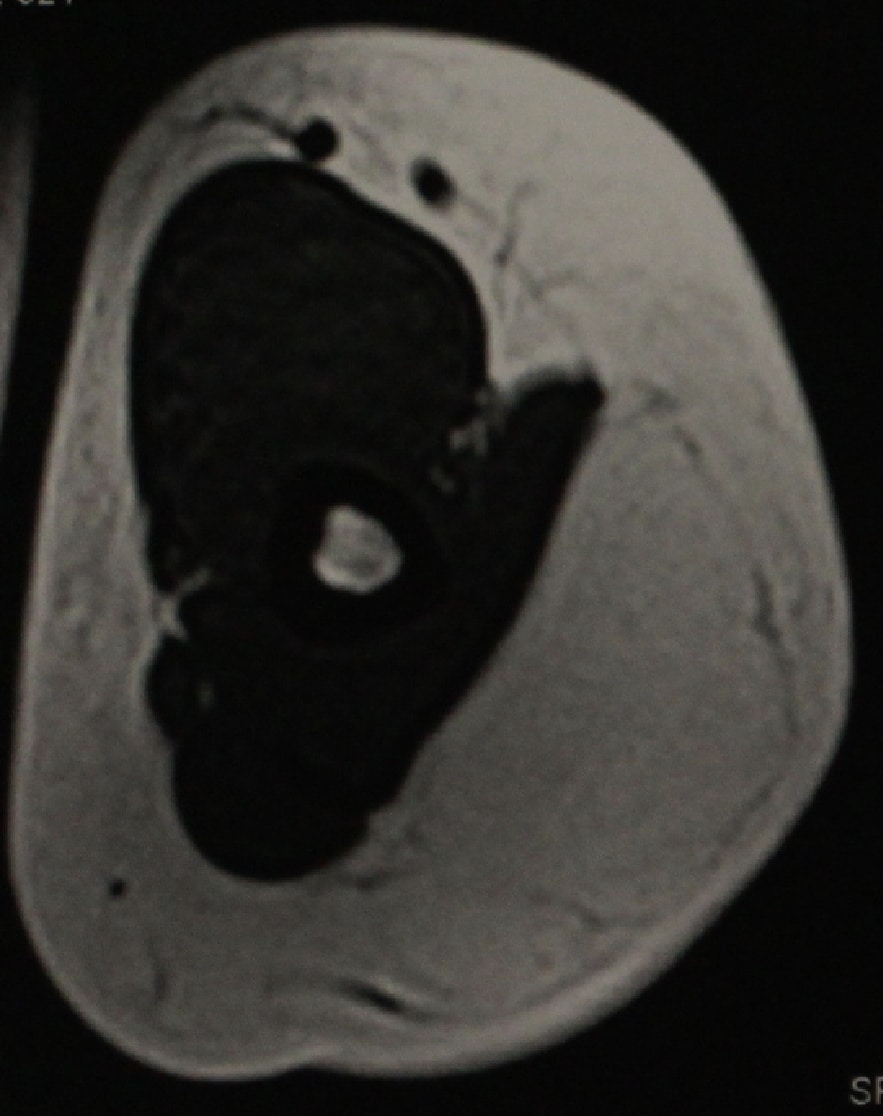
These deep forms, known as heterotopic, warrant particular attention (imaging, analysis) because they are harder to assess clinically.
02Lipoma or cyst: how to tell them apart?
The two « lumps under the skin » are often confused. A lipoma is a mass of fat: soft, deeper, mobile, with no connection to the surface (no blackhead). A cyst, on the other hand, is a pouch closed by a capsule: firmer, more superficial, sometimes topped by a blackhead and liable to become infected. The distinction is made on clinical examination, with an ultrasound if needed. Discover sebaceous cyst removal.
03Is a lipoma dangerous? Lipoma or liposarcoma?
In the vast majority of cases, a lipoma is perfectly benign and does not turn malignant. There is, however, a malignant and rare fatty tumour, the liposarcoma, which can resemble it in its early stages. A few warning signs should prompt a consultation and imaging of the lesion: a mass that grows quickly, becomes hard or fixed to the deeper tissues, measures more than 5 cm, is painful or lies deep (thigh, retroperitoneum). It is precisely to rule out this doubt that the surgeon may order imaging (ultrasound, MRI) before the procedure, and that every removed lipoma is sent for histological analysis. When in doubt, it is removed: that is the best safeguard of all.
04When should a lipoma be removed?
Removal is not automatic. The first indication is functional discomfort or pain (a lipoma that presses on a nerve, hinders movement, or rubs under clothing). Other reasons justify removal:
- doubt about the nature of the lesion on clinical examination;
- a cosmetic concern;
- a large size (longest axis > 5 cm; beyond 10 cm it is called a giant lipoma);
- a marked change (size increasing rapidly).
To decide on removal, examination by the surgeon is essential.
05Can a lipoma be made to disappear without surgery?
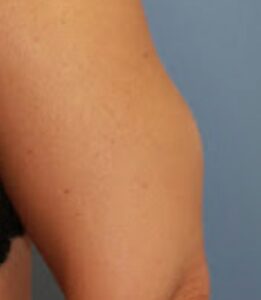
No. No ointment, essential oil or « natural treatment » dissolves a lipoma: it is an organised fatty tissue, not a build-up that could be reabsorbed. Nor should you try to pierce it — unlike a cyst, it contains no fluid to drain: you would risk an infection and a needless scar, while removing nothing. For soft, well-defined lipomas, the surgeon can sometimes offer removal through a micro-incision or targeted liposuction (a more discreet scar); but only complete removal of the mass, fatty capsule included, prevents recurrence.
06How the procedure works
Before the procedure
It all starts with a consultation: the surgeon examines the « lump », confirms that it is a lipoma, assesses its size and depth, and decides whether any tests are useful. These are not systematic but may include an ultrasound or MRI (deep or large lipoma, diagnostic doubt), a sample for histological purposes, or a blood test. The usual instructions apply: stopping smoking and any aspirin-based medication before the procedure.
During the procedure
In the most common cases, the excision is performed in the practice, under local anaesthesia, and takes less than an hour. The sequence: marking the lipoma with a surgical pen, local anaesthesia of the area, an elliptical incision, complete removal of the mass, closure with absorbable sutures, then systematically sending the lipoma to the laboratory for histological analysis. The surgical approach is tailored to the number of lipomas, their location and their size; a deep or large lipoma may require a different setting.
After the procedure
Recovery is generally very mild: the surgery is painless thanks to the local anaesthesia, and the only instructions concern bathing (to be avoided for a few weeks) and care of the dressing and the scar. Complications are rare and minor (slight swelling, suture intolerance, infection of the site rare if dry dressings are properly applied). The scar, the size of the removed lipoma, is worked on to stay discreet and fades over time (scar massage and healing ointments help with this).
07Prices & fees in Paris
| Procedure | With insurance coverage | Aesthetic fees |
|---|---|---|
| Lipoma surgery | 400 € | 400 € |
Indicative “from” prices, surgeon fees included. The final quote is given at the consultation, after examination, depending on the area treated and the technique chosen. Part of the procedure may be covered by French national health insurance when the medical criteria are met.
08Your questions
How much does lipoma removal cost in Paris?+
At Rive Droite Paris Étoile, expect from 400 € (see the price table below). The price depends mainly on the size, depth and number of lipomas to be removed; it is set precisely during the consultation, with a quote.
Is lipoma removal covered by France's national health insurance?+
When the procedure is purely cosmetic, it is not covered. In the event of functional discomfort, pain or medical necessity (diagnostic doubt, large or deep lipoma), insurance coverage is possible; the surgeon will confirm this on a quote during the consultation.
Is removing a lipoma painful?+
No: the removal is performed under local anaesthesia and is painless. Recovery is also very mild, with simple painkillers if needed.
Does the procedure leave a scar?+
Yes, a scar the length of the removed lipoma, but the surgeon makes it as discreet as possible and it fades over time. Scar massage and healing ointments improve its appearance further still.
Can the lipoma come back after the procedure?+
Removal is generally permanent. Recurrence is rare and occurs mainly when the excision could not be complete; this is why the surgeon makes sure to remove the mass in its entirety.
Can several lipomas be removed in a single procedure?+
Yes, it is most often possible to remove several lipomas during the same procedure, depending on their number, size and location.
Are tests needed before removing a lipoma?+
Not always. The surgeon decides during the consultation; they may order an ultrasound or MRI (deep, large or doubtful lipoma), a histological sample or a blood test.
Which specialist removes a lipoma?+
A surgeon (plastic or dermatological). The complete removal of the mass, the care of the scar and the systematic analysis of the specimen make it a job for a surgeon rather than an improvised procedure.