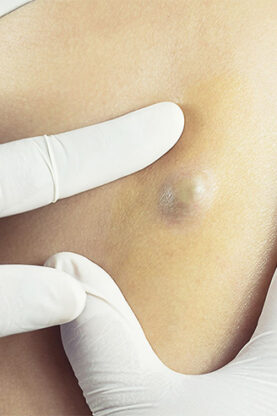
01How to recognise a sebaceous cyst
A sebaceous cyst appears as a lump under the skin, between 5 mm and 5 cm across. The lump is generally rounded, mobile, relatively firm to the touch and rubbery in consistency; it is sometimes topped by a small blackhead (the opening of the blocked duct). As long as it is not infected, the cyst is painless in itself, but it may be bothersome depending on its location. To rule out any doubt, only an examination by a healthcare professional (a dermatologist or surgeon) can confirm the diagnosis, which is essentially clinical.

One useful point: the name « sebaceous cyst » is in fact a misnomer. In the vast majority of cases, it is actually an epidermoid cyst (or epidermal cyst) or a pilar cyst, whose pocket is filled with keratin — not sebum. The true sebaceous cyst (steatocystoma) is rare. This makes no difference to the treatment, but it explains why a dermatologist will often speak of an « epidermoid cyst ».
02Cyst, « fatty lump » or lipoma?
A cyst is often confused with a « fatty lump ». A lipoma, by contrast, is a build-up of fat cells: it is softer, deeper, and does not connect to the surface of the skin (no blackhead). A cyst, being more superficial, is attached to the skin. The distinction is made on clinical examination, and if needed with an ultrasound scan. The treatment principle is similar — a complete excision — but the technique differs: discover lipoma removal.
03Which areas of the body can develop a sebaceous cyst?
This type of cyst can form in many areas of the body (the so-called seborrhoeic regions), the most common being:
- face
- neck
- back and shoulders
- torso / chest
- pubic area and genitals
- scalp
04Why have a sebaceous cyst removed?
Removing a sebaceous cyst is by no means compulsory, but it offers many benefits. Beyond the cosmetic or functional discomfort it causes, excision performed by a surgeon helps to prevent future infections and avoid any recurrence, provided the sac is removed in its entirety. If you are wondering whether a particular cyst needs to be removed, a simple consultation can answer this after an examination.
05Should you pop a sebaceous cyst yourself?
No, you should never pop or squeeze a cyst yourself. The temptation is real but counterproductive: it carries a risk of infection (the contents are not sterile), it can trigger painful inflammation, and above all it does not remove the sac. As long as this wall remains in place, the cyst almost always re-forms — this is the main cause of recurrence. Handling the cyst also tends to leave a wider, more visible scar. The only lasting solution is the surgical excision of the entire cyst, sac included.
06An infected cyst: how to recognise it and what to do
During the inflammatory phase, the cyst becomes tender to the touch, swollen and red. This inflammation can worsen into what is known as the abscess phase: the cyst softens and sometimes drains spontaneously as purulent sebum. This phase is a medical emergency that can leave unsightly scars, with a high risk of recurrence (the sac is rarely eliminated by spontaneous drainage).
When the cyst is already infected (the « hot » phase), the priority is to treat the infection and bring it back to a « cold » phase before removal: local antiseptics, sometimes combined with antibiotics. The surgeon can then remove the cyst cleanly, thanks to much clearer margins. If the abscess phase has already been reached, another approach (a drainage puncture, for example) may be taken to limit the damage, with the complete excision scheduled for a later date.
07Is a sebaceous cyst dangerous or cancerous?
In the vast majority of cases, no: the sebaceous (epidermoid) cyst is a benign lesion. The main real risk is not cancer but infection. Malignant transformation of an epidermoid cyst is exceptional. Caution is nonetheless warranted if a « lump » grows rapidly, becomes hard or fixed, bleeds or changes in appearance: these signs should prompt a consultation, as they may suggest another lesion (a lipoma, or more rarely a lesion that needs to be analysed — see basal cell carcinoma surgery). This is precisely why any cyst that is removed can be examined under the microscope (histopathological examination) if there is any doubt.
08How the procedure works
Before the procedure
It all starts with a consultation, during which the surgeon examines the cyst, confirms the diagnosis (with an ultrasound scan if needed), assesses its size and location, and determines the exact price of the procedure. A few usual instructions: stop smoking 7 to 15 days before the procedure and stop any aspirin-based medication over a similar period. If the cyst is in an infected phase, the infection is treated first to bring it back to a « cold phase » before removal.
During the procedure
The excision takes place in the office, under local anaesthesia. The surgeon makes a spindle-shaped incision (elliptical) to reach the cyst, then gently detaches the sac from the tissues holding it: it is the complete removal of this wall that ensures there is no recurrence. Once the cyst has been removed, a careful suture is placed (most often with absorbable threads) and a dressing is applied after cleansing. The procedure usually takes between 45 minutes and 1 hour.
After the procedure
Recovery is very mild: pain is generally minimal or absent (simple painkillers if needed). The main precautions concern swimming (not advised in the weeks following the procedure), scar care as instructed, and sometimes a break from sport depending on the location. The scar, whose size depends on that of the cyst, is worked on to remain as discreet as possible; it fades over the weeks and months. If there is any doubt about the nature of the lesion, the removed cyst is analysed (histopathology).
09Prices & fees in Paris
| Procedure | With insurance coverage | Aesthetic fees |
|---|---|---|
| Sebaceous cyst removal | 400 € | 400 € |
Indicative “from” prices, surgeon fees included. The final quote is given at the consultation, after examination, depending on the area treated and the technique chosen. Part of the procedure may be covered by French national health insurance when the medical criteria are met.
10Your questions
Is removing a sebaceous cyst painful?+
No. The removal is done under local anaesthesia and is completely painless. Recovery is also very mild: minimal discomfort, well relieved by simple painkillers if needed.
How much does sebaceous cyst removal cost in Paris?+
At the Rive Droite Paris Étoile practice, expect from 400 € (see the price table below). The exact price depends on the size and location of the cyst; only an examination during the consultation can establish it precisely and provide a quote.
Is cyst removal reimbursed by the French health insurance?+
When it is purely cosmetic, removal is not covered. However, in the case of a history of infection or functional discomfort, partial coverage is possible: the surgeon will tell you during the consultation what applies in your case.
Does the procedure leave a scar?+
Yes, any excision leaves a scar, the length of which depends on the size of the cyst removed. The surgeon makes it as discreet as possible through suitable incision and suture techniques; it fades noticeably in the weeks and months that follow.
Can the cyst come back after the procedure?+
The risk of recurrence is very low once the sac has been removed in full — this is the whole point of surgical excision compared with simple drainage or a cyst popped by yourself, where the wall remains in place and the cyst re-forms.
Which specialist removes a sebaceous cyst?+
A surgeon (a plastic or dermatological surgeon). The procedure is technically simple, but removing the entire sac to prevent recurrence, and looking after the appearance of the scar depending on the area, make it a job for a surgeon rather than an improvised gesture.
Is the cyst analysed after removal?+
If there is any doubt about the nature of the lesion, the removed cyst undergoes a histopathological analysis under the microscope. Sebaceous cysts are, however, most often benign and result from a simple blockage of a skin duct.
Are there any contraindications to the procedure?+
The contraindications are general ones. Above all, we ask you to stop smoking 7 to 15 days before the procedure and to stop any aspirin-based medication over a similar period. A cyst in an infected phase is treated first before being removed.