
01Tuberous breasts: what are they?
The term tuberous breasts comes from « tubercle », referring to the tube shape the breast takes in the most pronounced forms. The malformation stems from a defect in the breast’s base of implantation: a fibrous ring forces growth towards the centre and prevents the periphery from developing. Appearing in adolescence, its cause remains poorly understood; it most often affects both breasts, to varying degrees.
Several features help establish the diagnosis of tuberous breasts:
- underdevelopment of the lower part of the breast, with an inframammary fold that sits too high;
- wide, bulging areolas (areolar protrusion), the result of a herniation of the gland;
- hypotrophy of the lower quadrants (more rarely hypertrophy);
- frequent breast asymmetry, the two breasts not being at the same stage;
- a reduced skin envelope, with thin, fragile skin.
These anomalies, often difficult to live with, can now be corrected effectively with plastic surgery.
02The stages of tuberous breasts: the classification
The corrective procedure depends above all on the stage of the malformation. The French reference is the Grolleau classification, in three grades:
- Stage 1 (mild): only the inferomedial quadrant is deficient, with the areola pointing downwards. Simple correction by glandular redistribution, most often through a periareolar incision; lipofilling or an implant is added only if there is a lack of volume.
- Stage 2 (moderate): both lower quadrants are deficient. The correction combines reshaping in the manner of a breast lift (periareolar and vertical incision) and, more often, lipofilling or an implant.
- Stage 3 (severe): all four quadrants are affected, hence the typical tubular appearance. The correction is more involved — often in two stages a few months apart — combining lowering of the fold, skin reshaping and, almost always, an implant and lipofilling.
Surgeons also use the international von Heimburg classification, which distinguishes four types (I to IV) according to the extent of the lower-pole and skin deficit — type IV (« stage 4 ») corresponding to the most severe form. The exact stage is determined during the examination at the consultation and guides the technique.
03Tuberous breast correction: the techniques
Whatever the stage, the procedure pursues three objectives:
- widen the breast’s base of implantation to restore a round shape;
- fill and redistribute the volumes in the deficient areas;
- reposition the breast and reduce the bulging areola.
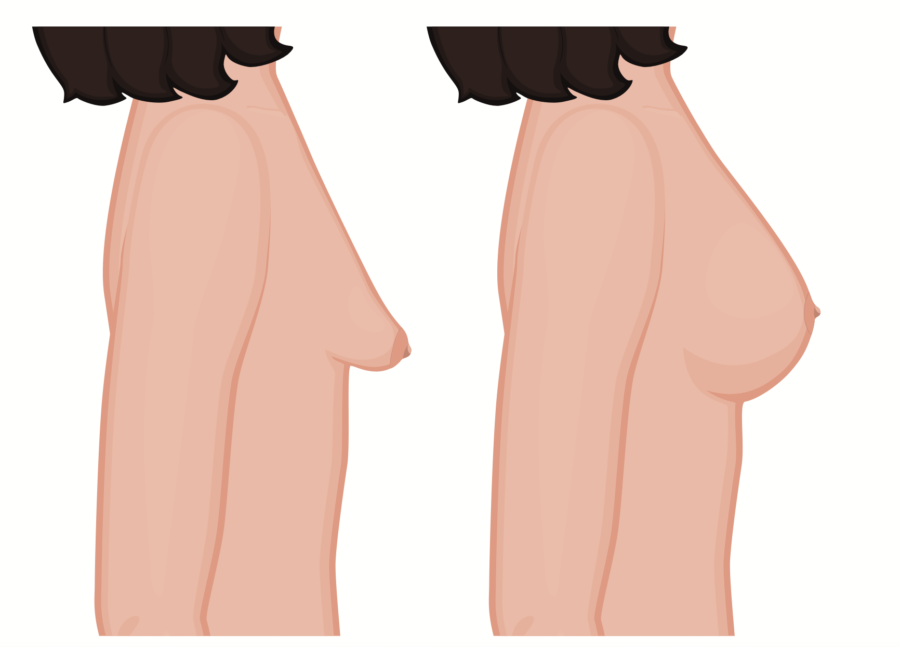
To achieve this, the surgeon releases the fibrous constriction and redistributes the gland, then completes the procedure as needed: breast lipofilling (autologous fat) for moderate deficits and to cover an implant, a breast implant when a large amount of volume is missing, and skin reshaping to lift and reduce the areola. The correction can be combined with a breast lift (normal volumes) or a breast reduction in case of hypertrophy.
04Results, scars and insurance coverage
The result is assessed 3 to 6 months after the operation, once the swelling has subsided: the breasts regain a rounded, symmetrical shape. The scars, visible at first, fade from the 3rd month and become discreet after a year.
Because tuberous breasts are a malformation (and not a purely cosmetic request), insurance coverage by the French national health insurance is possible, particularly for pronounced forms (stages 2-3), significant asymmetries or Poland syndrome; it requires a prior-agreement request approved before the procedure. The out-of-pocket cost is then limited to fee supplements. Without coverage, expect from €6,000; the details are set out in the pricing schedule and insurance coverage.
05How the procedure works
Before the procedure
The correction begins with a consultation at the Rive Droite Paris Étoile practice: a clinical examination to determine the stage and the technique, and answers to any questions — healing being the most frequent concern. The surgeon looks into personal and family history of breast cancer. Before the procedure:
- a mammogram and/or breast ultrasound are prescribed, particularly after the age of 35;
- stop smoking 1 month beforehand, for better healing;
- no aspirin in the 10 days before;
- an appointment with the anaesthetist at least 48 hours before the operation.
During the procedure
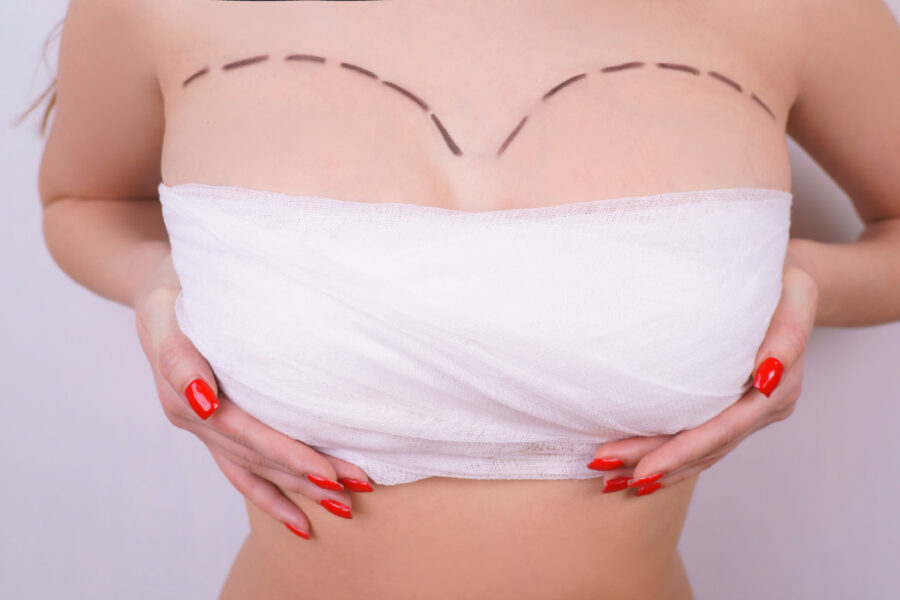
The procedure is performed under general anaesthesia, most often on an outpatient basis, and lasts from 1 hour to 1 hour 30 minutes. After the pre-operative markings, the surgeon proceeds in several steps:
- lowering of the inframammary fold to widen the base of implantation;
- release of the fibrous constriction, which frees the gland and allows it to be redistributed across the whole breast;
- adding volume if needed — an implant and/or lipofilling to cover the implant and project the quadrants;
- skin reshaping to lift and reduce the areola. The incisions are closed with absorbable threads and a sculpting bra-shaped dressing is applied.
After the procedure
Pain, especially when an implant is used, is relieved with painkillers; bruising fades within about a fortnight. A compression bra is worn for a month, with washing using mild soap for the first 15 days and dressings renewed regularly.
Time off work of 5 to 10 days is usual; sport resumes after a minimum of 4 weeks, and sun exposure as well as swimming, sauna and hammam should be avoided for at least 3 weeks. Follow-up visits are scheduled at 7 days, 15 days and then 1 month.
06Prices & fees in Paris
| Procedure | With insurance coverage | Aesthetic fees |
|---|---|---|
| Tuberous breasts, Poland syndrome, breast asymmetry | 3 500 – 4 500 € | 6 000 – 8 000 € |
Indicative “from” prices, surgeon fees included. The final quote is given at the consultation, after examination, depending on the area treated and the technique chosen. Part of the procedure may be covered by French national health insurance when the medical criteria are met.
07Your questions
How do I find out the stage of my tuberous breasts?+
The stage (1 to 3 on the Grolleau scale, up to type IV on von Heimburg) is determined during the clinical examination at the consultation, based on the deficit of the lower quadrants, the shape of the areola and the quality of the skin. It directly guides the corrective technique.
Is tuberous breast correction reimbursed by the French national health insurance?+
Yes, it is possible: as tuberous breasts are a malformation, coverage can be granted, especially for pronounced stages, marked asymmetries or Poland syndrome. It requires a prior-agreement request approved before the operation; see the pricing schedule and insurance coverage.
What is the price of tuberous breast correction in Paris?+
Without coverage, expect from €6,000; when the reimbursement criteria are met, the out-of-pocket cost is limited to fee supplements (from €3,500). The price varies according to the stage and whether an implant or lipofilling is used. Details in the pricing schedule.
Lipofilling or implants to correct tuberous breasts?+
It depends on the stage and the volume available. Breast lipofilling suits mild forms and contour refinement; a breast implant is essential when a lot of volume is missing. The two are often combined for a natural result.
Can tuberous breasts be corrected without an implant?+
Yes, for mild stages (stage 1): glandular reshaping, sometimes supplemented with lipofilling, is enough to restore the shape without an implant.
From what age can tuberous breasts be operated on?+
Once breast development is complete, generally at the end of puberty. The procedure is therefore most often considered from the age of 18.
Are several procedures needed?+
Most often just one. Severe stages (stage 3) may require two stages a few months apart, and lipofilling sometimes calls for an additional session.
Will breastfeeding still be possible after the correction?+
Breastfeeding generally remains possible, as the gland is reshaped rather than removed. This point is discussed at the consultation according to the chosen technique.
Is the result permanent?+
Yes, the result is long-lasting, provided significant weight fluctuations are avoided; a subsequent pregnancy may alter its appearance.