How to choose the best plastic surgeon in Paris
Despite becoming far more common in recent years, undergoing plastic surgery is not a trivial decision to be taken lightly. Choosing the right surgeon for your procedure therefore calls for careful thought and perspective. It affects not only your appearance but also your long-term well-being. To find the best plastic surgeon in Paris, many factors come into play. Skills, experience, qualifications, teaching ability, support throughout the journey… so many parameters to weigh up when making your choice. Here is our advice for benefiting from a premium procedure with natural, discreet and harmonious results.
Contents
Qualifications and credentials: what you absolutely must check
The first essential factor to consider is the practitioner’s academic background and professional qualification. In France, plastic surgery is tightly regulated, and only a surgeon holding a qualification recognised by the French National Medical Council (Conseil National de l’Ordre des Médecins, CNOM) is authorised to perform this type of operation.
Make sure the surgeon holds not only a hospital diploma (a sign of rigorous training in a university setting) but also recognised credentials such as the DES (Diplôme d’Études Spécialisées, the specialist qualification, formerly the DESC) with a specific qualification in plastic, reconstructive and aesthetic surgery. This qualification reflects comprehensive, long training (at least 12 years), covering medicine, general surgery and plastic and reconstructive surgery alike.
Good to know: before any consultation, remember to check the surgeon’s registration number with the Ordre des Médecins as well as any accreditation with the French National Authority for Health (Haute Autorité de Santé, HAS).
Beyond qualifications, membership of learned societies also signals a strong scientific commitment and a desire to continuously update skills and surgical techniques through new methods that are ever less invasive and more refined. The leading bodies in this field include in particular:
- SOFCPRE (the French Society of Plastic, Reconstructive and Aesthetic Surgery);
- SOFCEP (the French Society of Aesthetic Plastic Surgeons);
- SNCPRE (the National Union of Plastic, Reconstructive and Aesthetic Surgery).
Dr Hunsinger, founding president of the Rive Droite Paris Étoile practice in the 17th arrondissement and president of the Centre Chirurgical des Princes (92), has comprehensive, specialised training in plastic surgery, including a DESC in plastic, reconstructive and aesthetic surgery. A member of the board of the SNCPRE and of the SOFCEP, and an active member of the SOFCPRE, he is particularly recognised for his expertise in breast reconstruction and microsurgery.
Dr Henri Derhy and Dr Privé likewise hold a qualification in plastic, reconstructive and aesthetic surgery, along with a specialisation in aesthetic medicine and in restorative dermatological care using the most advanced technologies.
The training of the surgeons at the CERDPE clinic in Paris 17 therefore guarantees you rigorous, professional follow-up throughout the procedure, for discreet and harmonious results.
Experience, case volume and portfolio: the concrete proof
Beyond qualifications and the essential theory to master, you should also look for concrete proof of the practitioner’s practical skill. A well-established surgeon should be able to demonstrate their experience in plastic surgery through a broad range of procedures performed, especially in the field of expertise you are looking for (facial surgery, body-contouring surgery, breast surgery, aesthetic medicine, etc.).
A long track record and the surgeons’ regular practice in both private and hospital settings are positive indicators of how serious the facility is. Their experience and versatility allow them to perform various precision procedures and to manage any complications.
So do not hesitate to ask the practitioner for proof of procedures performed (rhinoplasty, abdominoplasty, breast augmentation, facelift, etc.). A well-stocked portfolio with standardised before-and-after photos (similar lighting and angle) can give you a fairly precise idea of the results that can be achieved. Also look for patient testimonials from people who have gone through a complete care journey.
On the website of the Rive Droite Paris Étoile aesthetic clinic, you will find before-and-after pictures of the main procedures performed, along with approximate price ranges. You will notably see the premium French approach, with balanced volumes, refined contours and discreet, harmonious results. Feel free to contact Dr Hunsinger, Dr Henri Derhy and Dr Privé directly to arrange an initial consultation. They can listen to your expectations and propose a care plan tailored to your goals and your anatomy.
Patient reviews and online reputation: how to interpret them
In 2026, patient reviews and online reputation have become essential elements for assessing how reliable any professional is, and even more so in a medical context. Reviews on Doctolib, on RealSelf (the reference for reviews of plastic surgery professionals), on Doctissimo, or Google Reviews, offer an important first glimpse of a practitioner’s skills and experience. They can reassure a hesitant patient about how a procedure unfolds, about post-operative follow-up and, more broadly, about the level of satisfaction observed against the expected results.
That said, they should not be taken at face value, and it is wise to keep a certain perspective on online ratings. Between fake reviews, impulsive comments and isolated hateful attacks, it can sometimes be hard to form an objective opinion about a clinic or a surgeon. So be wary of reviews that are too uniform, lacking nuance, lacking context and vague about the various stages of the procedure.
Favour authentic, verified reviews that provide detailed feedback on the procedure. Reviews on Doctolib, in particular, are based on genuine past experiences. Reviews should also be numerous and varied enough to truly reflect the practitioner’s quality. A dozen unanimous five-out-of-five-star reviews is therefore far from a guarantee of reliability. Less happy experiences are virtually inevitable across a large number of procedures.
A professional’s seriousness is also measured by their ability to respond to dissatisfaction and to ensure patient follow-up even after the procedure. Responses to comments can therefore also give you valuable information about a facility’s practices and its follow-up after the procedure.
Among the plastic surgery professionals in Paris, the surgeons at the CERDPE practice, Dr Hunsinger, Dr Privé and Dr Henri Derhy, enjoy a very good online reputation. The many patient comments praise in particular their availability, their attentiveness and their teaching approach. Their clear explanations and their support throughout the procedure help to reassure patients faced with procedures that may seem intimidating at first. Patients especially commend the harmonious results achieved with a measured, restrained approach for a natural French style.
The consultation: the decisive moment to assess your surgeon
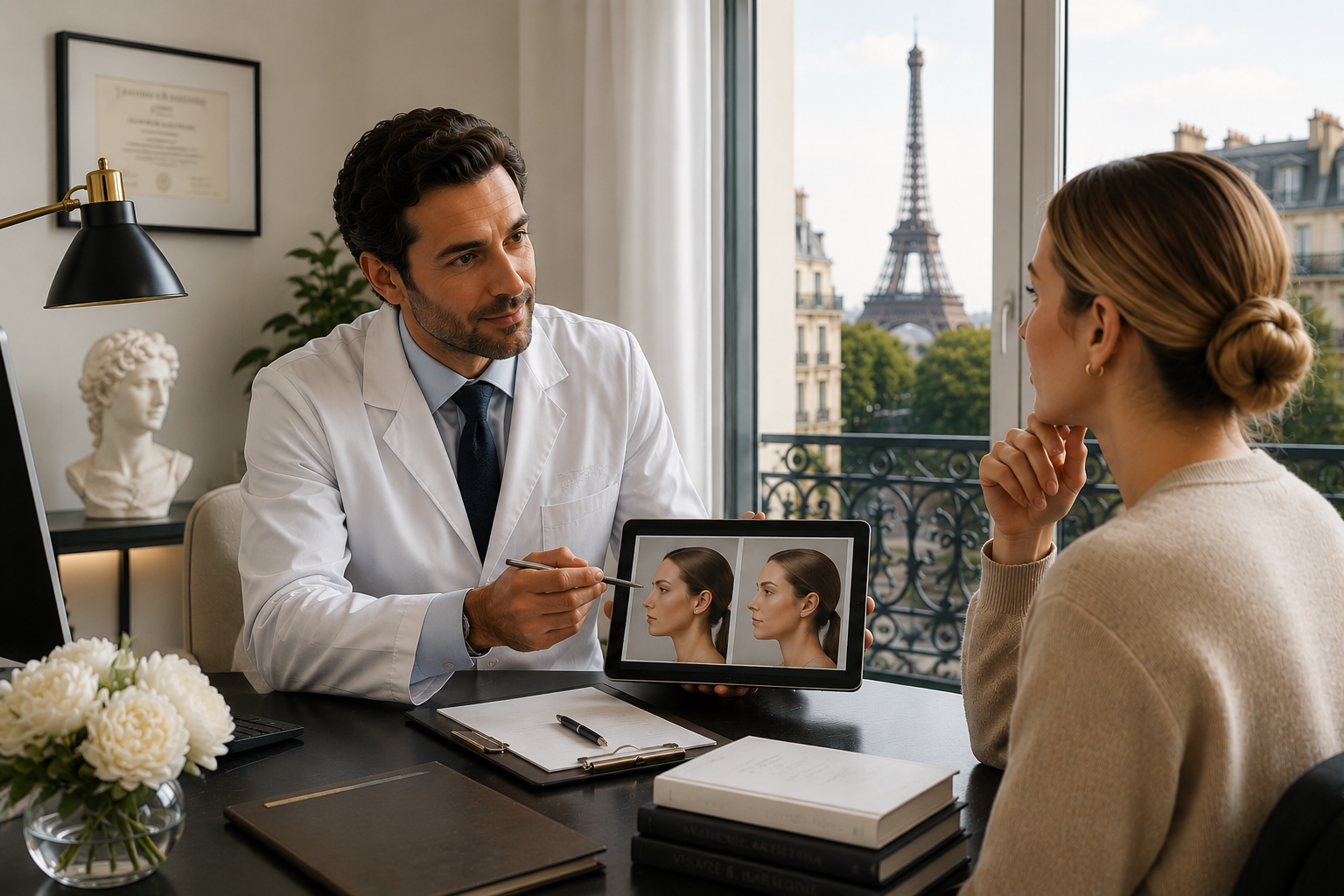
Once you have settled on a surgical professional, the consultation is the final step that confirms or disproves your first impression. It is the key moment when the practitioner is fully attentive to your expectations, your goals and also your concerns. A competent professional takes the time to analyse your anatomy and to guide you towards realistic treatment options. A good surgeon must therefore be able to say « no » to excessive requests that are unsuited to the patient’s profile, or at the very least advise against them.
Following the diagnosis and the discussion with the patient, the practitioner recommends a precise treatment plan that reconciles the patient’s expectations with their anatomical constraints. They detail in particular the results that can be achieved, the specifics of the procedure, the associated risks and the pre- and post-operative recommendations. Serious facilities generally have sophisticated tools so that patients can visualise their future appearance (3D simulation, trial sizers, AI-assisted 2D morphology analysis, etc.).
At the Rive Droite Paris Étoile aesthetic practice, very close to the Arc de Triomphe, you can benefit from personalised consultations in a premium setting conducive to discussion and discretion. You will be free to ask any question that comes to mind or to share any legitimate concerns, in complete confidentiality.
Dr Hunsinger, Dr Privé and Dr Henri Derhy will listen to your expectations and will detail the care protocol to consider based on your observations, how the procedure unfolds and any possible complications. This caring, educational approach is part of a measured, restrained philosophy whose guiding principle is to achieve natural and harmonious results.
The clinic matters as much as the surgeon (Clinique des Princes)
A good plastic surgeon goes hand in hand with a high-quality, fully secure operating environment. Procedures must be performed in a certified clinic, preferably accredited by the French National Authority for Health (HAS), with modern operating theatres and perfectly sterilised equipment. The operation is also a team effort, with the essential role of the anaesthetist, who must be consulted before the procedure.
Dr Vincent Hunsinger, Dr Privé and Dr Henri Derhy operate in recognised facilities, with nursing staff fully qualified in aesthetic, plastic and reconstructive medicine and surgery, and an anaesthetist–intensivist constantly present. As president of the Clinique des Princes in Boulogne, a highly regarded establishment in the Hauts-de-Seine, Dr Hunsinger also has a perfect knowledge of the facility where most operations take place. You will therefore be in good hands for a procedure with high standards of comfort and safety.
The 5 warning signs you should never ignore
In Paris 17 as anywhere else, caution remains essential when it comes to choosing a professional for a plastic surgery procedure. Here are five things that should raise a red flag about a practitioner’s professionalism:
- The absence of qualifications (DES) or credentials recognised by the CNOM in plastic surgery. For example, an aesthetic doctor who performs injections should not be confused with a plastic surgeon, the latter being the only one authorised to perform surgical procedures;
- Low-cost prices that are too good to be true: safety and expertise come at a cost. Behind very attractive prices often lie inadequate support, a lack of attentiveness, equipment that is not always up to standard, or results far from patients’ expectations. Be wary, too, of vague prices that may hide extra charges. The practitioner must indeed give you a very detailed quote for the entire surgical procedure;
- Promises of spectacular results completely disconnected from the patient’s original anatomy are a poor indicator of a surgeon’s seriousness. The same goes for a practitioner who downplays the risks of complications and potential side effects;
- A lack of transparency about the clinic where the procedure will take place, or hazy information about the practitioner’s track record (portfolio unavailable or apparently retouched). Even though online reviews should be treated with a degree of perspective, a large number of negative reviews on recurring topics is also a major warning sign that should prompt you to seek out other professionals;
- A sense of being rushed: if you feel pressured to schedule the operation, take the time to reflect and to seek other opinions. A good surgeon does not need to force a patient’s hand and should, on the contrary, show attentiveness, patience and a willingness to explain. Aggressive advertising is likewise not a reassuring sign of an establishment’s reputation, especially in such a specialised field.
Feel free to reach out to the surgeons at the CERDPE practice in the 17th arrondissement of Paris for an initial consultation, in full transparency and discretion, to potentially consider a future procedure.
Medical tourism: the hidden risks of surgery abroad
Medical tourism is an increasingly widespread practice for those who want to save money on their surgical procedure. While there are also many competent surgeons abroad, the risks of such a practice are nonetheless far from negligible.
Between sometimes lower hygiene standards, complications that are harder to manage (particularly in a foreign language), and legal recourse that is virtually non-existent, the dangers of medical tourism can quickly make you regret the money saved.
The other major drawback of this approach lies in post-operative follow-up, which is often absent and, in any case, very difficult to carry out remotely. Should a problem arise, it will then be quite tricky to find a professional in France willing to « repair » the damage caused by poor healing, an infection or a necessary touch-up. On top of the medical risks, you could then have to undergo a further procedure if the results are too far from your expectations, and therefore potentially bear substantial additional costs.
Turning from the outset to a professional French establishment such as the CERDPE practice guarantees you peace of mind through comprehensive, personalised support in a reassuring and regulated setting. Our recognised, experienced surgeons guarantee a premium, restrained approach for a natural French style with harmonious results, thanks in particular to long-term post-operative follow-up.
FAQ
How can I check a plastic surgeon’s qualification?
Check their qualification on the website of the French National Medical Council (CNOM). The mention of the specialty « plastic, reconstructive and aesthetic surgery » should appear, along with their identification number in the RPPS register. You can also look into their contributions to the various learned societies (SOFCPRE, SOFCEP, SCPRE).
What are the differences between an aesthetic doctor and a plastic surgeon?
A plastic surgeon holds a specialist qualification (DES) in surgery that allows them to perform most plastic surgery procedures (rhinoplasty, liposuction, bodylift, etc.). An aesthetic doctor does not necessarily hold this qualification, which limits their scope to non-invasive treatments (botulinum toxin injections or hyaluronic acid injections, chemical peels, lasers, etc.).
How many consultations are needed before the operation?
It depends on the type of procedure, but at least two consultations are generally recommended to confirm your rapport with the surgeon and to fine-tune the various parameters of the procedure. A consultation with the anaesthetist will also be necessary before the procedure.
Why choose the Rive Droite Paris Étoile clinic in the 17th?
This clinic, located near the Arc de Triomphe, stands out for its measured approach to plastic surgery and its premium vision of beauty. Its renowned surgeons (Dr Hunsinger, Dr Henri Derhy and Dr Privé) guarantee a personalised, highly secure procedure and harmonious, natural results, a world away from standardised procedures.
Book an appointment
If you are considering a procedure, book an appointment in just a few clicks: our surgeons will answer all your questions and guide you toward a tailored, personalised solution.
Book on Doctolib