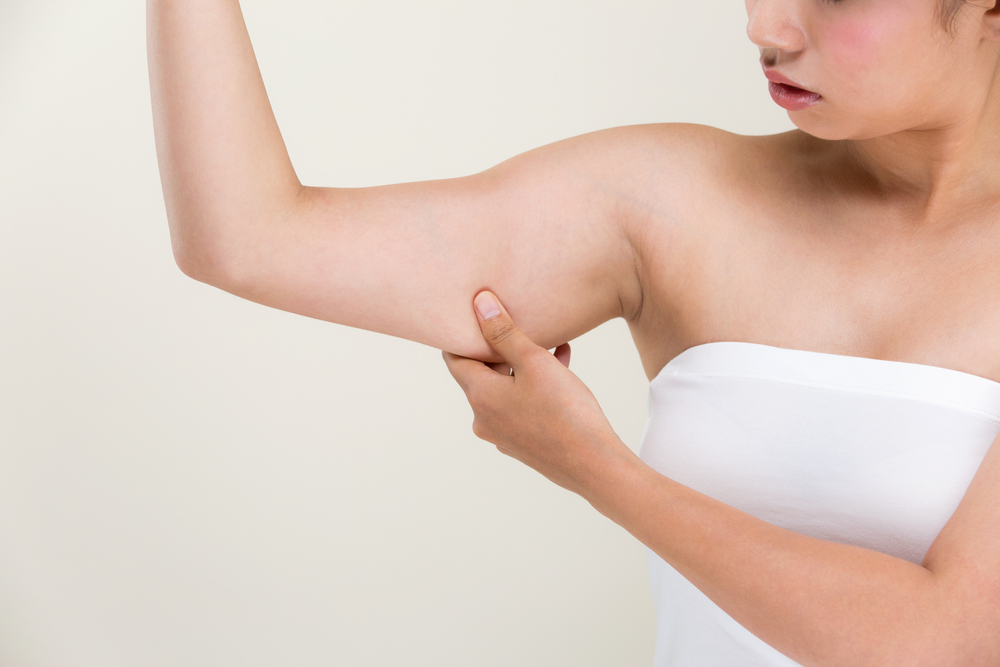
Sagging arm skin: how to restore beautifully toned arms
With age, sagging arm skin becomes increasingly visible and affects a great many people. When the skin on the inner arm starts to droop, crease or look crepey, it becomes a real source of self-consciousness — particularly for women, when warmer weather arrives and it is time to wear short sleeves or head to the beach. The good news: between aesthetic medicine and surgery, there is now a solution suited to every situation. Radiofrequency, focused ultrasound, micro-needling, injections, cryolipolysis, liposuction or an arm lift — here, jargon-free, are all the options for tightening the skin of the arms and restoring beautifully toned arms.
Contents
Crepey or creased arm skin: what to do first?
Before considering a medical or surgical procedure, it helps to understand what type of laxity you are dealing with, because the solution is not the same in every case:
- Mild to moderate laxity (skin that creases or crinkles slightly, with good overall tone) responds well to non-invasive aesthetic-medicine techniques and to good day-to-day habits.
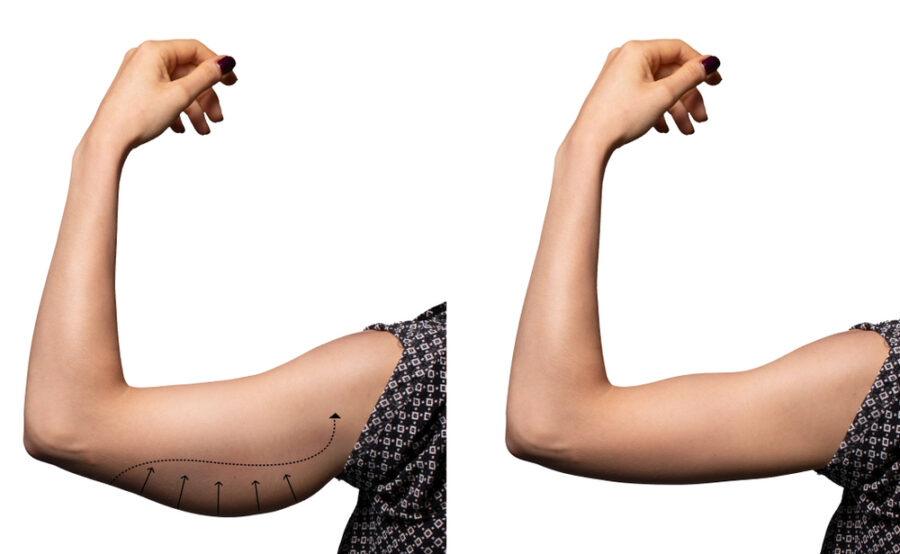
- Marked laxity, with excess skin that droops noticeably (the well-known « bat-wing effect ») and/or established fat deposits, usually calls for surgery to achieve a lasting result.
In every case, only a consultation can assess the quality of the skin, its capacity to retract and the amount of fat involved. It is this assessment that points to the right technique — non-surgical where possible, surgical where necessary.
Why does the skin on the arms sag?
A natural phenomenon, skin laxity develops gradually over the years: the skin loosens in several areas of the body, including the face, the neck, the thighs, the belly, where the skin also becomes crepey and, of course, the arms. It is explained above all by the distension of the connective tissue located between, on one side, the organs and blood vessels and, on the other, the skin tissues. This tissue tends to thin and retract, causing a reduction in elastic fibres and a decline in collagen production, which are responsible for the slack, crepey appearance of the skin.
This ageing process is far from trivial: according to dermatology research, the skin loses on average about 1% of its collagen per year from the late twenties onwards, a decline that then accelerates (Varani et al., Journal of Investigative Dermatology, 2006). In women, the hormonal drop of menopause markedly amplifies the phenomenon: the literature estimates that up to around 30% of skin collagen may be lost during the first five years following menopause. This is one of the reasons the skin on the arms often becomes crepey faster from the fifties onwards.
This mechanism is made worse by several factors: repeated weight fluctuations, sun exposure and smoking. Over time, the skin takes on a slack appearance which, in the most marked cases, forms folds considered unsightly. Localised fat excess can further accentuate this withered look and prove very hard to remove despite dieting. Regular physical activity sometimes restores some tone; in other cases, only surgery or aesthetic medicine can remove the excess skin and fat and re-drape the skin.
Firming the arms day to day: the right reflexes
Certain habits help slow skin ageing and maintain the contour of the arms. While they are not enough to erase established laxity, they remain the first line of defence and a valuable support after a treatment:
- Regular physical activity, targeting triceps strengthening, to tone the muscles and limit the withered look.
- A healthy, balanced diet, rich in protein, to maintain a stable body weight and support collagen synthesis.
- Moderate sun exposure and the use of suitable sun protection, the sun being one of the leading causes of skin ageing.
- Quitting smoking, which accelerates the breakdown of elastic fibres.
- Daily moisturising of the skin with a suitable cream to protect it from external aggressions.
These reflexes act mainly as prevention: on skin that is already crepey or creased, neither cream nor exercise truly « tightens » distended skin. This is where medical techniques come in.
Tightening the skin of the arms without surgery: aesthetic medicine
Beyond day-to-day habits, aesthetic medicine offers several solutions to tighten the skin of the arms without surgery and soften the signs of time on the upper limbs. They are suited to mild to moderate laxity.
Radiofrequency
Radiofrequency to firm the arms restores tone by restructuring the existing collagen and elastin fibres to make them denser and firmer, which tightens the skin. It also stimulates the production of new fibres to visibly rejuvenate the skin and, through a thermal effect, reduces fat content by making the adipocytes more permeable (a lipolysis phenomenon), softening the orange-peel look.
High-intensity focused ultrasound (HIFU)
This non-invasive treatment uses ultrasonic energy beneath the epidermis of the inner arm. An acoustic wave precisely targets the area to be treated; brief bursts of heat, at different depths, prompt the fibroblasts to produce more collagen and elastin for firmer, more toned skin. Focused ultrasound also acts on the deep fat cells of the hypodermis, which are gradually eliminated by the body. It is a well-mastered method, with very little downtime and results that settle in over the months following the session.
Micro-needling and fractional radiofrequency
Micro-needling, like mesotherapy, involves creating micro-perforations with an electric pen to generate new fibroblasts, before applying a serum enriched with vitamins and hyaluronic acid. When it is combined with radiofrequency — as with the Morpheus 8 device, which pairs micro-needling with fractional radiofrequency — the collagen-stimulation effect is reinforced to tighten the skin at depth.
Injections of collagen inducers and hyaluronic acid
Tissue inducers work by injecting poly-L-lactic acid (PLLA), which promotes a rebuilding of collagen and the formation of new fibres, creating a supportive mesh beneath the skin. The skin is naturally and discreetly toned, the skin texture improves and irregularities fade. The best-known products are Sculptra® and Radiesse®. The effect is gradual (two sessions are generally needed) and temporary (up to about two years). A hyaluronic acid injection in the arms can additionally improve skin density and provide a slight tightening effect, though with a result that is less natural than collagen inducers.
« Botox » for the arms: who is it for?
Contrary to a common belief, botulinum toxin does not tighten the skin and does not treat sagging arm skin: it acts on the muscle, not on distended skin. It is reserved for very specific indications, such as hyperhidrosis (excessive sweating) of the armpits. To restore tone to a crepey or creased arm, it is radiofrequency, ultrasound, collagen inducers or surgery that are indicated — not Botox.
While all these techniques can prove effective on moderate laxity, they are only suited to those profiles. In cases of pronounced loss of contour or significant excess skin, only plastic surgery can deliver notable, lasting results.
Plastic surgery: a lasting result against drooping arms
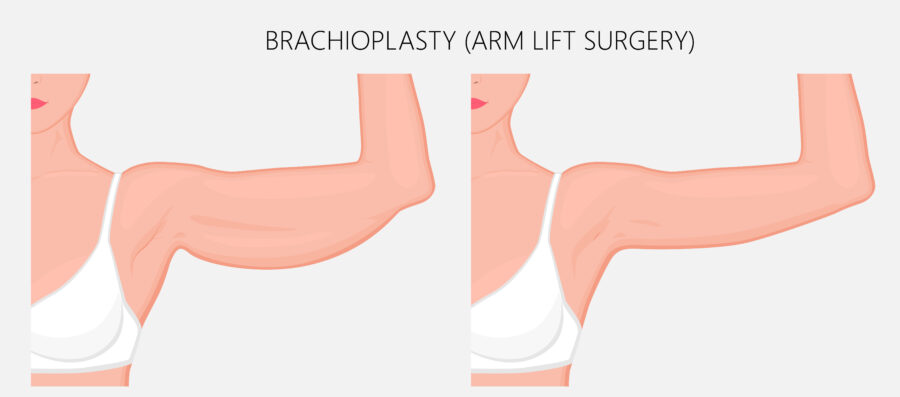
An arm lift, or brachioplasty, is the procedure best able to produce a definitive result against sagging arm skin. This operation, although common and well mastered, is not trivial and should be carefully considered.
It is also one of the best-accepted body-contouring procedures: the international literature reports high satisfaction rates — on the order of 80% of patients satisfied after brachioplasty (Cintra Junior et al., 2014), with a 2024 study even rating the result « excellent » in more than half of cases. The honest nuance to be aware of: this satisfaction holds despite the scar on the inner arm, which most patients report accepting in exchange for a toned arm. The scar is the true trade-off of this surgery: it fades over time but remains the element to anticipate carefully.
Who is arm surgery for?
Anyone bothered by the distended appearance of their arms can turn to plastic surgery of the arms. This laxity, visible at the triceps, affects men and women alike, even if women often find this « bat-wing effect » particularly hard to live with: discomfort wearing short sleeves, a vest top or a swimsuit.
When dietary rebalancing or toning exercises are no longer enough to remove the crepey look of the arms, an arm lift (or brachioplasty) becomes the best solution. It helps to retone the arms and re-tension the skin tissues discreetly, with scars concealed on the inside or under the arm.
The scarless arm lift with Renuvion (J-Plasma)
The scarless arm lift with Renuvion J-Plasma allows skin re-tensioning without skin resection. The device combines radiofrequency and helium plasma: under the thermal effect, the treated tissues contract and the skin firms, using a fine cannula introduced in a minimally invasive way. This technique requires moderate laxity and is not suitable after massive weight loss. The scarless arm lift with Renuvion is performed in the operating room, under general anaesthesia, and can be combined with liposuction for greater effectiveness.
The arm lift with a longitudinal scar
This is the most effective and most lasting procedure for permanently re-tensioning the arms. The brachioplasty is most often performed under general anaesthesia, sometimes under local anaesthesia depending on the conditions agreed with the surgeon. Relatively quick (30 to 40 minutes for the liposuction, 1 hour to 1 hour 30 for a full lift), it regularly requires a one- to two-day hospital stay; an outpatient procedure (discharge the same evening) is sometimes possible. The duration depends on how extensive the procedure is: a simple liposuction is often done on an outpatient basis, whereas combining it with a lift requires an overnight hospital stay.
The brachioplasty takes place in two stages:
- Removal of fat deposits by liposuction;
- Resection of the excess skin on the inner arm.
This second stage is not systematic if the skin retains a good capacity to retract.
Liposuction of the arms
In practice, the brachioplasty begins with fine 3 to 4 mm incisions on the inner side or under the arms in order to perform liposuction of the arms, carried out using fine, round-tipped cannulas. A vasoconstrictive and anaesthetic solution is applied beforehand to limit bleeding and bruising. The aspiration is conducted in a slow, even manner to avoid irregularities and folds, following the curves of the muscles (biceps, triceps).
The surgeon assesses the amount of fat to remove according to the quality of the skin. Where the fat is extracted, a new bond forms between the elastic fibres and the connective tissue, which appreciably improves the quality and elasticity of the skin.
The arm lift with skin resection
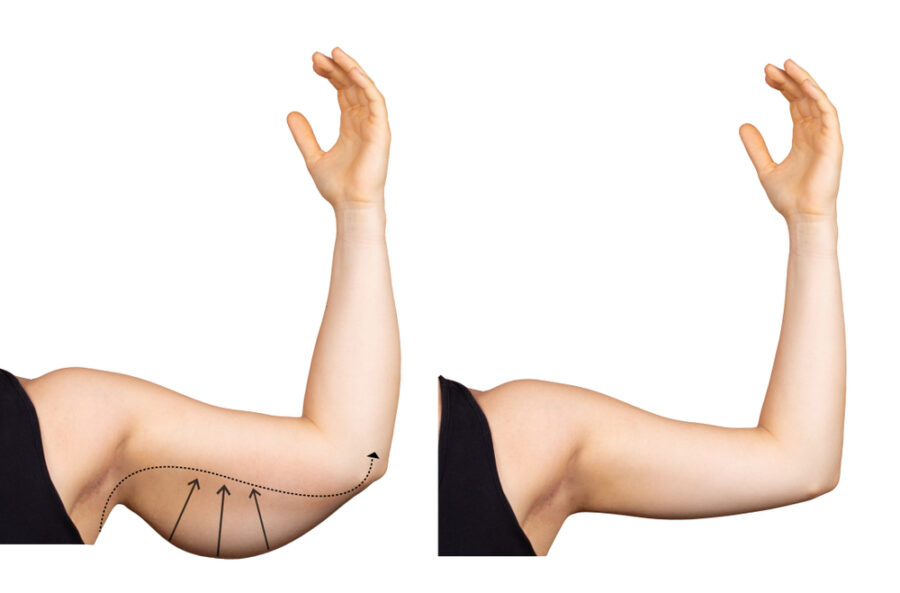
If the skin cannot retract because of laxity that is too pronounced, the surgeon performs an arm lift with resection of the excess skin tissue. A vertical scar on the inner arm is then made. The brachioplasty re-tensions the skin and firms the tissues: the arms regain a toned shape that is more harmonious and even.
Recovery after an arm lift
As with most plastic-surgery procedures, an arm lift can cause bruises and ecchymoses, which usually fade within about two weeks. Temporary disturbances of sensation are sometimes felt in the first weeks; drainage and physiotherapy sessions help limit them. Some pain comparable to muscle soreness may be bothersome during the first 24 hours and is relieved with painkillers. More pronounced fatigue may also occur.
In the first days, or even the first weeks, excessive effort must be limited — sport and heavy lifting — to properly consolidate the healing. The simplest everyday activities are resumed quickly, since the brachioplasty does not require a prolonged time off work.
Healing and results
After the operation, a compression garment (arm sleeves) must be worn for 3 to 4 weeks to aid compression, resolve the swelling and encourage skin retraction. The swelling generally takes longer to disappear than for another area treated by liposuction: it can persist for a few weeks, begin to subside between 4 and 6 weeks and disappear between 3 and 6 months depending on the patient. The results become final from that point, even if the first effects are noticeable from the third week.
The healing is the subject of regular follow-up by the surgeon in the weeks and months that follow. The scar remains visible on the inner arm for a fairly long period (8 to 12 months), then gradually whitens to become less and less apparent. In the event of imperfections (asymmetry, irregularities, insufficient correction linked to weight fluctuations), touch-ups are possible on an outpatient basis, observing a 6-month interval after the procedure.
Sagging arms are not inevitable, but no single solution is universal: it is the quality of your skin and the extent of the excess skin that determine the best option. Dr Vincent Hunsinger holds consultations at the Rive Droite Paris Étoile practice to assess your situation and guide you towards the most suitable technique, from simple medical firming to an arm lift.
Frequently asked questions
How can I tighten crepey arm skin without surgery?+
For mild to moderate laxity, aesthetic-medicine techniques can tighten the skin of the arms without surgery: radiofrequency, high-intensity focused ultrasound (HIFU), micro-needling combined with fractional radiofrequency or injections of collagen inducers. All of them stimulate the production of collagen and elastin to gradually firm the skin. Day to day, targeted triceps exercise, good hydration and quitting smoking help maintain the result. However, neither creams nor exercise are enough to erase excess skin that is already established.
How can I firm the skin of the arms after 60?+
After 60, the skin has lost a significant share of its collagen and its capacity to retract is often reduced. Medical treatments (radiofrequency, HIFU, collagen inducers) remain useful for moderate laxity, but when the skin droops noticeably, it is generally the arm lift (brachioplasty) that offers the most lasting result. A consultation makes it possible to assess the quality of the skin and choose between a medical and a surgical solution.
Which cream for crepey arms?+
No cream truly « tightens » distended skin. A quality moisturiser, possibly enriched with retinol, hyaluronic acid or vitamin C, improves suppleness and skin texture and is a useful support for prevention, but its action remains superficial. On arms that are already crepey or creased, only medical or surgical techniques act deeply on the collagen and the excess skin.
Can Botox treat arm laxity?+
No. Botulinum toxin acts on the muscle, not on distended skin: it therefore does not tighten the skin and does not correct sagging arm skin. In the arms, its indications are very specific, such as treating excessive sweating (hyperhidrosis) of the armpits. To restore tone to a crepey arm, the options are radiofrequency, ultrasound, collagen inducers or surgery.
How can I get rid of drooping skin under the arms (bat-wing effect)?+
The « bat-wing effect » corresponds to excess skin, often associated with fat, on the inner side of the arm. When this excess is marked, non-invasive treatments are not enough: the arm lift (brachioplasty), sometimes combined with liposuction, removes the surplus skin and re-tensions the tissues for a lasting result. For milder laxity, re-tensioning with Renuvion or an aesthetic-medicine protocol may be considered.
Does an arm lift leave a scar?+
Yes, when a skin resection is necessary, the arm lift leaves a scar on the inner arm. It is deliberately placed to remain as discreet as possible, stays visible for 8 to 12 months, then whitens and gradually fades. International studies show that the vast majority of patients accept this scar in exchange for a toned arm. When the laxity is moderate, the scarless arm lift with Renuvion (J-Plasma) makes it possible to avoid this scar.
Book an appointment
If you are considering a procedure, book an appointment in just a few clicks: our surgeons will answer all your questions and guide you toward a tailored, personalised solution.
Book on Doctolib