Lip lift (upper lip lift): techniques, scar and price
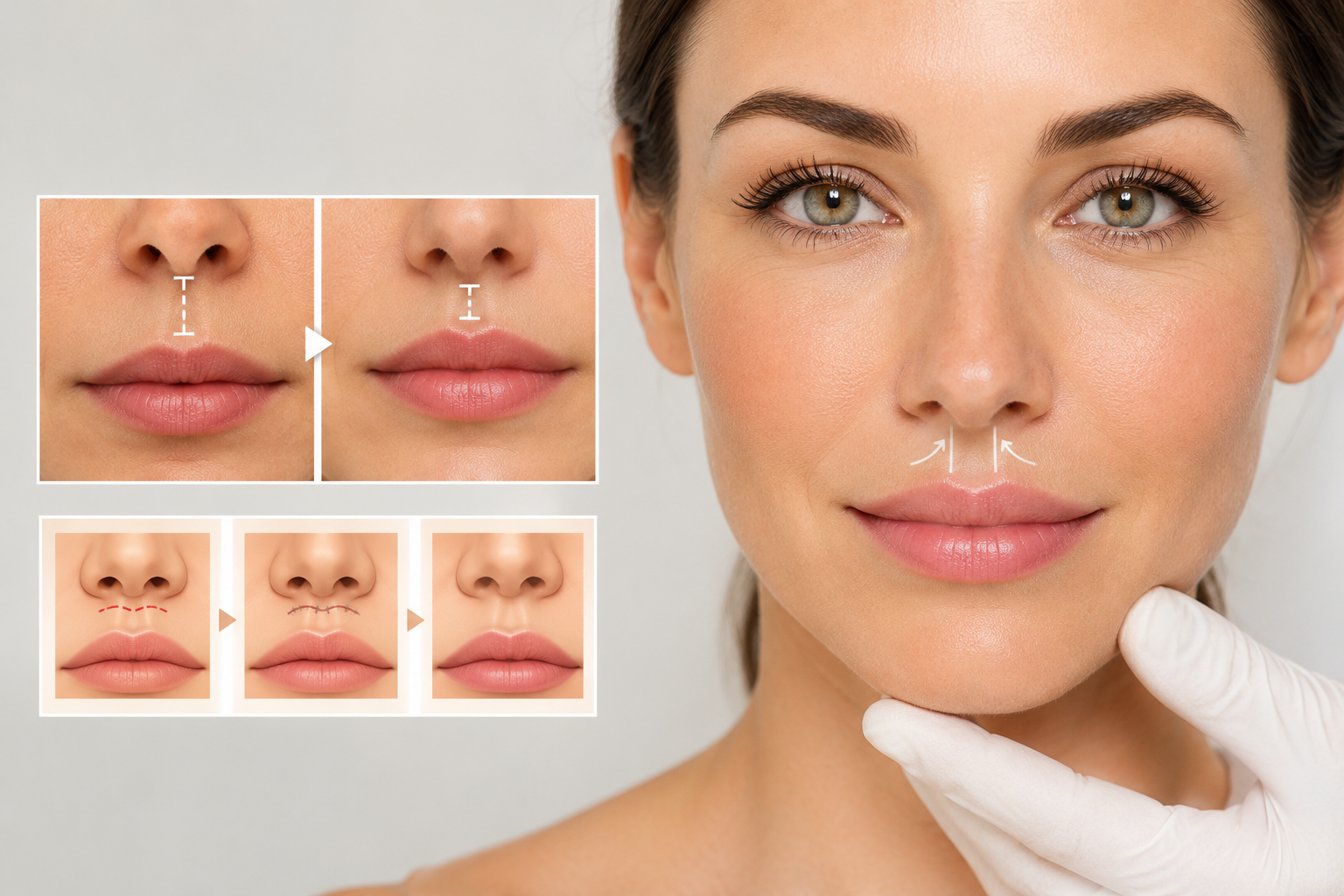
A lip lift (or upper lip lift) removes the excess skin between the nose and the upper lip (the philtrum), which is responsible for the thinning of the red lip. This surgical procedure, which shortens the white lip, durably redefines the vermilion border and restores the Cupid’s bow for an immediate rejuvenation of the smile. Performed as day surgery under local anaesthesia, it takes 30 to 45 minutes and costs between €2,500 and €4,000 in Paris.
Contents
What is a lip lift, and why does the upper lip get longer?
An upper lip lift is a surgical procedure that shortens the distance between the base of the nose and the vermilion (also called the red lip), which is the coloured, visible part of the lips. This area, known as the white lip or philtrum, gradually lengthens over time under the natural effects of gravity and skin ageing. This lip ptosis can be explained in particular by several factors:
- a loss of elasticity combined with laxity of the skin around the mouth (perioral tissues);
- a loss of tone in the orbicularis oris muscle, which keeps the lips projecting forward;
- gradual resorption of the maxillary bone;
- sun exposure and smoking, two aggravating factors.
As it sags, the skin tends to roll inwards towards the mouth, which blurs the border with the red lip. Thanks in particular to the removal of the excess skin, a lip lift can then shorten the white lip and restore, without excess, the Cupid’s bow (the M-shaped double curve above the upper lip), bringing the lower third of the face back into harmony.
Upper lip lift: who is it for? The criteria for a good indication
Although everything depends on each patient’s anatomical characteristics, a lip lift is generally considered appropriate once the distance between the base of the nose and the red lip is greater than 15 millimetres. Beyond this distance, the red lip becomes less visible, as do the incisors, which show less and less when smiling, giving the face a sadder, more austere look. Generally speaking, a lip lift is therefore recommended for patients with one or more of the following indications:
- an overly long white lip (more than 15 mm between the columella and the upper edge of the red lip);
- a red lip that has become too thin;
- a loss of definition of the philtrum;
- incisors that no longer show when smiling or at rest, giving a sad appearance;
- an asymmetry between the upper lip and the lower lip (whether genetic or not), when the lower lip is more than a third larger than the upper lip (the normal ratio);
- fine vertical perioral lines that have appeared above the upper lip, around the philtrum.
It is the surgeon who, after assessing the patient’s face, will recommend the procedure or not, taking into account the specific features and proportions of the face (size and shape of the columella or nostrils, skin quality, etc.).
Good to know: a lip lift can sometimes be combined with a facelift (face and neck lift) for a more global rejuvenation of the face. It is, however, contraindicated in patients with a pronounced gummy smile, as it could make it more noticeable.
Bullhorn, subnasal, corner lift: lip lift techniques
An upper lip lift can be performed using several techniques, depending on the practitioner’s diagnosis and the patient’s anatomical characteristics. Here is a comparison table of the different methods, with the type of incision made, the indications for each procedure and the characteristics of the scar:
| Technique | Shape and position of the incision | Main indications | Scar characteristics |
| Bullhorn lip lift (or subnasal lip lift) | Incision right along the base of the nostrils, hidden under the columella (bullhorn-shaped incision) | For an overall lengthening of the white lip (the most commonly performed technique) | Very discreet scar following the contours of the base of the nose and the columella (subnasal crease) |
| Direct lip lift (or direct excision) | Just above the vermilion, along the border with the red lip | To treat severe sagging of the mouth (particularly in older patients) or specific cases (major asymmetry, pinched lips) | Visible and directly apparent (rarely used) |
| Corner lip lift (or lifting the corners of the mouth) | At the corner of the mouth, at the lip commissure | For sagging confined to the corners of the mouth | Very short, very discreet scar in the crease of the lip commissure |
| Central lip lift | Under the columella only | For moderate ptosis localised to the centre of the lip (with no effect on the nasal alae) | Very short scar centred on the nostril sill |
From consultation to theatre: how a lip lift is performed
At the Rive Droite Paris Étoile practice in the 17th arrondissement, choosing the technique and carrying out a lip lift follow a protocol in several steps:
- A first consultation with one of the qualified specialist surgeons of the Rive Droite Paris Étoile practice (Dr Hunsinger, Dr Derhy or Dr Privé): it is used to understand the patient’s expectations and to analyse their facial characteristics (degree of laxity of the orbicularis muscle, length of the white lip, nose-to-lip distance, width of the nostrils, proportions, etc.). It also determines how large a crescent of skin should be removed;
- At the end of the consultation, the surgeon gives the patient a quote setting out precisely the different costs of the procedure. The patient must then observe a mandatory cooling-off period of at least 15 days, during which the procedure cannot take place;
- A second pre-operative consultation is very often offered, during which the surgeon explains the instructions to follow (stopping smoking several weeks before and after the procedure, stopping certain painkillers such as aspirin and anti-inflammatory drugs 10 days before and after the operation, etc.);
- An appointment with the anaesthetist is scheduled no later than 48 hours before the operation;
- On the day of the procedure, the surgeon makes a very precise pre-operative drawing, which serves as the guide for removing skin from the white lip (generally 5 to 9 mm depending on the case). Removing the strip of excess skin turns the upper lip outwards, redefining its contours and making it fuller. At the end of the operation, very fine sutures are placed at different points so that the skin does not pull. Absorbable sutures are generally not used, to ensure very discreet healing. The procedure is performed under local anaesthesia, with possible sedation, and lasts between 30 and 45 minutes. Patients leave the clinic the same evening (day surgery).
Recovery: what to expect day by day
Recovery after a lip lift is relatively mild, and patients get back on their feet fairly quickly. They must nevertheless follow a set protocol during their recovery, according to the following timeline:
- Day 0: on the day of the procedure, swelling appears, and applying ice is recommended to reduce it. Some discomfort and tightness may be felt. Pain can be relieved with painkillers. Petroleum jelly should be applied to the scar for about a week. A soft, lukewarm diet is recommended for a few days to limit chewing and mouth movements that could hinder healing;
- Day 5: the surgeon removes the stitches at the practice. Bruising may appear, and the swelling is still visible although less pronounced. Plan for social downtime until at least day 7;
- Days 7 to 10: end of social downtime. Swelling and bruising gradually fade, even though the lip remains sensitive and swollen. Social activities can be resumed gradually, and the scar can be hidden with make-up;
- Day 21: at 3 weeks, the residual swelling goes down markedly until it is practically invisible. The tissues soften, and more strenuous activities can be resumed.
Scar and results: how the lip evolves month by month
A scarless lip lift does not exist. Any surgical procedure involving skin removal inevitably leaves a more or less visible mark. Sutures placed by an experienced surgeon, however, greatly reduce its visibility, particularly with a bullhorn incision, which blends into the contours of the base of the nostrils and the columella. Here again, the scar evolves according to a fairly precise timeline:
- the 1st month: a pinkish, firm scar, still slightly raised;
- between the 2nd and 3rd month: a scar that is starting to mature and becomes paler and paler. The appearance is close to the final result as the swelling disappears;
- between the 6th and 12th month: the scar turns white. This is known as scar maturation. It is then extremely fine and hard to see with the naked eye, except up close. The red lip is plumper and the Cupid’s bow redefined, rejuvenating the smile thanks in particular to a subtle display of the teeth at rest.
Throughout the healing process, SPF 50+ sun protection is essential to prevent pigmentation problems.
Risks, complications and “failed lip lift”: prevention and correction
Although rare, complications can occur after a lip lift, as with any surgical procedure, including:
- lip asymmetry between the left and right sides of the white lip;
- a hypertrophic scar or widened scar: this can result from not following the pre- and post-operative instructions (stopping smoking in particular) or from excessive tension on the sutures;
- slightly widened nostrils when the incision extends too far into the nasal alae;
- a temporary loss of sensation in the upper lip (it usually resolves on its own within a few weeks);
- an over-shortened white lip due to excessive skin removal, which can then lead to a gummy smile;
- minor bleeding at the incision during the first few days, which can lead to infection;
- an overly visible scar that is poorly positioned.
Thanks to a measured approach, without excess, every qualified plastic surgeon at Rive Droite Paris Étoile does everything possible to prevent the risk of a failed lip lift. Several precautions are scrupulously observed:
- limited skin removal (no more than 9 mm);
- a controlled technique that always favours elegance, discretion and patient safety over overly obvious corrections;
- an in-depth consultation to choose the technique best suited to the patient’s anatomy;
- a dialogue with the patient based on listening and clear explanations, avoiding false promises about the results to expect from the operation;
- experienced, qualified surgeons who are active members of the main learned societies in surgery (notably the SOFCPRE);
- detailed pre- and post-operative instructions, systematically given to each patient well before the date of the procedure.
For a failed lip lift performed by a surgeon outside Rive Droite Paris Étoile (overcorrection or unsightly scarring), our specialists may be able to perform a surgical scar revision or a revision graft. To do so, at least 6 to 12 months should be allowed for the scar to stabilise fully.
Lip lift, lip flip or hyaluronic acid: how to choose?
The lips can also be corrected with aesthetic medicine (particularly for those who wish to avoid surgery), through:
While these techniques have certain advantages (non-invasive, no social downtime needed), they cannot address every issue related to lip laxity and perioral ageing. No injection can, for example, shorten an upper lip that is too long.
Here is a comparison table of what a lip lift offers compared with injectable aesthetic-medicine alternatives:
| Type of procedure | Lip lift | Hyaluronic acid injection (Russian Lips) | Botulinum toxin injection (lip flip) |
| Desired effects and results | – Surgical shortening of the white lip;
– Redefinition of the Cupid’s bow |
– Increased volume of the red lip (vermilion);
– Correction of an asymmetry |
– Relaxation of the orbicularis muscle to roll out and plump the upper lip;
– Blocking of the muscle whose contraction causes lines and fine wrinkles |
| Can it shorten the white lip (philtrum)? | Yes (the only technique) | No (risk of stretching due to the added weight) | No |
| Anaesthesia | Yes (local) | Case by case (local) | Not needed |
| Durability | Permanent | Temporary (6 to 18 months) | Temporary (3 to 4 months) |
| Scars | Visible but very discreet | No (risk of a “duck lips” look if overfilled) | No |
Hyaluronic acid and botulinum toxin injections (like lip fat transfer) can be useful complements for patients with a lack of volume or an inward-rolling vermilion. They are, however, in no way a substitute for a lip lift for more structural problems, in particular to durably correct a lengthened white lip (shortening the nose-to-lip distance).
Lip lift price and insurance coverage
The price of a lip lift in Paris ranges from €2,500 to €4,000 depending on the complexity of the procedure and the technique used. This price includes in particular:
- the surgeon’s fees;
- operating theatre and clinic fees;
- anaesthesia fees;
- post-operative follow-up consultations (generally for one year).
As a purely cosmetic surgical procedure, a lip lift is not covered by the French national health insurance (Sécurité Sociale). For the same reasons, it does not entitle you to sick leave, so you should make arrangements with your employer in advance for the social downtime period.
Your upper lip lift in Paris 17, between the Étoile and the Arc de Triomphe
The Rive Droite Paris Étoile plastic surgery practice welcomes you in the 17th arrondissement of Paris, in a warm and confidential setting close to the Arc de Triomphe and the place de l’Étoile. During your consultations with our surgeons, all qualified in plastic, aesthetic and reconstructive surgery, you will be able to express your expectations as well as any questions you may have about the procedure.
After listening carefully, the practitioner will clearly explain the techniques that can be used and the results to expect from the operation, with complete transparency. The proposed care protocol and pre-operative recommendations will in every case follow a high-end approach to the French-style natural look, for a proportionate, discreet and harmonious result.
Feel free to request a first personalised consultation and to ask the specialist surgeons at Rive Droite Paris Étoile (CERDPE) for a detailed quote.
Frequently asked questions
How much does a lip lift cost in Paris?+
The price of an upper lip lift in Paris depends on the technique used and the complexity of the procedure. It generally ranges from €2,500 to €4,000, with no reimbursement from the French national health insurance (Assurance Maladie), as it is a cosmetic procedure.
Does an upper lip lift leave a visible scar?+
A lip lift leaves a discreet scar that becomes barely visible around 6 months after the procedure. The bullhorn incision in particular allows optimal concealment in the natural creases of the columella and the nasal alae.
Is there a non-surgical lip lift?+
No, there is no non-surgical alternative that can reduce the height of the philtrum (white lip) by removing the excess skin. Injectable aesthetic-medicine alternatives (hyaluronic acid, botulinum toxin) can only temporarily increase the volume of the upper lip or roll out the vermilion.
Are lip lift results permanent?+
Yes, lip lift results are long-lasting. Even though skin ageing continues, the upper lip will always remain shorter than it was before the procedure, given the skin that has been removed.
What can be done after a failed lip lift?+
If the upper lip lift did not produce the expected result (asymmetry, for example) or left an unsightly scar, a surgical revision or a scar revision can be considered once several months have passed after the procedure (generally 6 to 12 months).
Book an appointment
If you are considering a procedure, book an appointment in just a few clicks: our surgeons will answer all your questions and guide you toward a tailored, personalised solution.
Book on Doctolib