01What is the French Lift®?
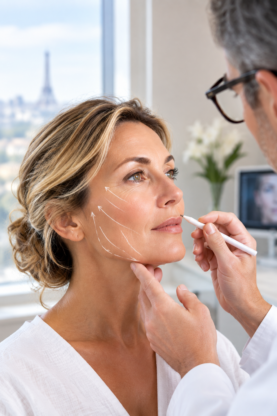
The French Lift® (an acronym for Facial Rejuvenation with Enhanced Cheek Lift) is a plastic surgery procedure that corrects skin laxity and muscle sagging of the face and neck while preserving the features that give the patient their personality.
Under the effect of gravity, the volumes of the face gradually drop as the skin loses elasticity and the anatomical support structures slacken. This natural process causes a shift of volume towards the lower face, with the appearance of jowls and a loss of definition of the facial contour. Skin ageing also deepens the folds and wrinkles around the mouth and on the neck.
The French Lift® can then restore lost volume and soften the folds that time has gradually deepened (nasolabial folds, marionette lines) without artificially stretching the features of the face and mouth. This rejuvenation approach relies on repositioning the deep tissues rather than pulling the skin, which allows a patient to look younger without looking different. This is what we call a natural facelift.
02Repositioning the tissues rather than pulling the skin: the principle
The success of a French Lift® depends above all on taking into account the patient’s original anatomy, and in particular the SMAS (superficial musculoaponeurotic system). The SMAS is the layer of deep tissue that holds the muscles and the bone structure of the face together through retaining ligaments. It is notably responsible for facial expressions. Over time, this fibromuscular layer sags as well, leading to a loss of tone and overall cohesion of the face (drooping cheeks, jowls).
The aim is therefore to reposition the deep tissues that form this supporting framework, and not merely to stretch the sagging skin. Repositioning the SMAS involves in particular:
- re-tightening the retaining ligaments weakened over time;
- re-tightening the neck muscle (platysma), responsible for creases in the skin of the neck and for unsightly vertical bands (platysmal bands);
- returning the sagging features of the face to where they were several decades earlier (cheeks, cheekbones);
- removing excess skin and redraping the skin without putting it under excessive tension.
The French Lift® performed by Dr Hunsinger and his team is therefore a measured approach that aims to bring back the volumes and contours of the past without losing the original structure of the face or each patient’s facial expression.
Unlike a poorly performed traditional facelift, this in-depth redefinition of the tissues makes it possible to avoid a pulled, frozen-looking face, which forced tightening of the skin can cause.
03No swollen face, no fat injection: what the French Lift does not do
The French Lift® differs from other facial rejuvenation procedures that try to compensate for sagging and the loss of the facial contour by adding volume. The aim here is to reposition the sagging tissues towards the upper cheeks and the cheekbones without artificially « filling » the area. Except in a few specific cases, the French Lift® is therefore not combined with lipofilling, i.e. injections of autologous fat (the patient’s own fat, processed before being reinjected).
Lifting the deep muscle and fat tissues restores the volumes that have melted away without the risk of an excessively swollen face or artificial, overly prominent cheekbones. The technique thus avoids the pitfall of overly rounded contours and a lastingly « puffy », expressionless face. Instead, it achieves a natural-looking rejuvenation, with a face that keeps the finesse of its features and all its character.
Beyond the natural look it leaves in the long term, the French Lift® limits the swelling that follows procedures based on fat transfer and on extensive undermining of the skin. This allows a faster recovery with less social downtime, since the face does not stay swollen for several weeks.
04French Lift, cervicofacial facelift or deep plane: which one for which face?
The French Lift® shares some features with other forms of facelift used to reshape volumes at depth. It differs from them mainly in the technique used and in the degree of sagging it addresses. In particular, it differs from:
- the cervicofacial facelift: the classic face and neck lift also works on the deep tissues (superficial SMAS) but also focuses on re-tightening the skin, which in some cases can cause excessive skin traction when the procedure is poorly performed. The cervicofacial facelift is also sometimes combined with lipofilling, which can lead to more swelling and a puffy face if the fat injection is disproportionate or poorly placed. It is mainly recommended for patients aged 50 to 60 with moderate laxity of the lower face and neck;
- the deep plane facelift (or deep vertical facelift): it involves redefining the very deep planes (beneath the SMAS), which are released (sub-SMAS dissection) and then repositioned. This vertical repositioning of the whole facial block (fat, muscles and skin) gives very long-lasting results (up to around 15 years), although recovery can be heavier. The deep plane can indeed put the facial nerve at risk and involves a very long operation (more than 4 hours). Its effect on the anterior column, the nasolabial fold and the marionette lines nonetheless remains limited, and it is often combined with lipofilling, which makes the face swollen. It is intended for people with significant, generalised laxity (cheekbones, nasolabial folds, jowls, neck) with deep sagging, marked volume loss and very deep folds;
- the SMAS plication or SMAS flap facelift: SMAS plication consists of folding and suturing the superficial muscle layer without having to release the SMAS. The SMAS flap, on the other hand, involves undermining beneath the SMAS to release the retaining ligaments. In both cases, these techniques have little effect on the anterior column, the nasolabial fold and the marionette lines. They are also very often combined with lipofilling, which leaves the face artificially swollen;
- the skin-only mini facelift: it is used to treat the lower third of the face and the upper neck when the first signs of ageing appear (between 40 and 50). A lighter form of the cervicofacial facelift, the mini facelift is limited to re-tightening the skin through shorter incisions, for a more discreet but only temporary result, with no deep effect on the anterior column, the nasolabial fold or the marionette lines.
Overall, the French Lift® aims to be the ideal synthesis of these different procedures. It provides an in-depth action (SMAS and neck muscles) at any stage of sagging (generally from a moderate stage) for tailored, elegant results without major complications and without any loss of facial expression.
05Who is the French Lift for?
The French Lift® is suitable for both men and women who wish to correct the various signs of facial sagging without changing their features or personality. It can be performed at any age but is generally carried out between 45 and 70, once the signs of ageing have set in. It treats in particular:
- loss of volume in the face;
- loss of the facial contour, notably due to jowls;
- drooping cheekbones that give a sad and/or tired look;
- loose skin on the neck;
- slackening of the neck muscles (platysma, neck bands);
- deepening nasolabial folds;
- the appearance of marionette lines.
The French-style facelift is aimed at patients who want natural, discreet results, and particularly at those who fear a frozen, pulled or swollen look.
06Results: looking younger without looking different
The French Lift delivers a natural-looking rejuvenation and a fairly spectacular before-and-after result, in which the patient can look ten or even fifteen years younger, with in particular:
- a redefined facial contour;
- the disappearance of the jowls that used to weigh the face down and give it a sad or tired look;
- a smoother neck, with creases and platysmal bands far less visible;
- redefined cheekbones that are not overly prominent;
- much less visible nasolabial folds and marionette lines;
- a brighter, more rested and relaxed face.
The final results are usually visible within 3 to 6 months, once the swelling has fully subsided. They last over time, even though skin ageing continues afterwards.
The French Lift lifts the volumes of the face as a whole without artificially increasing them with fat injections. It therefore offers a harmonious result that preserves the intrinsic characteristics of the face without any loss of expression. Long-term sun protection is recommended to maintain its effects for as long as possible.
07French Lift prices in Paris
A full French Lift (cheeks and neck) costs between €9,000 and €14,000 depending on the extent of the procedure. A partial French Lift costs between €7,000 and €9,000. The price includes the surgeon’s and anaesthetist’s fees, the operating theatre and hospital costs, and the post-operative follow-up.
As with other types of facelift, the French Lift is not eligible for insurance coverage by the French national health system, as it is considered a purely cosmetic procedure rather than a reconstructive one.
08The French Lift at Rive Droite Paris Étoile
At the Rive Droite Paris Étoile plastic surgery practice (CERDPE), located in the 17th arrondissement of Paris near the Arc de Triomphe, Dr Hunsinger and his colleagues (Dr Derhy and Dr Privé) will see you to define the outline of your future procedure.
With a measured approach rooted in natural French chic, they will listen to your expectations and take the time to explain, step by step, how the deep tissues are repositioned, the results you can expect and the recovery. In an upscale, discreet and welcoming setting, you can ask all your questions freely and share any concerns you may have about the operation.
True to the method developed by Dr Philippe Bellity and to his recommendations, the whole Rive Droite Paris Étoile team will ensure a safe procedure, with surgical precision tailored to you and a natural restoration of volume without excess.
Finally, Dr Hunsinger and his colleagues regularly take part in teaching the French Lift to surgeons from around the world during masterclasses organised by Dr Philippe Bellity. A clear guarantee of expertise to restore the lost volumes of your face naturally and discreetly.
09How the procedure works
Before the procedure
The French Lift® requires preliminary consultations to define the extent of the surgery, based on the patient’s expectations and the degree of sagging observed. A detailed quote is given to the patient after these consultations, and a mandatory 15-day cooling-off period applies before the procedure can take place. The surgeon also gives medical instructions (stopping smoking and certain medications for a set period). A consultation with the anaesthetist is also systematically scheduled no later than 48 hours before the operation.
During the procedure
The procedure itself is performed under general anaesthesia (or, more rarely, under local anaesthesia with deep sedation). It is most often done as day surgery (leaving the clinic the same evening), or sometimes with one night in hospital for monitoring when the deep tissues are extensively redefined. It generally lasts between 1h30 and 2h30, depending on the extent of the areas to be treated.
The surgery begins with a peri-auricular incision at the temples, from the earlobe to the tragus (the cartilage in front of the ear canal), blending into the base of the hairline. This incision allows very discreet healing once the scar has matured, despite a pink or even red tint during the first post-operative weeks.
The surgeon then reaches the areas that have slipped (cheekbones, around the mouth, neck) without excessive undermining, in order to lift the muscle and fat tissues without pulling the skin. Once these deep tissues have been lifted and firmly anchored higher up with sutures, he removes the excess skin and carefully redrapes the remaining skin (aligned with the deep structure) to avoid any frozen or pulled effect. Once the sutures are complete, a compression band is placed over the incision to keep the tissues well supported during the first hours.
After the procedure
The French Lift® is generally not very painful, with relatively mild recovery. After the operation, swelling and bruising may appear, usually within 48 hours. They fade naturally after a few days or weeks. Slight tightness may also be felt around the ears and neck during the first days, but it remains very bearable. Numbness or a pulling sensation in the cheeks may also be noticed.
Plan for 1 to 2 weeks of social downtime depending on the person, with make-up allowing you to resume social interactions after about 7 days. A rest period recommended by the surgeon must also be respected, with a position to keep during the first days and daily care (notably massages or silicone gel). Very high sun protection is also essential during the first year to optimise healing and avoid depigmentation at the incision site.
The scars are shorter than with a traditional facelift. They are pink or even red during the first weeks, then fade and blend naturally into the patient’s skin texture after a few months.
10Prices & fees in Paris
| Procedure | Aesthetic fees |
|---|---|
| Partial French Lift | 7 000 – 9 000 € |
| Full French Lift (cheeks and neck) | 9 000 – 14 000 € |
Indicative “from” prices, surgeon fees included. The final quote is given at the consultation, after examination, depending on the area treated and the technique chosen. Part of the procedure may be covered by French national health insurance when the medical criteria are met.
11Your questions
What is a French Lift?+
The French Lift is a facelift that delivers natural-looking rejuvenation by vertically lifting the deep muscle and fat tissues (SMAS). Developed by Dr Philippe Bellity, this technique restores the facial contour and raises sagging tissues without artificial volume injections and without the face looking frozen or pulled.
How much does a French Lift cost in Paris?+
A full French Lift in Paris costs between €9,000 and €14,000 and is not eligible for insurance coverage by the French national health system. The cost depends on the number of areas treated, the extent of the sagging and any additional procedures. A personalised consultation will allow a tailored quote to be drawn up.
Does a French Lift leave visible scars?+
The scars of a French Lift are shorter than with a classic facelift (cervicofacial facelift) and kept to a minimum because the skin is not pulled. The peri-auricular scar (around the ear, at the temple) is therefore generally less visible and partly blends into the hairline and the natural creases of the skin once healing has matured.
What is the difference between a French Lift and a deep plane facelift?+
Both techniques work at depth for a natural repositioning without adding volume. Whereas the French Lift lifts the superficial SMAS and the retaining ligaments back to their original position, the deep plane facelift involves an even deeper dissection, beneath the muscles and connective tissues.
How long do the results of a French Lift last?+
The result of a French Lift can last 10 to 15 years, much longer than traditional facelifts. Rigorous sun protection is recommended to prolong its effects. This effectiveness does not, however, stop the natural process of skin ageing.
What can be done after a failed French Lift?+
If a French Lift has not produced the expected effect (for example because of asymmetry or excessive skin traction), you should consult a qualified specialist in reconstructive surgery (such as Dr Hunsinger) to assess the options for a tailored correction.