PDO, PLLA and PCL threads: what's the difference between absorbable thread lifts?
Absorbable thread lifts have become one of the leading techniques for non-surgical facial rejuvenation. But faced with the three available materials – PDO (polydioxanone), PLLA (poly-L-lactic acid) and PCL (polycaprolactone) – one question comes up again and again right from the consultation: which one to choose, why, and for what results? The answer depends on each patient’s profile, the degree of skin laxity, and the effect expected over time. This article walks you through the characteristics of each material, their concrete clinical differences and the criteria that allow Dr Vincent Hunsinger, plastic surgeon in Paris 17 and a champion of the « natural French look », to design a protocol suited to your anatomy.
Contents
What is an absorbable thread lift?
An absorbable thread is a medical thread inserted under the skin using a fine blunt cannula or a needle, without any incision, in order to reposition sagging tissues and stimulate the natural production of collagen. The term absorbable or biodegradable refers to a thread that the body gradually absorbs through hydrolysis – that is, through chemical breakdown on contact with biological fluids – until it disappears completely.
By contrast, non-absorbable or permanent threads remain in the tissues indefinitely, which carries a higher risk of long-term complications: extrusion, chronic infection, persistent inflammatory reaction. Recent clinical studies show that absorbable threads have extrusion rates of 1.6% compared with 7.6% for permanent threads, and paraesthesia rates of 3.1% compared with 11.7%. This markedly superior safety profile explains why biocompatible absorbable threads are now the medical standard.
The action of absorbable threads relies on two complementary mechanisms. The first is mechanical: as soon as it is placed, the thread – barbed, with cones or smooth – exerts traction on the tissues and physically repositions the sagging structures. The second is biological: the presence of the synthetic polymer in the dermis and hypodermis triggers a controlled healing response that activates fibroblasts and stimulates neocollagenesis – the synthesis of new collagen. It is this second mechanism that explains why results keep improving for several weeks after the session, well beyond the immediate lifting effect.
PDO, PLLA, PCL: the complete comparison of the 3 materials
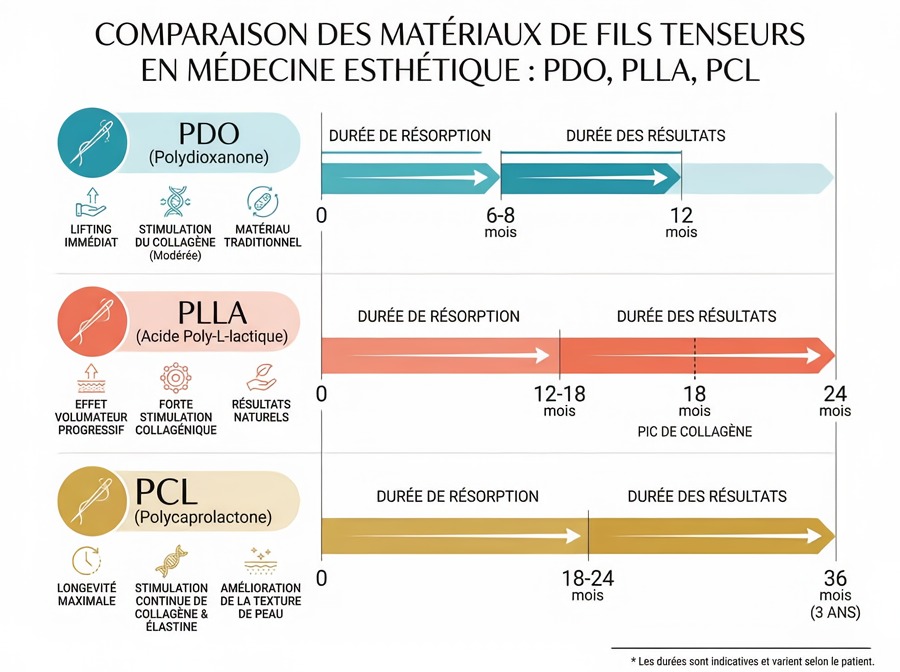
The three materials share the same basic principle but differ profoundly in their absorption time, their ability to induce collagen production and the longevity of the results obtained. The table below sums up the essentials:
| Material | Absorption time | Duration of results | Dominant mechanism | Preferred indications |
|---|---|---|---|---|
| PDO — polydioxanone | 6 to 8 months | 6 to 12 months | Mechanical lift + moderate neocollagenesis | First treatment, annual maintenance, thin skin |
| PLLA — poly-L-lactic acid | 12 to 18 months | 12 to 18 months | Prolonged collagen induction | Moderate ptosis, patients aged 40 to 55 |
| PCL — polycaprolactone | 18 months to 3 years | 18 to 36 months | Maximum biostimulation + superior longevity | Patients seeking maximum duration, aged 45–60 |
PDO threads (polydioxanone)
Polydioxanone is the most widely used thread-lift material since the early days of this technique. This synthetic polymer, already used for decades in absorbable surgical sutures, offers excellent biocompatibility and a very well-documented safety profile. Its complete absorption through hydrolysis takes place over six to eight months, generating moderate fibroblast activity during this period.
The immediate lifting effect of PDO threads is clearly perceived by patients, but the neocollagenesis they induce is of limited duration. Collagen synthesis peaks around the third month, then gradually declines as the thread breaks down. Results are generally maintained for six to twelve months, depending on the patient’s age, lifestyle and skin quality. PDO threads are particularly suited to a first approach or to an annual maintenance protocol in patients aged 35 to 50 with early laxity.
PLLA threads (poly-L-lactic acid)
Poly-L-lactic acid is a biopolymer better known under the brand names Sculptra or Silhouette Soft for its coned forms. Its absorption extends over twelve to eighteen months, offering a longer biological window in which to stimulate fibroblasts. Compared with PDO, PLLA induces more sustained and more gradual collagen production, with results that continue to refine between the third and sixth month following placement.
The gradual improvement – sometimes described as more natural and less pronounced in the first few weeks – is precisely what many patients seeking a discreet result are looking for. Results are maintained for twelve to eighteen months, which makes it an intermediate choice between the practicality of PDO and the longevity of PCL. Coned PLLA threads, such as those used in the Silhouette Soft or Instalift protocols, allow a structured lift of the cheeks and jawline with solid mechanical anchoring.
PCL threads (polycaprolactone)
Polycaprolactone represents the most recent generation of absorbable thread lifts. Its more complex molecular structure gives it markedly greater resistance to hydrolytic breakdown: complete absorption takes from eighteen months to almost three years. This longevity in the tissues sustains an exceptionally durable fibroblast stimulation.
Comparative preclinical studies have shown that PCL threads induce a significantly higher collagen density than PDO and PLLA threads at all measured time points, with a type I / type III collagen ratio closer to the profile of young skin. It is this prolonged inductive effect that normalises the composition of the extracellular matrix and explains results maintained for eighteen to thirty-six months. For patients aged 45 to 60 who want to space out their maintenance sessions as much as possible, PCL threads offer the best duration-to-investment ratio. Advanced formulations enriched with endogenous hyaluronic acid, available in certain next-generation devices, further reinforce this biostimulating capacity.
Smooth, barbed or coned threads: which structure for which effect?
Beyond the material, the geometric structure of the thread determines its main mechanism of action and the areas where it will be most effective. Three broad families of structures can be distinguished.
Smooth threads (monofilaments)
Smooth threads, also called monofilaments or mesh threads, exert no mechanical traction effect. Inserted in a network within the superficial dermis or the hypodermis, their action is exclusively biological: they stimulate collagen production and improve skin texture through controlled reactive fibrosis. Particularly indicated to revitalise the neck and décolleté or to refine the skin of the face, smooth PDO threads are often combined with other treatments in an overall protocol.
Barbed threads (cog threads)
Barbed threads – also called cog threads – are fitted with micro-barbs oriented along their length. These micro-barbs grip mechanically onto the fibres of the subcutaneous tissue and of the SMAS (superficial musculoaponeurotic system), creating immediate mechanical traction and actively repositioning the ptotic structures. This is the thread type par excellence for correcting sagging jowls, redefining the jawline or lifting the tail of the eyebrow. Brands such as Aptos Thread or Miracu offer bidirectional barbed threads allowing more evenly distributed anchoring.
Coned threads
Coned threads – of which Silhouette Soft and Definisse are the best-known examples – combine an absorbable thread (PLLA or PLLA/PCL) with moulded cones distributed along its length. These cones provide deep anchoring, particularly in the temporal area, and allow firm mechanical support of the malar and cheek tissue. The effect is both lifting and volumising, as the cones create slight gathering of the overlying tissue. This type of structure is particularly suited to moderate ptosis of the mid-face area.
Spiral threads
Spiral threads (screw threads) coil around themselves during placement, increasing the surface of contact with the tissues. Their action is mixed: slightly mechanical and strongly biostimulating. Often used to improve the volume and firmness of the cheeks or the neck, they are an ideal complement to a protocol including barbed threads.
How do thread lifts act on the skin?
Inserting a thread into the subcutaneous tissue triggers a biological cascade that can be divided into two distinct phases.
The immediate mechanical phase occurs as soon as the thread is placed. The thread – barbed, coned or spiral – exerts physical traction on the underlying structures. When placement targets the supra-SMAS plane or directly engages the SMAS, the lifting of the tissues is visible from the session itself. The immediate lifting effect comes from this anatomical repositioning of the fat pads and superficial fibrous structures, not from a simple skin compression.
The delayed biological phase begins in the days following placement and extends over months. The synthetic polymer acts as a biocompatible foreign body, triggering a controlled healing response. The fibroblasts of the dermis and hypodermis – the cells responsible for producing collagen – are activated around the thread pathways. They begin to synthesise type III collagen, which gradually reorganises into type I collagen, which is stronger and more structural. This neocollagenesis improves skin firmness, densifies the extracellular matrix and gradually restores a rejuvenated, toned appearance to the skin. The optimal result is generally reached two to three months after the session, when collagen production is at its peak.
It is the duration of this biological stimulation – directly linked to the longevity of the polymer in the tissues – that fundamentally differentiates PDO, PLLA and PCL, beyond the simple initial mechanical component.
Which areas of the face and body can be treated with thread lifts?
Thread lifts are suited both to the face and to certain body areas, with protocols adapted to the anatomy of each region.
The face
The face remains the main indication. The most frequently treated areas are:
- The jawline and the jowls (cheek area): this is the prime indication for barbed threads, which lift sagging tissues towards the temporal area and redefine the mandibular contour.
- The cheekbones (malar area): coned or spiral threads restore the volume and curve of cheeks flattened by ptosis.
- The nasolabial fold: the sagging of the jowls deepens this fold. By lifting the tissues, the threads naturally soften this fold without the need for filling.
- The tail of the eyebrow and the temples: a few threads can correct slight eyebrow ptosis and open up the eyes without surgery.
- The neck (cervical area) and the jowls: smooth or barbed threads improve tone and soften early cervical laxity.
- The corners of the lips and the contour of the mouth, more rarely treated, can benefit from fine threads to soften sagging of the lip contour.
The body
Thread lifts are increasingly used on certain body areas to improve skin tone without surgery: the décolleté, the inner arms, the abdomen and also the buttocks and the thighs. For these applications, smooth or lightly barbed PDO or PCL threads are preferred, often as a complement to other contouring techniques. Each area requires a suitable thread type and gauge, as well as a specific placement technique.
How is a thread lift performed?
A thread lift is an outpatient session carried out in the office, with no hospital stay. Here is how the protocol unfolds at Dr Hunsinger’s plastic surgery practice, Rive Droite Paris Étoile.
Please note: Dr Hunsinger does not currently offer dedicated thread-lift procedures, preferring the facelift or the non-surgical facelift for more durable or less invasive results.
The preliminary consultation
Everything begins with a thorough preliminary consultation. Dr Vincent Hunsinger assesses the degree of skin laxity, skin quality, facial anatomy and the patient’s expectations. This step is fundamental: it allows the material (PDO, PLLA or PCL), the thread type (smooth, barbed, coned), the number of threads needed and the placement vectors to be chosen. A health assessment is carried out to identify any contraindications. No placement is performed without this prior medical consultation.
The course of the session
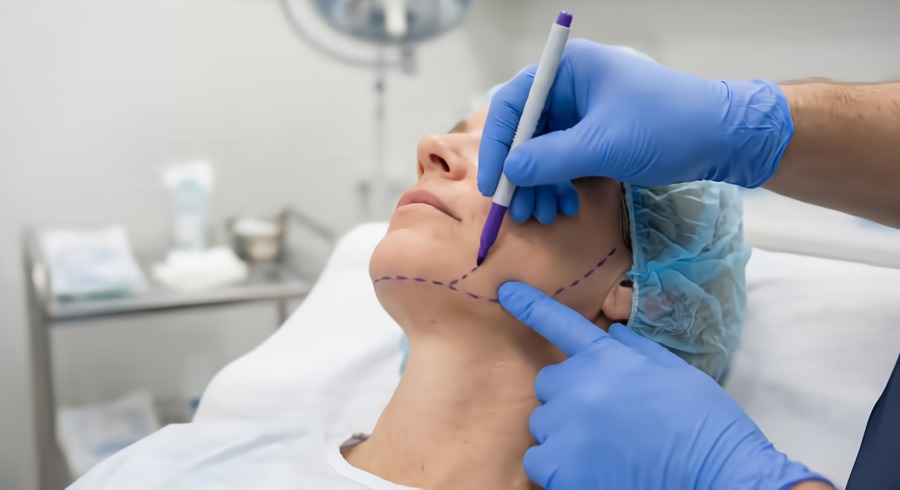
On the day of the session, Dr Hunsinger begins with a precise preoperative marking of the face, in a seated position, to define the thread pathways and anchoring points while taking the optimal traction vectors into account. Local anaesthesia with Xylocaine — or an anaesthetic cream applied beforehand — is used to make the procedure comfortable.
The threads are then inserted through practically invisible millimetre incisions, using a fine needle or a blunt cannula depending on the area. The session lasts 30 to 60 minutes depending on the number of threads and the areas treated. No sutures are needed. The patient can go home as soon as the session ends. A follow-up consultation is scheduled at day 15 or day 30 to check the integration of the threads and adjust the protocol if necessary.
« Every thread-lift protocol is built to measure, taking into account the patient’s anatomy, their degree of laxity and their goals. The aim is not to mechanically ‘pull up’ the face, but to restore a natural harmony by working with the existing structures. »
— Dr Vincent Hunsinger, plastic surgeon in Paris
Results: when to see them and how long do they last?
Thread lifts offer a dual timeline of results, which sets them apart from simple filler injections.
The immediate lifting effect is visible as soon as the session ends: the jawline is more defined, the jowls lifted, the eyes slightly opened. During the first seven to ten days, slight swelling (edema) and a few bruises may transiently soften this initial result. Between the third and sixth week, the tissues adapt to the presence of the threads and the collagen stimulation takes over. The optimal result is generally reached two to three months after placement, when neocollagenesis is at its peak.
The duration of results then varies according to the material:
- PDO threads: results visible for 6 to 12 months, with a maintenance session recommended every 12 months.
- PLLA threads: results maintained for 12 to 18 months, with gradual improvement up to the 6th month.
- PCL threads: durable results over 18 to 36 months, with exceptional stability beyond 12 months.
Several factors influence the duration of results: the patient’s age, smoking (which impairs collagen synthesis and accelerates skin deterioration), the initial quality of the skin, and the degree of laxity treated. Sun-damaged or photo-damaged skin will respond less favourably than well-hydrated, protected skin. Dr Hunsinger’s approach delivers natural results that are discreet and gradual – with no « frozen » look -, characteristic of a placement carried out to the highest standards with a personalised protocol.
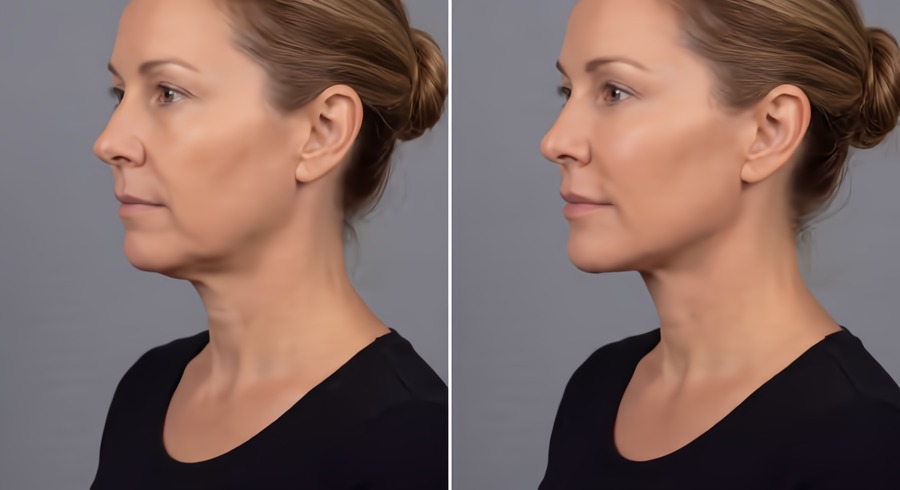
Simulation of a before/after result of a thread lift – © Rive Droite Paris Étoile
Recovery and aftercare following a thread lift
Recovery after a thread lift is generally mild, which is one of the great advantages of this technique compared with surgery. Here are the post-treatment instructions usually given at the Rive Droite Paris Étoile practice.
In the first few days, localised swelling (edema) and bruising may appear at the entry points. These transient effects disappear on their own within five to ten days. Sensations of slight tightness or discomfort when moving the face are also normal and gradually subside.
The main instructions to follow are as follows:
- Return to work: immediate, from day 2 for most patients, depending on individual tolerance.
- Sport: not advised for one week, to avoid excessive movements that could displace the threads while they are integrating.
- Facial massages: strictly to be avoided for at least three weeks. Any deep massage or skin manipulation risks moving the threads before they are definitively anchored.
- Intense facial expressions (exaggerated yawning, demonstrative laughter): to be moderated during the first ten days.
- Anticoagulants and anti-inflammatories: to be avoided in the days before the session, after clearance from your GP, in order to limit bruising.
- Alcohol: to be avoided for the 48 hours following placement, to limit swelling.
- Dentist: postpone invasive dental work for two weeks.
Who are thread lifts for? Candidates and contraindications
Absorbable thread lifts are primarily for people aged 35 to 60 with moderate skin laxity: a slightly blurred jawline, early jowls, cheeks that have lost their curve, a neck that is starting to sag. It is this profile — neither too early to justify the procedure, nor too late to benefit fully from it — that matches the ideal candidate. Results are all the more satisfying when the skin retains a certain residual elasticity, which will amplify and maintain the traction effect.
Patients wishing to avoid any surgery or to benefit from gradual, natural rejuvenation are also good candidates, provided the laxity is not too severe. Beyond a certain degree of ptosis or in patients with significant excess skin, threads can only offer partial improvement.
The main contraindications to thread lifts are:
- Pregnancy and breastfeeding
- Active autoimmune diseases or known healing disorders
- Coagulation disorders or chronic anticoagulant treatment that cannot be interrupted
- Active skin infection in the area to be treated
- Implants or prostheses in the target area
- Severe skin laxity or significant excess skin, for which a surgical facelift remains the reference indication
The price of a thread-lift session varies according to the number of threads placed, the areas treated and the practitioner’s expertise. The range seen in Paris is between €800 and €3,000 per session. This procedure is not reimbursed by French national health insurance, as it is an aesthetic act. A detailed quote is provided during the consultation with Dr Hunsinger.
Thread lift or surgical facelift: how to choose?
This is one of the most frequent questions in consultation. Thread lifts and the surgical facelift are not in opposition: they address different degrees of laxity and distinct expectations.
Thread lifts are indicated when laxity is moderate — a slightly drooping jawline, early jowls, incipient malar ptosis — in a patient aged 35 to 55 whose skin retains sufficient tone. In this context, the threads deliver a visible, discreet and gradual result, without surgery, without scarring and with almost immediate return to activity. They can also be combined with hyaluronic acid injections or Morpheus 8 for an overall rejuvenation protocol.
The surgical facelift remains the reference alternative for severe laxity — significantly loose skin, substantial excess skin, marked cervical bands — or in patients over 55–60 whose tissues will no longer respond sufficiently to threads alone. The facelift allows a deep, durable and structural correction that no non-surgical technique can match at this stage. Dr Hunsinger, a plastic surgeon trained in both approaches, can help you identify the solution best suited to your situation during a personalised consultation.
Beyond surgery and threads, techniques such as the non-surgical facelift (HIFU, fractional radiofrequency) can complement or prepare the ground for a thread lift in patients with very early laxity and reduced skin quality.
FAQ — your questions about PDO, PLLA and PCL thread lifts
What is the difference between PDO, PLLA and PCL threads?
All three materials are biodegradable absorbable polymers, but they differ in their absorption time and their ability to stimulate collagen. PDO (polydioxanone) is absorbed in 6 to 8 months and gives results over 6 to 12 months. PLLA (poly-L-lactic acid) is absorbed in 12 to 18 months, with results maintained over 12 to 18 months. PCL (polycaprolactone) is the most durable: absorption in 18 months to 3 years, results over 18 to 36 months. PCL is also the material that most intensely stimulates neocollagenesis.
How long do the results of a thread lift last?
The duration varies according to the material: 6 to 12 months for PDO threads, 12 to 18 months for PLLA threads, and 18 to 36 months for PCL threads. These durations can be shortened by smoking, advanced age or very photo-damaged skin. The optimal result is reached 2 to 3 months after placement.
Is a thread lift painful?
The procedure is carried out under local anaesthesia (Xylocaine) or with an anaesthetic cream, which makes it very comfortable. The session lasts 30 to 60 minutes. Recovery is mild: swelling and bruising for 5 to 10 days. Return to work is possible from day 1 or day 2. Dr Hunsinger systematically adapts the protocol to minimise discomfort throughout the session.
How much do thread lifts cost in Paris?
The price ranges between €800 and €3,000 depending on the number of threads, the areas treated and the practitioner’s level of expertise. This procedure is not reimbursed by French national health insurance. A personalised quote is drawn up after the consultation at the Rive Droite Paris Étoile practice.
Thread lift or surgical facelift: how to choose?
Thread lifts are suited to moderate laxity (ages 35–55), with no general anaesthesia and no scarring. The surgical facelift is recommended as soon as laxity is severe or excess skin is significant — situations where threads can only offer partial correction. Dr Hunsinger can determine the best option for a natural, harmonious result during a consultation at his practice.
Are PDO threads the best thread lifts?
There is no absolute hierarchy. PDO threads are versatile and well documented. PLLA threads offer a good duration/cost compromise. PCL threads offer maximum longevity and biostimulation. The optimal choice depends on each patient’s clinical profile and their medium-term goals.
Which areas can be treated with thread lifts?
Mainly the face: jawline, cheekbones, jowls, nasolabial fold, tail of the eyebrow, temples and neck. Also certain body areas: décolleté, arms, abdomen, buttocks, thighs. Each area requires a suitable thread type and technique.
Frequently asked questions
What is the difference between PDO, PLLA and PCL threads?+
All three materials are biodegradable absorbable polymers, but they differ in their absorption time and their ability to stimulate collagen. PDO (polydioxanone) is absorbed in 6 to 8 months and gives results over 6 to 12 months. PLLA (poly-L-lactic acid) is absorbed in 12 to 18 months, with results maintained over 12 to 18 months. PCL (polycaprolactone) is the most durable: absorption in 18 months to 3 years, results over 18 to 36 months. PCL is also the material that most intensely stimulates neocollagenesis thanks to its superior inductive effect.
How long do the results of a thread lift last?+
The duration of results varies according to the material: 6 to 12 months for PDO threads, 12 to 18 months for PLLA threads, and 18 to 36 months for PCL threads. These durations can be influenced by the patient’s age, smoking, skin quality and the initial degree of laxity. The optimal result is reached 2 to 3 months after placement, when the collagen production induced by the threads is at its peak.
Is a thread lift painful?+
Placement is carried out under local anaesthesia (with Xylocaine) or after applying an anaesthetic cream, which makes the procedure very comfortable. The session lasts 30 to 60 minutes. Recovery is mild: slight swelling and a few bruises may appear for 5 to 10 days. Return to work is generally possible the next day or the day after. Dr Hunsinger always adapts the protocol to minimise discomfort.
How much do thread lifts cost in Paris?+
The price of a thread-lift session in Paris ranges between €800 and €3,000 depending on the number of threads placed, the areas treated and the practitioner’s experience. This procedure is not reimbursed by French national health insurance. A personalised quote is provided after the consultation with Dr Hunsinger in Paris 17.
Thread lift or surgical facelift: how to choose?+
Thread lifts are suited to moderate skin laxity, generally in patients aged 35 to 55. They involve no general anaesthesia, no scarring and a very quick recovery. The surgical facelift is recommended for severe laxity, significant excess skin or marked cervical bands, situations where threads can only offer partial correction. During a consultation in Paris 17, Dr Hunsinger can assess which solution matches your degree of laxity.
Are PDO threads the best thread lifts?+
There is no absolute hierarchy between the materials: each one meets different needs. PDO threads are versatile, well documented and affordable, ideal for a first approach or annual maintenance. PLLA threads offer a good compromise between duration and cost. PCL threads offer maximum longevity and the most intense biostimulation, but their cost is higher. The optimal choice depends on the patient’s profile, the clinical indication and their medium-term goals.
Which areas can be treated with thread lifts?+
Thread lifts mainly treat the face: the jawline, the jowls, the cheekbones, the nasolabial fold, the tail of the eyebrow, the temples and the neck. They can also be used on the body: décolleté, inner arms, abdomen, buttocks and thighs. Each area requires a specific thread type and placement technique, determined during the consultation with the practitioner.
Book an appointment
If you are considering a procedure, book an appointment in just a few clicks: our surgeons will answer all your questions and guide you toward a tailored, personalised solution.
Book on Doctolib