Blepharoplasty results over time: what to expect
Blepharoplasty is a plastic surgery procedure especially recommended for people whose face is marked by a tired-looking gaze or drooping eyelids. It can also form part of a more global facial rejuvenation plan, alongside botulinum toxin injections around the eyes or hyaluronic acid injections to treat under-eye hollows or a sunken appearance around the eyes. Eyelid surgery thus corrects imperfections around the eyes, which usually become apparent from the forties onwards. What are the goals of this procedure? What is the recovery like? What results can you expect from a blepharoplasty over time? Here is everything you need to know about how effective eyelid surgery really is.
Contents
What you need to know about blepharoplasty
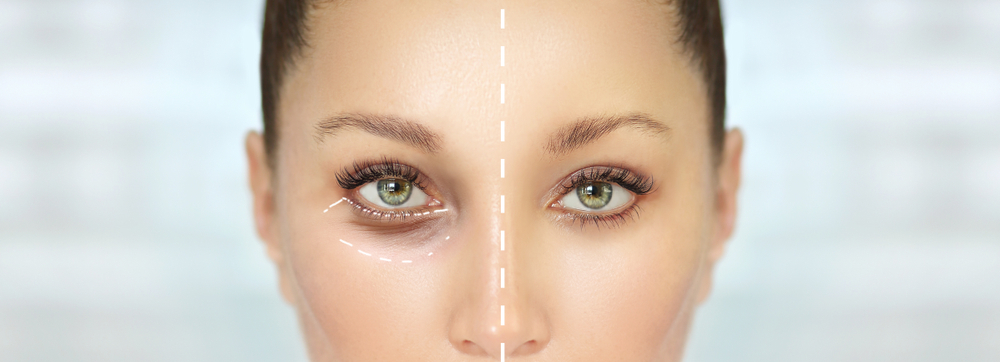
Blepharoplasty is the surgical procedure that corrects loose, distended eyelids and certain irregularities around the eyes. It is designed to treat the signs of ageing in the eye area. This procedure also helps prevent heavy, drooping eyelids that give the eyes a tired, dull appearance. The aim of the procedure is to restore harmony to the mid-face by smoothing the folds in the hollows and opening up the patient’s gaze.
Three main types of procedure are performed, depending on the level of skin elasticity and the areas to be treated:
- First, upper blepharoplasty is recommended to treat drooping, heavy eyelids that have lost their elasticity. It is performed by removing the excess skin, muscle and fat tissue, followed by redraping of the skin.
- Lower blepharoplasty, for its part, is advised when wrinkled eyelids are marked by skin laxity and begin to sag, causing fat hernias to appear as adipose tissue shifts downwards. This procedure significantly reduces the well-known « bags under the eyes » that give the eyelids a puffy or swollen appearance.
- Lastly, pinch blepharoplasty also corrects wrinkled, crepey or thick lower eyelids, but this time in a non-invasive way, without lifting the skin or muscle, thanks to an eyelid pinch that tightens the tissues.
The main goal of blepharoplasty is to rejuvenate the eyes and erase the tired appearance by addressing drooping eyelids. It also helps smooth away the wrinkles under the eyes caused by excess skin and fat. This technique makes it possible to get rid of all the imperfections around the eyes, such as under-eye hollows, dark circles, fat bags or folds under the eyes. The eyes then take on a more youthful appearance. For under-eye hollows that are purely volumetric in origin, facial fat transfer using autologous fat injections can also be an alternative or a complement to eyelid surgery; a full overview of the options is detailed in our article on the different methods of eye rejuvenation. The effects of this procedure are long-lasting, with the fat bags permanently removed and skin laxity treated for a good ten years. Whichever procedure is performed, it will in no way alter the expression of the face.
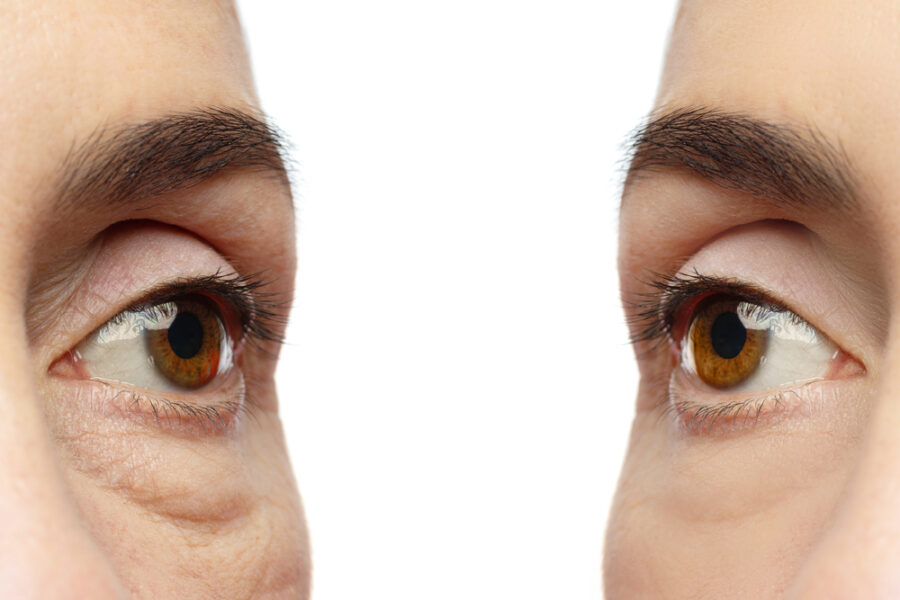
This procedure can be performed from the forties onwards, when the first signs of ageing appear around the eyes and gradually dull the patient’s gaze. It is indeed recommended at the onset of the first signs of skin deterioration, caused not only by age but also by other factors such as alcohol consumption, smoking or sun exposure. This procedure is also recommended to treat congenital imperfections (hereditary factors) that give a sad expression and a dull complexion to the people concerned. Blepharoplasty can be performed on both men and women and helps restore radiance and tone to a tired face.
What is the recovery like, and how do the results of blepharoplasty evolve over time?
As with most plastic surgery procedures, the results of a blepharoplasty are gradual and become increasingly noticeable over time. To avoid the risk of complications, which are relatively minimal, the patient should plan a period of rest and a few days away from social life to allow the results of the procedure to consolidate, in particular by avoiding sources of light as much as possible in the early stages.
The first day after blepharoplasty
During the first 24 hours, post-operative pain remains limited and bearable, although the patient may feel some discomfort and tension in the eyelids. Dry eyes causing slight irritation may also be felt. Using moisturising eye drops can then help ease this discomfort. A first partial result can already be appreciated, despite the swelling and bruising that may appear the day after the procedure.
The first 7 days: blepharoplasty day by day
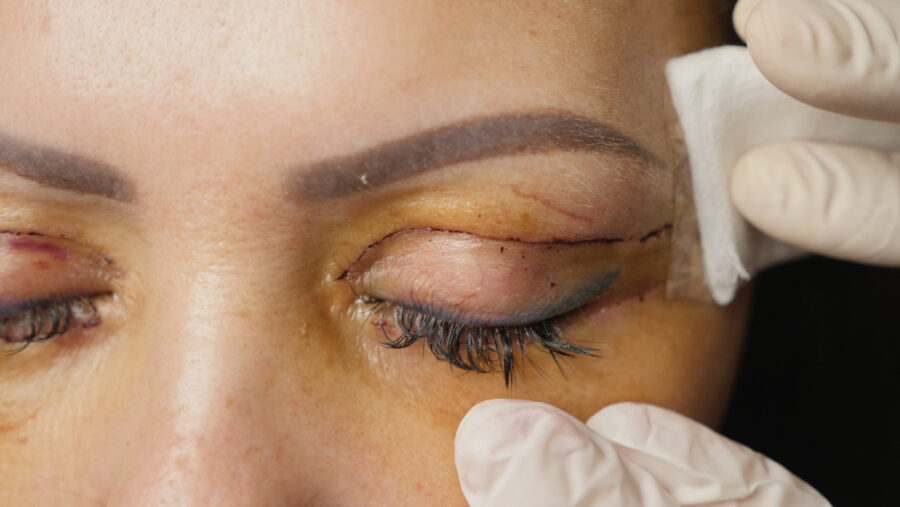
In the days following blepharoplasty, the sensations will then vary from one patient to another. Swelling and bruising are usually at their peak between days 2 and 3, then ease off markedly after 3 to 5 days. If the swelling is too pronounced, ice-cold saline compresses should be applied daily so that the cold produces an anti-inflammatory effect.
After 5 days, the swelling has already gone down considerably: the eyelids look less heavy, even if some residual discolouration from the bruising may remain. After 10 days, the swelling has usually largely subsided and the bruises have almost faded; the eyes then begin to look natural again, which makes returning to social life much more comfortable.
If the upper or lower eyelid procedure was performed via the subciliary approach, the stitches will be removed around day 4 or day 6 after the procedure. During the first few weeks, the scars will be slightly pink without being overly visible. It is possible to return to social and professional life about a week after the procedure. Physical activity can be resumed gradually after 2 to 3 weeks. The length of recovery will depend on how each patient’s skin reacts, as well as on its ability to retract and heal.
As for swelling, how long does it last? The most visible swelling goes down within one to two weeks, but a slight, residual swelling can persist for several weeks, particularly after a lower blepharoplasty: this is a normal evolution, which gradually fades and should only be a concern if it worsens or is accompanied by pain, marked redness or visual disturbance.
After 1 month
The patient can really begin to appreciate the concrete result of their blepharoplasty after 4 to 6 weeks, or about a month, although the final results are not apparent until around 3 months. After this period, the tissues become more supple and the scars more mature. The eyes then take on a more rested and refreshed appearance. The eyelids will also have a smoother appearance. In short, the eyes regain a new youthfulness.
The result of blepharoplasty after 2 months
After 2 months, most of the swelling has gone and the result becomes much clearer. It is generally at this stage that the temporary asymmetry and the feeling of tension fade, and that patients begin to perceive rested, harmonious eyes that come close to the final outcome. The scars, still slightly pink, continue to mature. It should be kept in mind, however, that the final result is best assessed at around 3 to 6 months, once the tissues have fully softened: « before and after » comparisons made too early should therefore be interpreted with caution, as each person’s skin heals at its own pace.
After 1 year
Here is a photo showing the result of a lower and upper blepharoplasty after 1 year; the procedure was performed at our aesthetic centre.
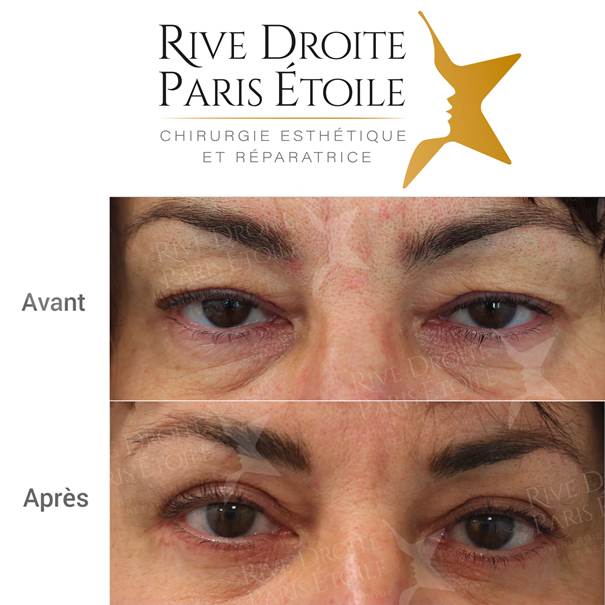
It should be noted that the natural ageing process will not stop for all that, even though the result remains visible for 7 to 10 years. It can even last longer if the patient follows healthy lifestyle measures (moderate sun exposure, limited alcohol and tobacco consumption, etc.). International plastic surgery studies in fact report some of the highest long-term satisfaction rates in facial plastic surgery: the excess skin and the fat bags that are removed do not come back, which explains how durable the result is. Blepharoplasty does not, however, stop the clock, and a more global laxity of the face may, years later, justify a complementary procedure such as a facelift to rejuvenate the face as a whole.
The scars, fairly discreet from the first few weeks, will reach their final appearance between the third and sixth post-operative month and become almost imperceptible. To avoid the risk of dyschromia (a pigmentation disorder), it is again recommended to protect yourself from the sun and to wear sunglasses as much as possible, right from the first days after the procedure.
What imperfections and potential complications can occur?
Because of unexpected tissue reactions or unusual scarring (infections, epidermal cysts, corneal ulcerations), rare complications can occur after a blepharoplasty. These may include, for example, changes that reveal slight asymmetry, undercorrection or brownish scars. It is nevertheless entirely possible to correct these imperfections with a few minor « touch-ups » at your surgeon’s. The procedure can then be carried out under simple local anaesthesia and must be scheduled at least three months after the initial procedure.
The very rare complications that may occur after blepharoplasty can also involve slight changes in the appearance of the eyes, in particular the round eye (a rounded or « pulled-down » appearance of the lower eyelid) when too much skin is removed from the lower eyelid. When it occurs, this defect can be corrected with a targeted touch-up or, if necessary, with a canthopexy to reposition the outer corner of the eye. Some haematomas may also require a further procedure. If the patient is prone to infection, an antibiotic eye drop will then be needed.
Finally, a few pre-operative precautions should be observed to optimise recovery after the procedure. In particular, aspirin should not be taken in the 10 days before the procedure. Stopping smoking is also strongly recommended for 10 days before and after the procedure, as it can delay the healing process.
The essentials to know about scars after a blepharoplasty
Like all procedures, blepharoplasty will also leave a few visible scars, although far less visible than for most plastic surgery procedures. During a procedure on the upper eyelids, in the eyelid crease, the marks extend outwards and continue to the tail of the eyebrow. In this case the scars are almost invisible.
For a procedure on the lower eyelids, the scars are placed below the lashes and extend outwards. They then continue into a wrinkle. If the correction is performed at the level of the fat bag, the marks will be located on the inside of the lower eyelids.
Frequently asked questions
How long does swelling last after a blepharoplasty?+
The most visible swelling of the eyelids subsides within one to two weeks. A slight, residual swelling can, however, persist for several weeks, particularly after a lower blepharoplasty. This is a normal evolution that gradually resolves. Applying cold saline compresses in the first few days helps limit this swelling.
Is persistent swelling after blepharoplasty a cause for concern?+
Slight swelling that lasts a few weeks, especially around the lower eyelids, remains common and benign. It should only raise concern if it worsens or is accompanied by significant pain, marked redness, fever, discharge or visual disturbance: these signs justify contacting the surgeon promptly.
What do the eyes look like 10 to 15 days after the procedure?+
After 10 days, the swelling has usually largely subsided and the bruising is almost gone: returning to social and professional life becomes comfortable. At 15 days (two weeks), a discreet residual swelling may remain without being a concern, and make-up can generally be resumed once healing is sufficient and after the surgeon has given approval.
When can you see the final result of a blepharoplasty?+
A first result is visible from the first month, but the final result is best assessed between 3 and 6 months, once the tissues have softened and the scars have completed their maturation. « Before and after » comparisons made too early should therefore be interpreted with caution.
How long does the result of a blepharoplasty last?+
The result is long-lasting: the excess skin and fat bags that are removed do not come back, and the improvement remains clearly visible for around 7 to 10 years, often longer. Surgery does not, however, stop the natural ageing process: the stability of the result depends on skin quality, sun exposure, smoking and lifestyle.
What is the "round eye" after a lower blepharoplasty?+
The « round eye » refers to a rounded or slightly pulled-down appearance of the lower eyelid, linked to too much skin being removed from the lower lid. This complication is rare and can be corrected with a targeted touch-up or, if necessary, with a canthopexy that repositions the outer corner of the eye.
Can you sleep on your side after a blepharoplasty?+
During the first few days, it is advised to sleep on your back with your head slightly raised, in order to limit swelling and avoid pressing on the operated eyelids. Returning to a side position happens gradually, usually after one to two weeks, depending on the surgeon’s advice.
Book an appointment
If you are considering a procedure, book an appointment in just a few clicks: our surgeons will answer all your questions and guide you toward a tailored, personalised solution.
Book on Doctolib