Keloid scars: treatments and solutions
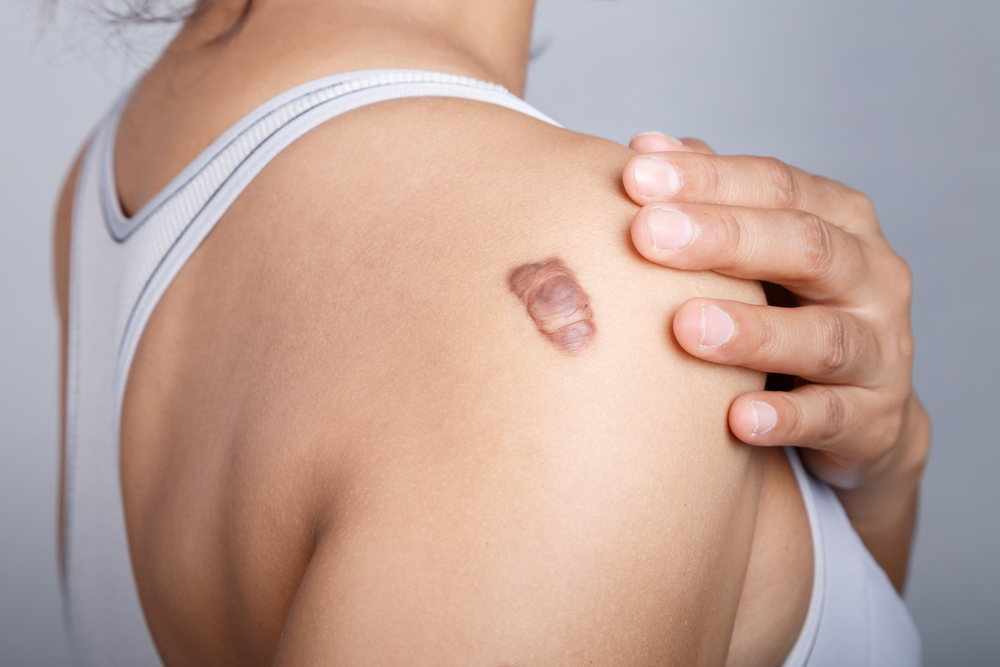
A keloid scar is an inflammatory reaction of the skin that develops while a wound heals. Although it poses no health risk despite the irritation, itching and relative pain it can cause, it can above all become troublesome from an aesthetic and psychological point of view. Visible as a raised, hardened, bulging scar that spreads beyond the original wound, it differs from a hypertrophic scar, which stays within the limits of the wound and may regress on its own. Keloid scars do not in fact disappear by themselves and therefore call for medical treatment, or even surgery in some cases. They occur more frequently on darker skin tones and in people with a family predisposition, and tend to affect certain areas such as the earlobe, the décolleté or the shoulders. Various options can be considered for patients who want to get rid of these raised areas of skin. Here is a detailed look at all the treatments and solutions that can be considered to deal with keloid scars.
Contents
Compression therapy
Compression therapy is a paramedical pressure technique that helps boost blood and lymphatic circulation. It consists of applying constant, mechanical compression to the keloid scar in order to flatten and soften it. This technique can prove highly effective, provided the constant compression is properly maintained over time. The compression actually reduces the diameter of the collagen fibres and lowers the mucopolysaccharides. It thereby brings about vascular regulation.
This technique starves the dermal fibroblasts that have developed in excess. To be effective, the compression-therapy method lasts around 6 months and is carried out using elastic compression garments tailored to each body shape. These garments are washable and reusable. Wearing them slows the progression of the scar and noticeably improves its appearance. Occlusive, self-adhesive, thin and durable, they are worn daily throughout the treatment. When keloid scars are located on the ears or the face, compression is instead applied using silicone dressings or ear clips that must be worn 24 hours a day, which can make the treatment fairly hard to tolerate from a social standpoint.
Corticosteroid therapy or the dermojet
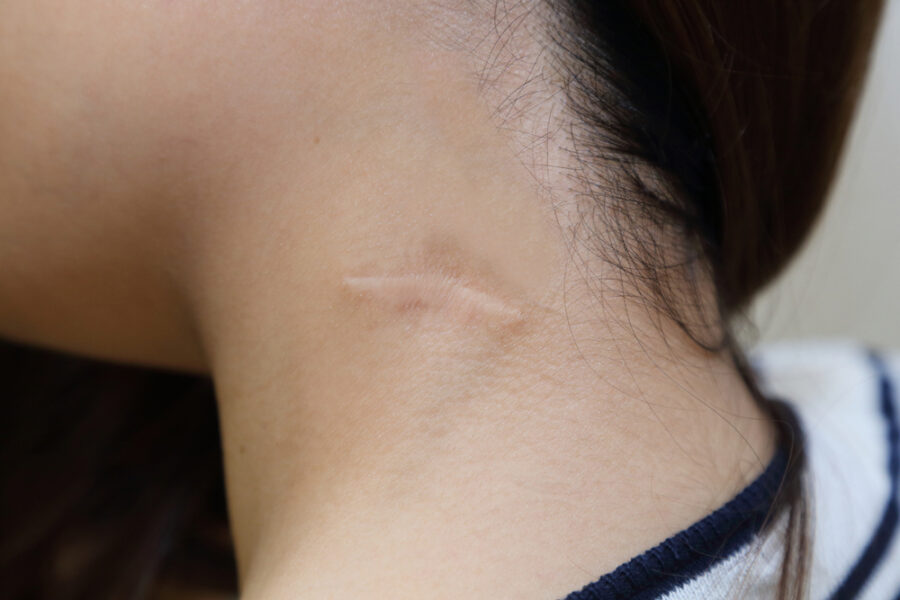
Corticosteroid therapy is, as its name suggests, a treatment based on corticosteroid injections — natural molecules that stimulate the production of anti-inflammatory proteins and, at the same time, reduce the molecules responsible for inflammation. As inflammatory lesions that are thick, hardened and bulging, keloid scars respond positively and effectively to this technique.
Corticosteroid therapy is delivered by injecting corticosteroids with a microsyringe or by means of the dermojet. The latter looks like a pen-shaped syringe with a built-in needle. It allows pressurised, completely painless injection. Corticosteroid therapy with the dermojet involves injecting depot injectable corticosteroids such as Kenacort* 40 or Kenacort* 80 into the scar. The product is injected along the entire length of the keloid scar’s dermis at a concentration of 40 mg/ml or 80 mg/2 ml. Ampoules of 40 mg and 80 mg are equally effective.
The injection is always given superficially and tangentially, with the bevel of the needle just embedded and turned outwards. This treatment is applied during the healing process and up to one or two years after the procedure. In general, the injections are given every 3 to 6 weeks. The scientific literature places the response rate to intralesional corticosteroid injections within a wide range of 50 to 100% depending on the scar and the protocol (Perdanasari et al., 2014); a ten-year follow-up of triamcinolone injections reports complete flattening of the scar in 71% of cases (Coppola et al., 2018). This method is one of the most commonly used and is, alongside compression, a mainstay of medical treatment for keloid scars. It is especially suited to young scars in the inflammatory phase, before they become too visible, and therefore has a relatively preventive role. On a painful or itchy scar, these injections also help ease the discomfort.
Radiotherapy
Radiotherapy is a treatment to be used as a last resort, when other treatments have not produced satisfactory results. It is carried out internally or by intra-scar brachytherapy. Despite the low radiation doses involved in radiotherapy, it is nonetheless not highly recommended for irradiated skin. In particular, tumour risks must be taken into account in young patients or on scar areas exposed to UV and sunlight. This technique is most often combined with an initial surgical reduction.
The causes of keloid scars are sometimes linked to genetic factors and an individual predisposition, which is more pronounced on darker skin tones. Their development can, however, be spontaneous, with no real apparent cause. It is therefore up to the doctor to choose the various treatments that can be considered and tailored to each patient. Radiotherapy may suit some people and not others. Likewise, this treatment is contraindicated in pregnant women, those under 18, and if the scar is located near an organ that is sensitive to X-rays. This may include the thyroid, the ovaries, the testicles or the breasts.
The surgical method for treating keloid scars
The surgical method can also be used to reduce an excessively large volume of keloid scar. This solution is not always permanent, however, because the risk of recurrence is relatively common. Indeed, with surgical removal, the patient risks a return of the hypertrophy and a progression in the keloid pattern. Surgical revision alone is then often insufficient to treat this type of scar on its own. It is therefore recommended to combine it with an additional treatment, most often compression or corticosteroid injections, to limit this risk of recurrence. When the keloid scar is too extensive and thick, the other treatments will not always be effective enough to deal with it either. Surgical treatment, while not a cure-all for treating a keloid scar, nonetheless very often forms an integral part of the overall protocol recommended for a complete and optimal result. This approach is a true scar revision performed by a surgeon, who determines on a case-by-case basis the most suitable combination of treatments.
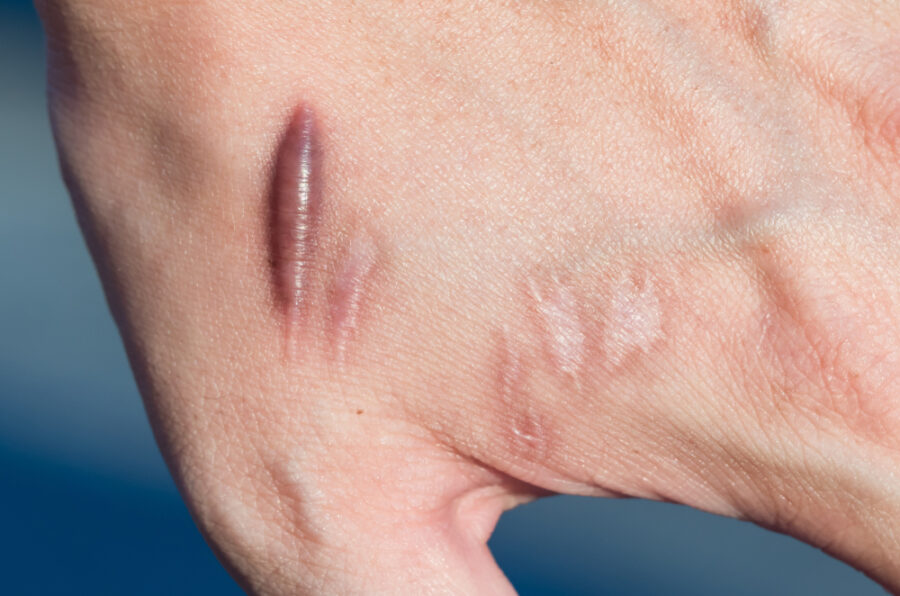
In practical terms, during the intervention, when removing the lesion the surgeon must never enlarge the scar, which carries a high risk of recurrence. Removal of the lesion within the scar must always be carried out without spilling over onto the edges — that is, by means of an intra-scar excision. This in turn limits the risk of recurrence even further. Resorting to surgical treatment must be preceded by a reliable diagnosis to determine whether it really is a keloid scar or « merely » a hypertrophic scar, which does not spread to the surrounding tissue and can still retract on its own.
Other possible treatments
Besides the treatments mentioned above, there are several other solutions for dealing with keloid scars. These treatments notably include cryotherapy, which involves destroying excess collagen cells with cold. The technique consists of injecting liquid nitrogen into the scar using a needle. A single application reduces the scar’s volume by 50%. It also considerably limits the itching, discolouration and pain felt. This solution is generally indicated for small keloid scars.
Laser treatment is also indicated for this type of scar. It works by limiting fibroblast activity and reducing redness. The so-called ablative laser destroys the scar to a greater or lesser depth and over a very wide surface. As for the vascular laser, it burns the vessels and consequently also reduces redness. Here too, however, recurrence after the ablative laser is relatively common. The laser is also among the techniques used for treating scars with radiofrequency and laser.
Finally, botulinum toxin injection, one of the most recent techniques used, also appears to be effective and able to treat this type of scar, through the inhibition of fibroblast proliferation and the promotion of angiogenesis, which speeds up the healing process. The injections must, however, be performed immediately after surgery to achieve the desired effect. This indication remains distinct from the usual aesthetic uses of Botox injections. The most suitable treatment — often a combination of several methods — is decided during a consultation at the practice of Dr Vincent Hunsinger in Paris.
Frequently asked questions
How do you make a keloid scar disappear?+
A keloid scar does not disappear on its own and resists over-the-counter products. Its management relies on targeted medical treatments, often combined: compression (compression therapy), corticosteroid injections, cryotherapy, laser and, in some cases, surgery combined with an additional treatment. The most effective protocol is defined on a case-by-case basis with a doctor, according to the age, size and location of the scar.
What is the difference between a keloid scar and a hypertrophic scar?+
A hypertrophic scar stays within the limits of the original wound and tends to regress on its own over time. A keloid scar, on the other hand, spreads beyond the initial wound, extends into the neighbouring tissue and does not regress by itself. This distinction determines the treatment: a reliable diagnosis is essential before any management, particularly before any possible surgery.
Can a keloid scar be treated naturally?+
Natural remedies and over-the-counter creams have no proven effectiveness in making an established keloid disappear. Silicone dressings and gels can, however, help soften a young scar and prevent it from worsening. For an established keloid, only medical treatments (compression, injections, cryotherapy, laser) bring real improvement.
Why do people develop keloid scars?+
A keloid results from excessive collagen production during healing. An individual and family predisposition comes into play, and the phenomenon is more common on darker skin tones. Some areas of the body are more prone to it, such as the earlobe, the décolleté, the shoulders or the upper back. Development can also be spontaneous, with no apparent cause.
Are corticosteroid injections effective on a keloid?+
Yes, intralesional corticosteroid injections (by microsyringe or dermojet) are one of the mainstays of medical treatment. The response rates reported in the literature range from 50 to 100% depending on the scar and the protocol. They are all the more effective on young scars in the inflammatory phase, and are generally repeated every 3 to 6 weeks.
Why does a keloid come back after surgery?+
Surgical removal alone carries a high risk of recurrence, because the procedure creates a new wound that may heal again in the keloid pattern. This is why surgery is rarely performed in isolation: it is almost always combined with an additional treatment (compression, corticosteroid injections or radiotherapy) in order to limit this risk of recurrence.
Book an appointment
If you are considering a procedure, book an appointment in just a few clicks: our surgeons will answer all your questions and guide you toward a tailored, personalised solution.
Book on Doctolib