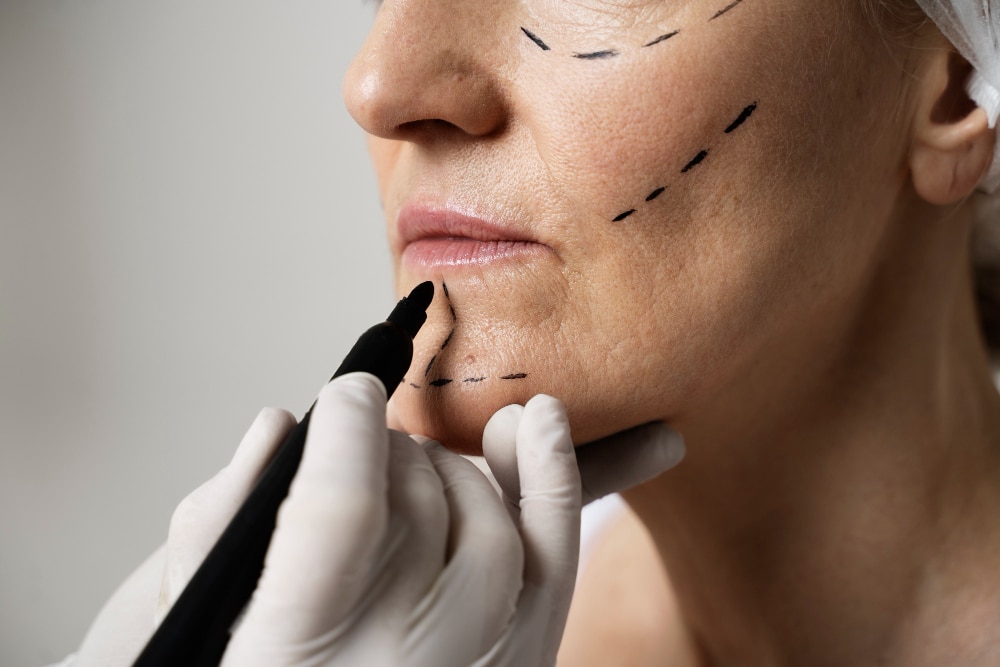
Facial feminization surgery: understanding FFS procedures
In some people, one or more areas of the face (forehead, chin, jaw, nose, brow ridge, etc.) may have features perceived as too masculine. Facial feminization surgery — or FFS, for facial feminization surgery — then makes it possible to refine these features so the face looks more feminine. Here, procedure by procedure, is what you need to know about facial feminization: who it is for, how it is performed, its insurance coverage and its price.
Contents
What does FFS surgery involve?
FFS surgery is a set of surgical procedures that can target one or more parts of the face (lower third, middle third, upper third) with the aim of feminizing a face.
These procedures, performed together or separately, are intended to refine and soften facial features considered too masculine. They make it possible to correct certain aspects of the face that are a source of self-consciousness, so they better match the patient’s gender identity.
They mainly relate to the areas where the bone structure is particularly pronounced compared with traditional feminine aesthetic standards (forehead, chin, jaw and Adam’s apple in particular).
Who can consider facial feminization surgery?
FFS surgery may be requested by 2 specific types of people:
- transgender or non-binary people as part of a male-to-female transition (gender reassignment). The aim is then to soften masculine features so that one’s appearance matches one’s felt gender identity. Feminizing the face alongside hormone therapy (administration of oestrogens) then allows the person in transition to feel more comfortable in their own skin and to put an end to potential social and emotional distress (gender dysphoria);
- cisgender women who feel self-conscious about a part of their face they consider too masculine (chin, forehead, nose, etc.). A procedure to refine the area or areas concerned can then help them regain self-confidence.
What are the main anatomical differences between a masculine and a feminine face?
Masculine features are characterised by more pronounced, assertive contours, whereas feminine features are generally smoother and more refined. This is largely explained by often more pronounced bone growth in men due to testosterone.
A masculine face generally shows a forehead that slopes more towards the back (because of the frontal bossing), a more prominent nose and a wider, squarer chin.
A feminine face, for its part, tends to be more linear with softer, less pronounced curves. The female face is nonetheless characterised by more prominent cheekbones creating an inverted-triangle shape.
In a general, schematic sense, one can speak of an oval face for women (sometimes tending towards a round face shape) and a more square and/or assertive look for men.
At the level of the soft tissues, fat tends to appear on the lower third of the face in men, whereas it accumulates more evenly across the whole face in women.
What are the different procedures used to feminize the face?
To feminize the face harmoniously, the surgeon classically works third by third (upper, middle, lower) and at the level of the neck. Depending on the morphology and the expectations, a single area or several can be treated during the same procedure.
The upper third: forehead, brow ridge and eyes
The upper face sets the tone for the femininity of the eyes. The reference procedure is forehead contouring: it consists of reducing the frontal bossing and the prominence of the brow ridge (supraorbital ridge) at the glabella, then lowering and rounding the frontal hairline, often combined with a scalp advancement (cranioplasty) to shorten a forehead that is too high. The result is a smoother forehead and a more open look. The correction of the frontal bossing depends on the thickness of the bone above the frontal sinus. Surgeons classically distinguish several forehead morphologies (a classification described by Dr Douglas Ousterhout): when the bony wall is thin — the most common case, known as « type 3 » — the anterior wall of the frontal sinus must be repositioned rather than simply shaved down, otherwise the result is insufficient or the bone is left fragile. A blepharoplasty procedure or a repositioning of the eyebrows can complete the feminization of the eyes.
The middle third: nose and cheekbones
At the centre of the face, feminizing rhinoplasty refines a nose considered too prominent: the bridge is reduced, the size of the nostrils is decreased and the nasal tip is refined — or even raised — for a more delicate profile. At this level, cheek augmentation also softens the face: the cheeks are enhanced through fat transfer (fat harvested elsewhere on the body and then reinjected) or, for a significant redefinition, by placing implants.
The lower third: jaw and chin
The lower face is one of the most distinctive areas of facial gender. A square or projecting chin is corrected with genioplasty: the chin bone is then shortened, thinned or repositioned to reduce its projection and round off the curves. A wide, angular jaw is treated with mandible reduction and jawline contouring, by shaving down or removing bone at the angles in order to soften the squareness and obtain a finer, more feminine jawline.
The neck: Adam’s apple reduction
A typically masculine feature, the Adam’s apple is a protrusion visible on the neck linked to the size of the larynx. Its reduction (chondrolaryngoplasty), performed by shaving the thyroid cartilage, gives a smoother, more refined neck. Often essential for transgender people, it is carried out with care to preserve the voice.
The choice of procedures depends on a personalised, in-depth analysis of the patient’s morphological features and expectations. After one or more consultations, the surgeon, together with the patient, sets a date for the procedure and the operative framework, and provides pre- and post-operative advice for a safe procedure and optimised results.
Process and insurance coverage: care pathway and reimbursement (ALD)
Facial feminization is prepared during one or more consultations that allow the surgeon to analyse the face, prioritise the procedures and explain each step. For transgender people, FFS is part of an overall transition pathway, usually coordinated with the endocrinologist (hormone therapy) and the follow-up team.
As for reimbursement, the situation differs depending on the context. For a transgender person, certain procedures may, on a case-by-case basis and under conditions, qualify for partial coverage by the French national health insurance (Assurance Maladie) as part of a long-term condition (ALD) linked to gender identity, subject to prior approval. Conversely, a purely aesthetic request (cisgender woman) falls under unregulated, non-reimbursed fees. As the terms change and are assessed individually, it is strongly advised to make enquiries beforehand with the Assurance Maladie and your surgeon: a detailed quote is provided at the end of the consultation.
Recovery and post-operative course
In the first few days, facial feminization causes swelling (oedema) and bruising that gradually fade. Depending on the extent of the procedures, a short hospital stay may be necessary, followed by a return to social life that is most often possible within two to three weeks, once the main swelling has gone down. The post-operative instructions (rest, head position, hygiene, avoiding certain efforts) largely determine the quality and comfort of the recovery.
Facial feminization: what results can you expect after FFS surgery?
Depending on the extent of the procedure, the results of a facial feminization appear gradually, depending in particular on the degree of post-operative swelling and bruising. As healing progresses, the tissues may also take some time to settle into their new position. Visible results therefore generally do not appear before several weeks and may only become fully apparent after a few months.
FFS surgery makes it possible to reshape the contours of the face to refine them, soften the features and make them more feminine. Feminizing the face then gives patients the opportunity to feel more comfortable in their own skin and to improve their self-confidence. For transgender people, it is also a way of finally aligning their physical appearance with their felt gender identity.
Most of the procedures performed as part of a facial feminization deliver permanent results, because they most often involve changes to the bone structure (mandible reduction, tracheal shaving, rhinoplasty in particular).
When FFS surgery acts on the soft tissues, the results are also long-lasting, but these tissues nonetheless remain subject to the effects of natural ageing and long-term skin laxity. Additional procedures may then be needed in the shorter or longer term to maintain the feminine appearance over time.
How much does facial feminization cost?
The prices for FFS surgery are quite variable, given that it involves a greater or smaller number of procedures depending on the morphology and the expectations of each patient.
Broadly speaking, the price of a facial feminization can range from €8,000 to €25,000.
In detail, the cost of FFS surgery may, for example, include:
- a genioplasty procedure costing between €4,500 and €6,000;
- a forehead contouring procedure ranging from €5,000 to €7,000;
- a feminizing rhinoplasty costing between €5,000 and €7,000;
- a laryngoplasty that can range from €3,000 to €4,000.
A personalised quote following an in-depth consultation remains the best way to get a relatively precise idea of the price of FFS surgery, and to discuss, where applicable, the question of its insurance coverage.
Frequently asked questions
What is FFS surgery (facial feminization surgery)?+
FFS, or facial feminization surgery, refers to all the procedures of facial feminization surgery. It aims to soften features considered too masculine — forehead and brow ridge, nose, cheekbones, jaw, chin, Adam’s apple — to make the face more feminine, in one or more procedures depending on the morphology.
How much does a facial feminization cost?+
The price of a facial feminization most often ranges from €8,000 to €25,000 depending on the number of associated procedures (forehead contouring, genioplasty, rhinoplasty, Adam's apple reduction, etc.). Only a personalised quote, provided after a consultation, makes it possible to price your project precisely.
Is facial feminization surgery reimbursed (ALD)?+
It depends on the context. For a transgender person, certain procedures may, on a case-by-case basis and under conditions, qualify for partial coverage by the French national health insurance (Assurance Maladie) as part of a long-term condition (ALD) linked to gender identity, subject to prior approval. A purely aesthetic request, on the other hand, falls under unregulated, non-reimbursed fees. It is best to make enquiries beforehand with the Assurance Maladie and your surgeon.
How long does it take to see the results and recover?+
The first few days come with swelling and bruising that gradually fade; a return to social life is most often possible within two to three weeks. The results, for their part, appear gradually and are only fully visible after several weeks to a few months, once the tissues have settled into place.
What is a “type 3” forehead in facial feminization?+
Surgeons classify forehead morphology according to the thickness of the bone above the frontal sinus (a classification described by Dr Douglas Ousterhout). “Type 3”, the most common, corresponds to a thin bony wall: the frontal bossing then cannot simply be shaved down, the anterior wall of the frontal sinus must be repositioned for a durable, safe result.
Book an appointment
If you are considering a procedure, book an appointment in just a few clicks: our surgeons will answer all your questions and guide you toward a tailored, personalised solution.
Book on Doctolib