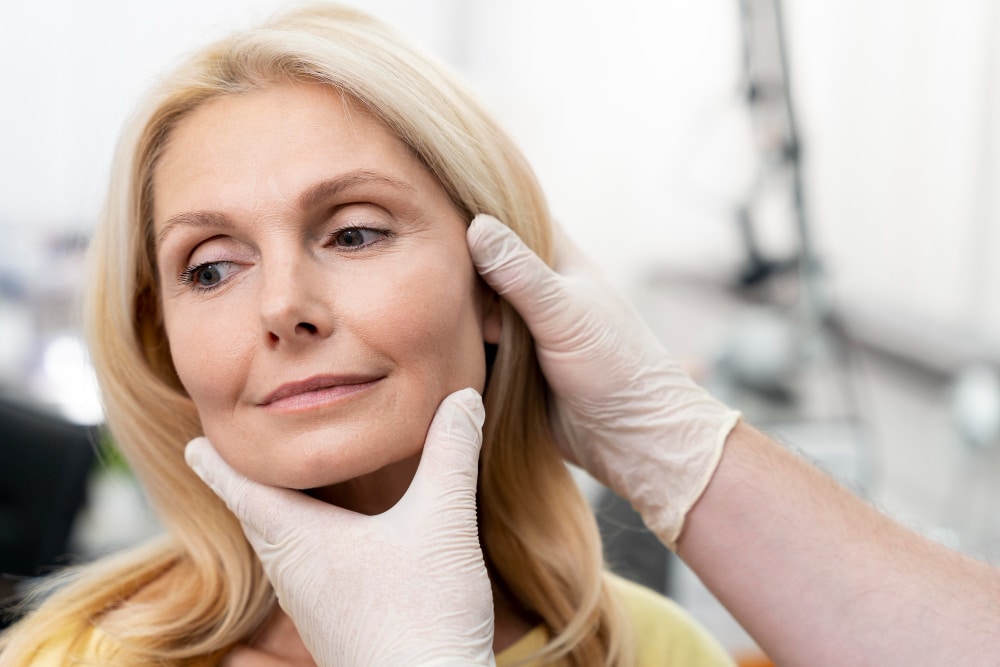
Facelift: expected results and scar healing
Have you had a facelift, or are you considering one to recover a more youthful appearance? This cosmetic procedure firms the skin and restores a well-defined facial contour. Like any surgical operation, it is not without consequences and may take some time to show its final results. Find out everything you need to know about the cervicofacial facelift, from the results to expect and scar healing to post-operative follow-up.
Contents
What does a facelift involve?
The facelift, also known as the cervicofacial lift, is a plastic surgery procedure designed to re-tighten the tissues of the face in order to give it a fresher, less tired appearance. The operation mainly aims to correct the principal signs of ageing such as sagging skin, deep wrinkles and the laxity of the facial muscles, which is responsible for the loss of volume in the face and neck.
At our Rive Droite Paris Étoile practice, the operation is most often performed under general anaesthesia. Dr Hunsinger makes fine, very discreet incisions around the ears, and sometimes under the chin, in order to access the internal structures of the face and then reposition the soft tissues and re-tighten the slackened muscles. The tension is applied above all to the deep plane, the SMAS (superficial musculo-aponeurotic system): the result rests on this layer, not on the skin, which makes it possible to achieve a natural effect without scars under tension. The operation generally ends with removal of the excess skin and re-draping of the skin to obtain a more toned appearance and a rejuvenated face. The facelift can be performed on its own or together with other complementary procedures such as targeted liposuction (notably around the chin), facial fat transfer to restore volume, or even a blepharoplasty, or eyelid surgery for even more refined results. When the laxity remains moderate, less invasive alternatives such as a non-surgical facelift can also be considered.
The results after the procedure
The facelift very often produces relatively dramatic results, even though we do everything possible to make the effect as natural as it can be. After the procedure, the patient has a rejuvenated appearance with a redensified face and a restoration of the face’s volumes and contours, particularly at the level of the jawline, cheeks, chin and neck (the cervicomental angle). Wrinkles and fine lines are also softened, the skin looks smoother, and the contours of the face recover their former appearance with the tissues repositioned to where they originally sat.
After a cervicofacial facelift, the result is only final after several weeks or even several months (generally 3 to 6 months), the time needed for the swelling to fully subside but also for the tissues to heal and rebuild. A period of social downtime of about one to two weeks should therefore be anticipated.
While the results are long-lasting, it should be noted that the procedure does not stop the skin’s natural ageing process, which may eventually begin to sag again. The results of a cervicofacial facelift are generally considered to remain genuinely appreciable for around ten years.
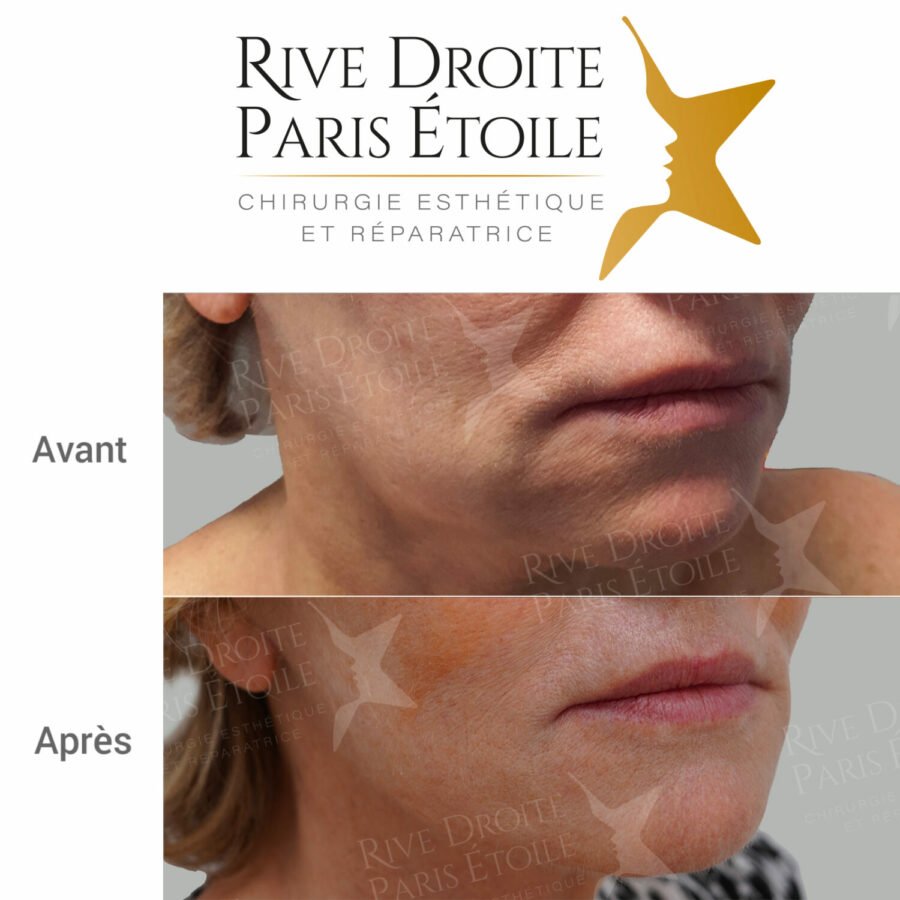
What scars are left after a facelift?
Even though they tend to become more and more discreet over time, small scars may be visible after a facelift. They are nevertheless generally well concealed in the natural folds of the skin, in the scalp or behind the ears. Their location actually depends on the treated area. They may therefore be situated:
- around the ear extending to the back of the hairline, for treatment of the neck and the jowls;
- in front of the temple, to treat the upper third of the face and in particular the upper lip and the tail of the eyebrows;
- along the hairline for a forehead or temporal lift. This is the case, for example, for a procedure aimed at reducing crow’s feet and forehead wrinkles or at working on the temples;
- at the lower eyelid for a midface (malar) lift on the middle third of the face. This aims to treat sagging cheekbones or very pronounced nasolabial folds.
The scar around the ear is the most common: it follows the natural fold in front of the ear and then continues behind it, which makes it particularly hard to spot once healing is complete. A scar check must be carried out by Dr Hunsinger within 5 to 10 days after the procedure, in order to confirm that healing is progressing well but also to check the skin’s reaction to the sutures (to avoid the risk of rejection of absorbable threads in particular). If non-absorbable sutures or even staples were used, they are generally removed about 7 days after the operation.
How scars evolve: the phases of healing, month by month
Healing after a facelift is a gradual process that spreads over several months. Understanding these different phases helps you avoid worrying when faced with a scar that is still red or firm a few weeks after the operation: its appearance will keep improving long after you feel « healed ».
- The first 10 days: a healing check between day 5 and day 10 and removal of any non-absorbable sutures. The scar is then recent, sometimes slightly swollen.
- From 2 to 8 weeks: the scars begin to flatten and fade. They may look more visible before they settle down, which is perfectly normal.
- From 2 to 3 months (inflammatory phase): the scars may take on a red or pinkish tone and cause itching. This is when they are most noticeable.
- Around 6 months: in the vast majority of cases, the scars are no longer red and become fine, pale lines that are hard to distinguish.
- Up to 1 year, or even 2 years: maturation continues. The scars eventually whiten and blend into the scalp to become almost imperceptible.
This timeline matches what plastic surgeons observe: according to the plastic surgery literature, the scars from a facelift are generally no longer red by around the sixth month, and their full maturation can take one to two years, with most patients satisfied with their appearance from around six months. Each person’s skin heals at its own pace, however, and a facelift performed on the deep plane (SMAS) limits tension on the skin, which favours fine scars.
Tips to speed up scar healing
In the first 2 to 3 months after the procedure, the scars may take on a red appearance and cause itching (the inflammatory phase). In most cases, they then fade naturally and whiten to become practically imperceptible, blending in with the scalp. Petroleum jelly can be used to help with difficult healing.
To speed up scar healing, several precautions can also be taken:
- we particularly recommend avoiding tobacco for a few weeks (ideally 15 days before and after the procedure), as it can increase the risk of necrosis and of the scar widening;
- also avoid sun exposure as much as possible to protect yourself from the risk of hyperpigmentation. Plan to use an SPF 50 cream and reapply it regularly, and limit exposing your face during the hottest hours, throughout the first year;
- maintain regular hygiene on the treated areas to support healing and avoid any risk of infection. Specific creams may be provided by our teams to soothe the inflammation;
- carry out regular lymphatic drainage and self-massage around the incisions once healing is complete. This will help refine the scar, making it all the more discreet.
If the prospect of a scar puts you off, you should know that incision-free techniques such as radiofrequency to firm the skin without a scar exist for early-stage laxity, though they do not replace the result of a genuine surgical facelift.
Recovery and post-operative care after a cervicofacial facelift
Beyond scar healing, the post-operative recovery from a facelift is not insignificant, even though it nevertheless remains limited. It is also fairly variable from one person to the next.
Patients may in particular experience perfectly normal swelling and bruising, as well as a feeling of tightness or even numbness in the face linked to the restructuring of the tissues. A press-lift, to be worn for a few days around the head, may be provided by Dr Hunsinger to limit swelling. Mild pain may also be felt in the first few days after the procedure. It can be relieved by taking painkillers.
A period of rest should be observed, with limited outings, social downtime of 5 to 10 days and a halt to sporting activities for at least 3 to 4 weeks. Rotating movements of the neck should also be limited. It is therefore preferable to favour sleeping on your back as much as possible, with the head slightly raised, in order to limit swelling and protect the operated areas.
Make-up should also be avoided for at least 5 to 6 days to let the skin breathe. Likewise, shampoos are forbidden for the first 2 days, and showers should be favoured over baths to support healing. Trips to the hairdresser should be postponed until at least 3 weeks after the procedure. Wait 4 to 6 weeks in the case of dyeing or colouring.
Possible risks and complications after a cervicofacial facelift
The cervicofacial facelift is a widespread operation that is very well mastered by our surgeons. As with any surgical procedure, however, risks and post-operative complications can nonetheless arise. They may notably manifest as excessive swelling of the face. We then advise you to apply cold compresses or ice packs to the skin regularly to limit swelling. It generally disappears within a variable period of between 10 and 20 days but may also subside after a month for some patients. A drainage system may also be put in place by our teams just after the procedure (suction drains) to reduce swelling.
Infections at the incisions are another possible complication to watch for after a facelift. Although they are extremely rare in this case, hypertrophic or keloid scars may, for example, develop in some patients. The scars must then be disinfected regularly, in particular using an antibiotic ointment, and the incisions checked shortly after the operation by Dr Hunsinger.
A temporary loss of sensation, most often temporary asymmetries during movement in the treated areas (the cheeks and neck in particular) as well as a certain firmness (induration) may also be observed in some patients. They are explained in particular by the lifting of the skin during the operation. This sensation disappears on its own over the following weeks.
Frequently asked questions
Where are the scars from a cervicofacial facelift located?+
The incisions follow the natural fold lines of the face: they most often start in front of the ear, go around the auricle and then extend behind the ear and into the scalp. Depending on the areas treated, they may also sit in front of the temple, along the hairline or at the lower eyelid. These locations make the scars very hard to spot once healing is complete.
After how long do facelift scars become invisible?+
Healing is gradual. The scars go through a red, inflammatory phase at around 2 to 3 months, are generally no longer red by around the sixth month, then continue to fade. Their full maturation can take one to two years, at the end of which they become fine, pale lines that are almost imperceptible. Most patients are already satisfied with their appearance from around six months.
Are the scars from a facelift visible?+
In the first few months they can be, especially during the inflammatory phase. But because they are concealed in the natural folds of the skin, behind the ears and in the scalp, in the vast majority of cases they become very discreet, even imperceptible, once maturation is complete. Tension applied to the deep plane (SMAS) rather than to the skin helps produce fine scars.
How should you sleep after a facelift?+
It is recommended to sleep on your back, with the head slightly raised, during the first few weeks. This position limits swelling, avoids pressing on the operated areas and supports good healing. Rotating movements of the neck should also be limited at first.
How can you speed up scar healing after a facelift?+
Several precautions help: avoiding tobacco (ideally 15 days before and after the procedure), protecting the scars from the sun with an SPF 50 sunscreen during the first year, maintaining gentle, regular hygiene, and carrying out lymphatic drainage and self-massage once healing is complete to soften and refine the scars.
How long does it take for swelling to go down after a facelift?+
The swelling and bruising largely fade within 10 to 20 days, sometimes up to a month depending on the person. The result, however, is only truly final after 3 to 6 months, the time needed for the tissues to rebuild. We go into more detail in our article on how long swelling lasts after a facelift.
How long do the results of a facelift last?+
A facelift does not stop natural ageing, but its results remain genuinely appreciable for around ten years on average. Skin quality, lifestyle and sun protection all influence this duration.
Book an appointment
If you are considering a procedure, book an appointment in just a few clicks: our surgeons will answer all your questions and guide you toward a tailored, personalised solution.
Book on Doctolib