
- Mastopexy, the medical name for a breast lift, corrects breast ptosis: it removes excess skin, raises the areola and reshapes the gland, with or without implants.
- The technique — round block, vertical or inverted T — depends on the grade of ptosis measured in consultation, on the quality of the skin and on the breast volume.
- The procedure takes 1h30 to 2h under general anaesthesia, most often with one night in hospital.
- Scars become mature between 12 and 18 months; support bra for 1 month, return to work in 1 to 2 weeks, sport at 3 months.
- In Paris, expect €6,800 to €8,800 without implants and €8,400 to €11,800 with implants. No cover from the health service, unless a breast reduction is combined, or for tuberous breasts or severe asymmetry.
01Mastopexy in practice: what it corrects, what it does not
Mastopexy is the reference operation for raising a sagging bust and giving it a harmonious shape again. Over time the breasts drop and lose elasticity, chiefly through weight fluctuations (after bariatric surgery, for instance), skin ageing, or repeated pregnancies and breastfeeding.
Gradually the breast tissue shrinks and slides downwards, taking the nipple and areola with it as far as the inframammary fold (the crease under the breast). This breast ptosis gives an emptied look and a flat décolleté, which many women find hard to live with.
Mastopexy is the medical term for a breast lift: it is exactly the same operation. It repositions the breast tissue and the nipple-areola complex, rebalancing the volumes, reshaping the contour and restoring projection. It is worth being clear about what the procedure can and cannot do:
- what mastopexy corrects:
- skin laxity;
- the position of the areola and nipple, raised higher;
- the shape of the gland, by redistributing the existing volume;
- an asymmetry between the two breasts caused by one dropping more than the other;
- what mastopexy does not correct:
- a lack of breast volume: the operation cannot increase volume on its own unless a breast augmentation with implants or a breast fat transfer is combined with it, notably for breast hypoplasia;
- likewise, mastopexy alone does not reduce breast volume, for example in breast hypertrophy. A breast reduction must be combined with it.
02Which grade of ptosis calls for which incision?
Mastopexy can be performed using several operative techniques. The choice depends on the grade of breast ptosis assessed by the surgeon during the preparatory consultations. Each incision follows a precise path and leaves a specific scar.
- Grade 1 (mild ptosis) — nipple level with the inframammary fold — periareolar (round block) incision — a circular scar around the areola;
- Grade 2 (moderate ptosis) — nipple slightly below the fold (1 to 3 cm) — vertical (lollipop) incision — around the areola plus a vertical scar down to the fold;
- Grade 3 (severe ptosis) — nipple well below the fold (more than 3 cm) — inverted-T (anchor) incision — around the areola, vertical, plus a horizontal scar in the fold.
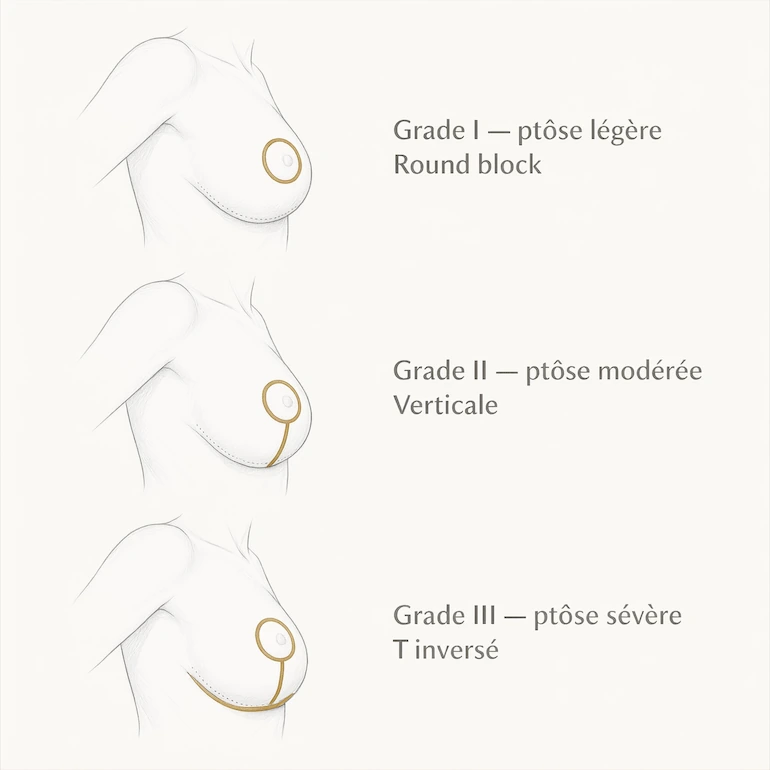
In detail:
- the periareolar or round block incision: mainly for mild ptosis, it uses concentric circles around the areola to remove the ring of excess skin and raise the areola and nipple. The scar is hidden at the natural border between the pigmented areola and the breast skin;
- the vertical or « lollipop » incision: for moderate ptosis, it adds a vertical incision running from the areola down to the fold. This gives easier access to the gland and allows more substantial reshaping;
- the inverted-T or anchor incision: essential for severe ptosis, it repeats the previous incisions and adds a horizontal one in the crease under the breast, making it possible to remove larger amounts of skin for a complete redraping.
The surgeon’s final choice is guided by:
- the grade of ptosis (the drop, measured in centimetres between the sternal notch and the top of the areola). As a rule of thumb, the ideal height of the nipple-areola complex above the sternal notch is the patient’s height divided by 10, plus 1 — about 17.5 cm for a woman of 1.65 m;
- the quality and elasticity of the skin;
- the breast volume available;
- the projection wanted;
- the stability of the patient’s weight.
At Rive Droite Paris Étoile, Dr Hunsinger, Dr Derhy and Dr Privé take all the measurements needed for your own anatomy before proposing the most appropriate technique, always aiming for elegance and a natural result.
03Mastopexy alone, with implants or with a reduction: which variant for which case?
Depending on the patient’s anatomy and expectations, three options can be considered:
- mastopexy alone, or mastopexy without implants (€6,800 to €8,800): for patients with enough breast tissue who want to correct the shape and position of the bust without changing cup size;
- mastopexy with breast implants (€8,400 to €11,800), including high-quality implants (€550 to €650): the reshaping is combined with a breast augmentation to add projection to the décolleté and firmness to the contour. It suits patients with little breast tissue, or who have lost volume and projection after significant weight loss — after a sleeve gastrectomy, for instance;
- mastopexy with a breast reduction (price on a personalised quote, depending on the volume removed): when the sagging is partly due to breast hypertrophy, gland can be removed at the same time as the skin. The aim is to rebalance the proportions of the bust, particularly for patients with back pain.
Mastopexy is sometimes part of a Mommy Makeover, a global reshaping of the silhouette after one or more pregnancies, usually alongside an abdominoplasty.
The clinical examination carried out at Rive Droite Paris Étoile, in the 17th arrondissement close to the Arc de Triomphe, defines the scope of the operation. Our surgeons listen to what you want and explain, step by step, how the operation will go and what results to expect.
04Mastopexy scars: pattern, month-by-month evolution, how to optimise them
However well the technique is executed, mastopexy inevitably leaves scars that are visible for a time. Healing depends on the incision used (vertical and inverted-T scars being the most visible), on the quality of the sutures, and on the patient’s own skin. Scars usually follow a maturation timeline of 12 to 18 months:
- first month (day 0 to day 30): the incisions close; the scars are fine and neat but pink or red. The stitches fall out or dissolve. Superficial healing is generally complete at around 3 weeks;
- 1 to 3 months: the inflammatory phase — the scar swells, thickens and looks raised. Itching is common and the colour turns red or purplish. This ungrateful stage is a normal part of healing, during which the tissues rebuild (collagen remodelling);
- 3 to 6 months: the softening phase — inflammation gradually subsides, the scar begins to flatten and soften. It stays fairly red but starts turning brown;
- 6 to 12 months: the fading phase — the scar lightens significantly, moving towards the patient’s natural pigmentation, and becomes finer, flatter and more supple;
- 12 to 18 months: healing is considered complete. The scar blends into the surrounding skin. It never disappears entirely, but becomes very discreet and imperceptible at a normal distance.
This timeline can be improved by following a disciplined post-operative routine:
- wearing a support bra or compression top day and night from discharge and throughout the first month (except when washing);
- applying silicone dressings (sheets or gel) to flatten the scar and limit swelling. They should be worn as much as possible for several months, and can only be started once the crusts have gone and superficial healing is complete;
- gentle scar massage with a moisturiser or silicone gel, once the dressings are off and the crusts have gone;
- strict sun protection for at least the first year, with limited UV exposure and SPF 50+ where needed, even under a swimsuit. Sun exposure can cause irreversible brown pigmentation of the scar;
- stopping smoking at least 8 weeks before the operation, and for 6 weeks afterwards according to some recommendations. Smoking impairs blood flow at the very moment the tissues need oxygen and nutrients, exposing the patient to wound breakdown, infection or necrosis of the areolar skin.
05Possible complications and revisions: what can happen, what can be corrected
However skilled the surgeon, complications are always possible, although they are usually mild:
- swelling and bruising, entirely normal after cosmetic surgery, which settle on their own within a few days;
- a haematoma, which may require a revision with drainage;
- an infection: rare, treated with antibiotics; surgical washout may occasionally be needed if an abscess forms;
- wound breakdown, when some of the sutures give way. The scar can open by a few millimetres or centimetres, most often where the incisions meet (particularly with an inverted T). The preferred approach is not to re-stitch immediately but to apply greasy dressings and let the wound heal in;
- partial necrosis of the areola, caused by compromised blood supply — a risk considerably increased by smoking;
- loss of sensation in the areola and nipple, usually lasting a few months before returning to normal.
Aesthetically, imperfections can also occur and sometimes justify a revision:
- a hypertrophic or keloid scar: swollen, red and raised with widened edges. Residual skin at the edges can usually be removed with a minor revision under local anaesthesia; laser sessions or corticosteroid injections can also be considered;
- a residual breast asymmetry in volume, shape or areola height. A revision under local anaesthesia is possible, either removing skin or realigning the areolae;
- recurrence of the ptosis, with the breast gradually sliding down again while the nipple points upwards: a second mastopexy is then needed to raise the gland and redrape the lower pole.
06Price and fees in Paris
Mastopexy prices at Rive Droite Paris Étoile, in the 17th arrondissement of Paris, vary with the type of surgery planned:
- for mastopexy alone, expect €6,800 to €8,800: this covers the surgeon’s fees and anaesthetic costs, theatre and hospital costs (operating theatre and room), and post-operative follow-up for one year;
- for mastopexy with a breast augmentation, the price is €8,400 to €11,800. It covers everything included in the mastopexy plus the augmentation itself (€550 to €650 for high-end implants; price on request for a breast fat transfer);
- for mastopexy with a breast reduction, the price depends on the volume of gland removed, any combined procedures and the time in theatre. Ask Dr Hunsinger, Dr Derhy or Dr Privé for a detailed quote.
07How the procedure works
Before the procedure
Before a mastopexy, several consultations with the surgeon (usually two) are needed. They serve to take the patient’s expectations and assess her anatomy in order to define the scope of the operation. The surgeon also sets out a pre-operative protocol to make the procedure as safe as possible:
- breast imaging (mammogram, breast ultrasound) to rule out any lesion;
- stopping smoking at least 8 weeks before the operation (and 4 to 6 weeks afterwards) so as not to compromise healing;
- stopping certain medicines at least 10 days before surgery (aspirin, anti-inflammatories, anticoagulants);
- an appointment with the anaesthetist, at the latest 48 hours before the operation;
- an antiseptic shower the evening before and on the morning of surgery.
To finalise the plan, the surgeon gives the patient a detailed quote. A mandatory 15-day cooling-off period must be observed between the first consultation and going into theatre.
During the procedure
Mastopexy is performed under general anaesthesia and usually takes 1h30 to 2h. It most often requires one night in hospital for monitoring, although in some cases it can be done as a day case, with discharge the same evening.
The operation begins with pre-operative marking of the incision lines and the new position of the areola. Once the patient is anaesthetised, the surgeon makes the incision and begins removing the excess skin partly responsible for the sagging.
Depending on the grade of ptosis, the breast tissue is then reshaped and repositioned higher. The nipple-areola complex is also raised to rebalance the breast. This is also the stage at which silicone implants are placed (or fat is grafted) for a breast augmentation, or gland removed for a breast reduction.
Once the gland is secured and the areola repositioned, the skin is redraped and the surgeon closes with dissolvable stitches. Drains are sometimes placed to prevent haematomas. A shaping dressing and a support bra are finally applied to consolidate the new position.
After the procedure
Mastopexy is generally well tolerated, with limited side effects. What little discomfort there is settles quickly with painkillers.
Recovery usually follows this timeline:
- days 1 to 3: moderate discomfort (a feeling of tightness) and first care (dressings changed daily, compression garment worn around the clock). First shower usually allowed on day 2. Rest at home, no raising the arms and no heavy lifting;
- days 7 to 15: first check-up of the scar with the surgeon, and removal of any drains. Dressings are generally taken off at this stage. The patient can consider returning to work;
- days 15 to 30: healing is well advanced and swelling and bruising have gone. Daily showers are allowed but baths and swimming pools are still off limits. Driving and gentle activity can be resumed;
- 1 month: the support bra can be removed at night but should still be worn until the surgeon says otherwise;
- 3 months: the breast begins to take its final shape and healing is well advanced. Scar massage can begin, and sport and heavy lifting can gradually be resumed;
- 1 year: healing is mature and the result is considered settled.
08Prices & fees in Paris
| Procedure | Aesthetic fees |
|---|---|
| Mastopexy alone, without implants | 6 800 – 8 800 € |
| Mastopexy with implants | 8 400 – 11 800 € |
| Mastopexy with a breast reduction | demander devis |
Indicative “from” prices, surgeon fees included. The final quote is given at the consultation, after examination, depending on the area treated and the technique chosen. Part of the procedure may be covered by French national health insurance when the medical criteria are met.
09Your questions
How much does a mastopexy cost in Paris?+
A mastopexy in Paris generally costs between €6,800 and €11,800. For a precise estimate, ask the surgeons at Rive Droite Paris Étoile, close to the Arc de Triomphe, for a detailed quote.
Is mastopexy covered by the French health service?+
No. As a purely cosmetic procedure to correct sagging breasts, mastopexy alone is not covered. Partial cover may nonetheless be obtained if the operation is combined with a substantial breast reduction (at least 300 g per breast), with the correction of tuberous breasts, or with the correction of a major breast asymmetry. The surgeon then submits a prior-agreement request before the operation.
Is there such a thing as a scarless mastopexy?+
No, mastopexy inevitably leaves a scar. It is, however, particularly discreet with a round block incision for mild ptosis.
What are the possible complications of a mastopexy?+
Possible complications include a haematoma, infection, necrosis of the areola or temporary loss of sensation. Healing problems can occasionally occur, with a risk of wound breakdown, hypertrophic or keloid scarring, breast asymmetry, or recurrence of the sagging.
How long does a mastopexy take?+
A mastopexy takes between 1h30 and 2h. It can vary with any combined procedures (breast augmentation or gland removal). The results are long-lasting over many years, which does not prevent the natural ageing of the breast skin.
How much does a mastopexy without implants cost?+
A mastopexy on its own, without implants, costs between €6,800 and €8,800 in Paris.
Is a mastopexy painful?+
No, compared with other procedures a mastopexy is not very painful. A feeling of tightness across the bust and aching in the chest can be felt in the first few days, and is quickly relieved by painkillers.
Can a mastopexy be redone later?+
Yes. A revision or a second mastopexy can be considered several years later if the breasts sag again, whether through natural skin ageing or a subsequent pregnancy.