Everything you need to know about thread lifts
Please note: this article is for informational purposes only and in no way constitutes encouragement or a recommendation to undergo any procedure. Although this technique is used by some plastic and aesthetic medicine specialists, Rive Droite Paris Étoile does not perform this type of procedure and does not offer it to its patients. Our surgeons in fact consider this thread lift method to be of limited effectiveness, and instead recommend a surgical facelift or even a non-surgical facelift for convincing, long-lasting results. These are procedures they perform very regularly and in which they have considerable expertise.
Would you like to firm up your facial features and regain smooth skin and a radiant complexion? Are you terrified of the scalpel and unable to take the plunge into surgery? Rest assured: there are now non-invasive methods to fight skin laxity without going to the operating room for a surgical facelift. One of the latest aesthetic medicine innovations is to opt for a re-meshing using tensor threads with no incision and no scar. What should we make of this very fashionable new technique? How does it actually work? Is it genuinely effective over time? Find out everything you need to know about this innovative non-surgical facelift method.
Contents
The principle of tensor threads, or thread lift
Over time, the various components of the face begin to sag, eventually causing the progressive loss of the facial oval (an inverted-V shape). The cheekbones, jowls, the nasolabial fold and the marionette lines all drop, not because of fat loss but mainly under the weight of gravity. The fatty tissues, while remaining intact in their proportions, gradually slide downward, creating hollows and unsightly contours. This facial skin laxity and loss of skin elasticity generally sets in from around the age of forty.
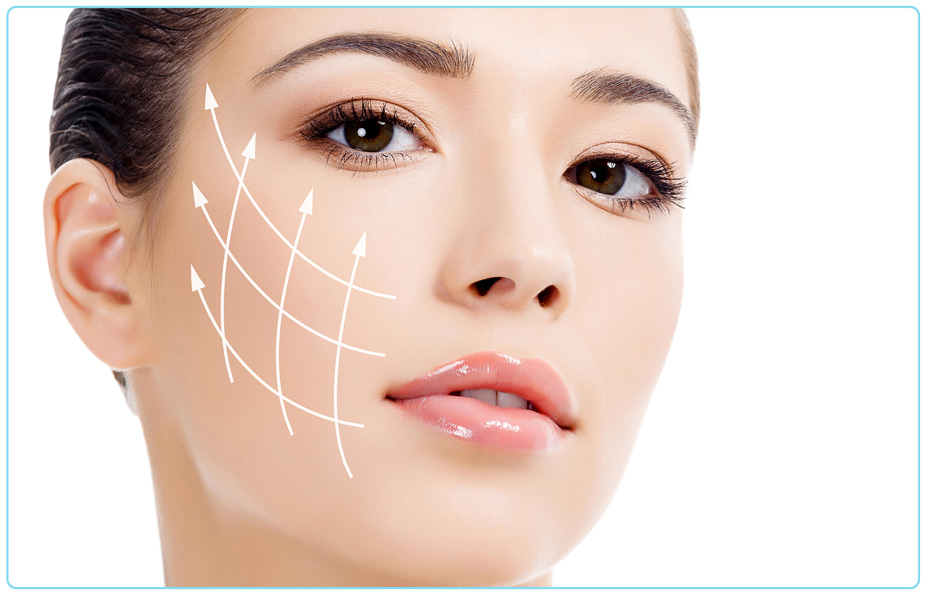
The thread lift technique addresses this sagging by re-tightening the areas affected by displaced fat using tensor threads designed to support a slackened area of skin, thereby producing a lifting effect or mini-lift.
Tensor threads are synthetic, medical-grade, biodegradable threads made from polydioxanone, which is why they are commonly called PDO threads.
They can be smooth and positioned in a mesh to spread collagen production over large surfaces. Conversely, they can be twisted to treat small, targeted areas, generally for fairly moderate laxity.
Tensor threads can be either absorbable or permanent.
Absorbable threads are generally used for younger people with mild skin laxity and limited, localized sagging. They create a collagen framework that supports and lifts the skin for a period of 12 to 24 months. To go further on the materials used, our dedicated article details the difference between absorbable PDO, PLLA and PCL threads.
Non-absorbable, and therefore permanent, threads lift the soft tissues toward the upper face more durably (for up to 5 years). In this case they are also known as suspension threads, tension threads or non-absorbable barbed threads, and they require a slightly longer procedure. Despite being called “permanent threads”, they do not mean a lifelong commitment for the patient. They can be removed at any time using an anesthetic product that over-hydrates the skin so the threads can slide out and be extracted. The term “permanent” in fact refers more to the very good biocompatibility of the threads, which stay in place and intact once inserted.
How a non-surgical facelift session with tensor threads works
The procedure to insert tensor threads takes place directly at the clinic in a sterile operating room, without the need for hospitalization. It lasts 30 to 90 minutes depending on the technique used. A simple local anesthetic is administered. To be able to perform this type of procedure, the skin must still be elastic, free of lesions and thick enough not to let the threads show through.
After applying an anesthetic cream, the practitioner slides the threads under the facial skin one by one, following a U-, V- or Z-shaped marking, then brings them back out and trims the ends once the desired tension is achieved and the skin is harmoniously re-draped. The threads are positioned along the patient’s tension lines and are generally placed across 4 areas:
- The temporal area at the temples
- The malar area at the cheekbones, above the jaw
- The jugal area around the bony arch of the cheek
- The cervical area at the neck
The absorption of the threads produces a vertical tightening action through traction and mechanically activates the growth of stem cells. The creation of these new fibroblasts in the hypodermis triggers a regenerating mechanism that reactivates the production of collagen and elastin, the substances that give the skin firmness and elasticity.
The different types of tensor threads
Several types of tensor threads are used depending on the chosen procedure and the patient’s profile:
- PDO threads: particularly used to re-tighten the heaviest areas of the face (cheekbones or jowls), they show notable effectiveness after one month, for an average duration of 9 months. After stimulating the fibroblasts and collagen production, the threads then absorb naturally, improving skin tone and elasticity in a natural way.
- The gold thread: this is a re-meshing technique mainly indicated for people experiencing moderate laxity, particularly as they approach their forties. Gold threads are extremely fine, very pure (99.9% gold) and lift the tissues while stimulating collagen. They are particularly suited to treating laxity of the cheekbones, jowls and neck. The results take some time to appear but are then more durable, with gold threads taking up to 5 years to break down.
- Barbed threads: able to treat ptosis of the tail of the eyebrow, ptosis of the jowls, the jaw or the neck, the barbed-thread technique is used on the most exposed areas of the face for profiles with moderate laxity. Made up of barbs oriented in opposing directions that anchor in the subcutaneous fat, they form a mesh that suspends and lifts the skin tissue from the edges toward the center. The results take several months to appear and last from 3 to 5 years.
- The Crantor method, which is similar to a mix of the last two techniques: gold-thread re-meshing and barbed-thread re-meshing. This technique thus combines collagen synthesis with a facial tightening effect to create a suspension-through-fibrosis effect. It is the most complete solution, acting on most exposed areas, including the eyebrows, cheeks, jaw and neck. Its effectiveness also lasts between 3 and 5 years.
The advantages of tensor threads
Tensor threads offer many advantages over a conventional surgical facelift. Among the strengths of this aesthetic medicine solution, the following points stand out in particular:
- A gentle, minimally invasive method comparable to acupuncture.
- A discreet result that avoids the “frozen look”.
- A quick (30 minutes to 1 hour) and painless procedure performed with fine cannulas, requiring no hospitalization and only a local anesthetic.
- No incision on the face and therefore no scar (a single injection point).
- Immediate results that continue to improve over the following months.
- A procedure that is safe for your health with absorbable threads (which are also regularly used in surgery for deep sutures).
The areas where tensor threads are used
Used from the age of 35 by men and women alike, tensor threads visibly reduce the skin laxity that naturally occurs over time on various areas of the face: eyelids, cheekbones, jowls, the corners of the lips, the nasolabial fold and the eyebrows. They thereby maintain the facial oval, preventing the generalized sagging that gives a tired appearance, a sad expression and a disharmonious profile. For marked laxity of the eye area, however, an eyelid surgery (blepharoplasty) or the various eye rejuvenation methods are the better options.
While the face is the main area where tensor threads are used, they can nonetheless be applied to prevent skin laxity in other parts of the body that are particularly vulnerable to it, such as:
- The arms — laxity for which the arm lift (brachioplasty) remains the reference surgical solution in cases of significant excess skin
- The knees
- The buttocks
- The belly
Using them on other parts of the body, although effective, is relatively expensive given the large quantity of threads needed to cover these surfaces.
What results can you expect from a non-surgical facelift with tensor threads?
Inserting tensor threads provides many benefits, especially for patients with moderate sagging. These include:
- Stimulation of collagen and of the tissue-repair mechanism;
- Re-tightened, toned skin thanks to the production of elastin and hyaluronic acid;
- A reduction in wrinkles and fine lines that can be perfected with botulinum toxin (Botox) injections and hyaluronic acid to fill wrinkles (for lines around the eyes and lips in particular);
- The disappearance of nasolabial folds;
- A redefinition of cheekbones that tend to drop;
- A lifting of the tail of the eyebrows;
- A redrawn facial oval, with the disappearance of jowls and re-tightened neck wattles.
It must be kept in mind, however, that these results remain temporary. A large international multicenter review published in 2025, covering more than 110,000 thread placements, puts the average duration of the lifting effect at around 6 to 12 months depending on the thread material and the area treated — a figure noticeably shorter than is sometimes claimed. This is one of the reasons why our surgeons favor solutions with more stable, long-lasting results.
How much do tensor threads cost: prices and budget to plan for
The price of tensor threads for the face depends mainly on the number of threads inserted, their type (absorbable or permanent) and the number of areas treated. As a guide, and based on the ranges commonly observed among practitioners, a session generally costs between 700 and 3,000 euros: around 700 to 2,000 euros for absorbable threads or simple placements, and up to 3,000 euros or more for complex placements using non-absorbable threads.
This initial price, however, reflects only part of the real budget. Since the effect is not permanent, the procedure must be repeated regularly to maintain the result, and you also have to add consultation fees and any complementary treatments (injections, etc.). In practice, a technique presented as inexpensive compared with surgery can therefore prove more costly than it appears in the long run. By contrast, a surgical face-and-neck lift is a one-off investment for a result that lasts years.
Recovery after a tensor-thread insertion procedure
Recovery after a thread lift procedure is very mild, and the patient can return to work and all ordinary activities after just a few days. Slight inflammation will be visible in the first days, due to the introduction of a foreign body into the skin, while healing takes place and produces a skin-tightening effect. Redness and a few bruises may also be observed. A local anesthetic cream can be applied to the skin in the days following the procedure to soothe these effects. A follow-up consultation with the surgeon usually takes place 15 days after the procedure.
What are the risks and complications of tensor threads?
While the immediate recovery usually remains mild, the insertion of tensor threads is not free of complications, particularly when the procedure is poorly indicated or performed by an insufficiently experienced practitioner. The most frequently reported side effects are bruising and transient swelling: an international meta-analysis devoted to thread-lift complications in fact reports edema in roughly one third of cases, along with the possibility of visible or palpable threads under the skin. Among the other complications described are:
- The extrusion of a thread, whose overly superficial end pokes out through the skin, creating a painful redness that may require its removal;
- An asymmetry, a migration or a breakage of threads;
- Inflammatory phenomena, or even a granuloma or an infection along the path of the thread;
- More rarely, when the threads are placed too deeply, vascular or nerve injuries.
These complications, which are sometimes difficult to correct, explain why such a procedure calls for genuine expertise and must be entrusted to a practitioner perfectly trained in facial anatomy.
Tensor threads or a facelift: what’s the difference?
The difference between a facelift and tensor threads lies in the very nature of the procedure and in how long the result lasts. Tensor threads act only at the level of the skin, exerting a simple traction and stimulating collagen: their effect is real but moderate and temporary, suited to early-stage laxity. A surgical facelift, on the other hand, repositions the deeper tissues (the skin and the platysma muscle, the SMAS), durably re-sets the volumes and removes the excess skin: it offers a natural, stable result over many years. For patients who do not wish to go to the operating room, the non-surgical facelift and other firming approaches such as fractional radiofrequency (the QUANTUM RF method) are better-controlled alternatives than threads. This is why our surgeons, who judge the effectiveness of tensor threads to be limited and inconsistent, steer their patients toward these solutions.
What are the limits of tensor-thread insertion?
While the thread lift technique may seem promising at first glance, it does have limits that make it a fairly unviable technique for the future:
- The thread lift is reserved for patients with moderate or even very moderate skin laxity. It will have no effect on skin that is too slack.
- Tensor threads deliver a limited aesthetic result compared with other facial rejuvenation techniques.
- It is also a technique whose results are very limited over time and which must therefore be repeated regularly.
- Inserting tensor threads in a specific area of the face tends to also shift certain other areas that do not particularly need it. It is therefore difficult for the surgeon to achieve perfect symmetry, which can be very disappointing for the patient.
- Some very mobile areas of the body require the insertion of many threads, which can therefore prove uncomfortable and which, moreover, do not stay in place for very long. This is notably the case for the neck, where the threads struggle to remain in place for more than 3 months.
Frequently asked questions
How much do tensor threads cost for the face?+
The price of a tensor-thread session most often ranges between 700 and 3,000 euros, depending on the number of threads inserted, their type (absorbable or permanent) and the number of areas treated. On top of this initial price come consultations and, above all, the renewals needed to maintain a result that is not permanent. For information, Rive Droite Paris Étoile does not perform this technique.
How long do tensor threads last?+
The lifting effect is temporary. A large international multicenter review (2025) puts the average duration at around 6 to 12 months depending on the material and the area; depending on the threads, 12 to 24 months is most often cited for absorbable threads, and up to around 5 years for some permanent or gold threads. The procedure must be repeated regularly to maintain the result.
What are the risks and complications of tensor threads?+
Mild after-effects (redness, bruising, swelling) are common: an international meta-analysis reports edema in roughly one third of cases. More troublesome complications do exist: visible or palpable threads, extrusion of a thread, asymmetry, migration or breakage, inflammation, granuloma or infection, and more rarely vascular or nerve injuries. This procedure demands genuine expertise.
Are tensor threads visible?+
When the placement is correct and the skin is thick enough, the threads remain invisible. However, a thread placed too superficially can become palpable, create an irregularity or even poke out through the skin — a complication that may require shortening or removing the thread.
Are tensor threads effective?+
Tensor threads provide a real but moderate and temporary effect, suited to early-stage to moderate laxity. They are not effective on very slack skin and do not replace a facelift. Our surgeons consider their results inconsistent and short-lived, and prefer a facelift or a non-surgical facelift.
What is the difference between a facelift and tensor threads?+
Tensor threads act only on the skin, through traction and collagen stimulation, for a moderate, temporary result. A surgical facelift repositions the skin and the platysma muscle (SMAS) at a deeper level and removes the excess skin, for a natural result that lasts several years.
At what age should you consider tensor threads?+
It is not so much a question of age as of skin laxity. Threads are generally indicated for patients with early-stage to moderate laxity, often around the age of 40 to 55, whose skin is still firm. On very slack skin, they provide no benefit.
Do tensor threads hurt?+
The procedure is done under local anesthetic and remains barely painful. You may feel some discomfort, tightness and tenderness in the following days, as well as bruising or slight swelling, which fade quickly.
Book an appointment
If you are considering a procedure, book an appointment in just a few clicks: our surgeons will answer all your questions and guide you toward a tailored, personalised solution.
Book on Doctolib