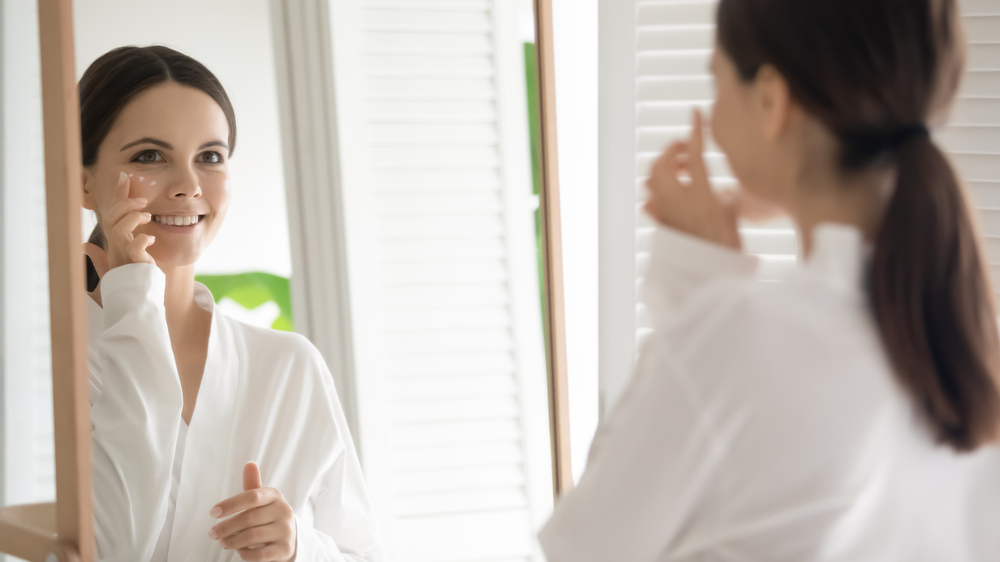
Eye rejuvenation: the different methods
The skin around the eyes is one of the thinnest on the face, and one of the most heavily used: we blink and move the eye area several thousand times a day. It therefore shows signs of ageing faster than the rest of the face, which translates into wrinkles, dark circles, under-eye bags and a tired or sad-looking gaze. The good news is that there are now many solutions, both medical and surgical, to rejuvenate the eyes. Here is an overview of the different eye-rejuvenation methods, from non-surgical aesthetic medicine all the way to eyelid surgery.
Contents
Why does the eye area age and look tired?
Before choosing a treatment, you need to understand why the eyes become hollow and droop over time. Several mechanisms combine:
- Volume loss: the loss of sub-orbital and temple fat hollows out the « tear trough » and accentuates under-eye hollows.
- Skin laxity: the decline in collagen and elastin production thins the skin, which creases and sags around the eyelids.
- Expression lines: the repeated contractions of the muscles in the upper third of the face etch in crow’s feet and frown lines.
- Dark circles and under-eye bags: pigmentation, poor circulation, water retention or fat herniation create a tired appearance, sometimes from the moment you wake up.
Sleep, stress, smoking and sun exposure all worsen these signs. Distinguishing the under-eye hollow (volume loss) from the under-eye bag (excess fat) is essential: they stem neither from the same mechanism nor from the same treatment. It is this precise analysis of the eye area that guides the choice between aesthetic medicine and surgery.
Can you rejuvenate the eyes without surgery?
In the majority of cases, yes. When there is no significant excess skin to remove, non-surgical eye rejuvenation relies on aesthetic medicine: targeted techniques that restore volume, smooth wrinkles and firm the skin, without a scalpel, without a scar and without downtime. These eye-area injections and medical treatments are often the first step, intended for patients who want a natural, gradual result. Eyelid surgery only comes into play when skin laxity or under-eye bags are too pronounced to be corrected any other way.
Hyaluronic acid: a key element of aesthetic medicine for the eyes
There are many methods to correct the effects of time on the orbital area. Those based on aesthetic medicine to rejuvenate the eyes offer real advantages and, in particular, avoid the use of a scalpel for the most reluctant patients.
Hyaluronic acid injections: a natural method
Hyaluronic acid is a molecule naturally present in the body. It provides continuous hydration of the skin, particularly in its deeper layers. With age, the body’s natural production gradually declines, causing facial skin laxity, with skin that becomes thinner, as well as the deepening of irregularities (wrinkles, fine lines, furrows). Hyaluronic acid injections around the eyes then provide a natural, painless, biocompatible method with no risk to health. Their role is to fill the visible gaps between the epidermal cells and to restore the skin’s elasticity.
The effects of hyaluronic acid on the orbital areas
Hyaluronic acid injections restore the facial volumes to make the face more harmonious and thus open up the eyes by eliminating the wrinkles and fine lines around the eyes, in particular crow’s feet and frown lines (glabella). If the area under your eyes has dark circles, hyaluronic acid injections will also fill in the visible hollows. In practice, the practitioner treats different areas depending on the patient: sometimes the lower eyelids, sometimes the temples and sometimes a combination of these zones. The tail of the eyebrow is thereby lifted, leading to rejuvenated eyes that look brighter and less tired.
How the procedure works
Hyaluronic acid injections can be carried out in different ways depending on the practitioner and the areas to be treated. Generally, however, they begin with an injection in the cheekbones for the dark circles. The area known as the tear trough is then treated. The temples are the last to be injected. To do this, the hyaluronic acid is introduced in gel form just beneath the epidermal tissue using fine, blunt-tipped needles (cannulas) for a completely painless administration. The synthetic HA blends with the natural hyaluronic acid to retain water and quickly produce a filling of the unwanted wrinkles around the eyes. The effects of the treatment last around a year, depending in particular on the degree of cross-linking of the filler injected; the medical literature reports an average duration of around ten to eleven months for tear-trough filling (retrospective study by Puyana et al., 2025, range of 8 to 12 months), with a high satisfaction rate.
Botox in eye-rejuvenation treatment
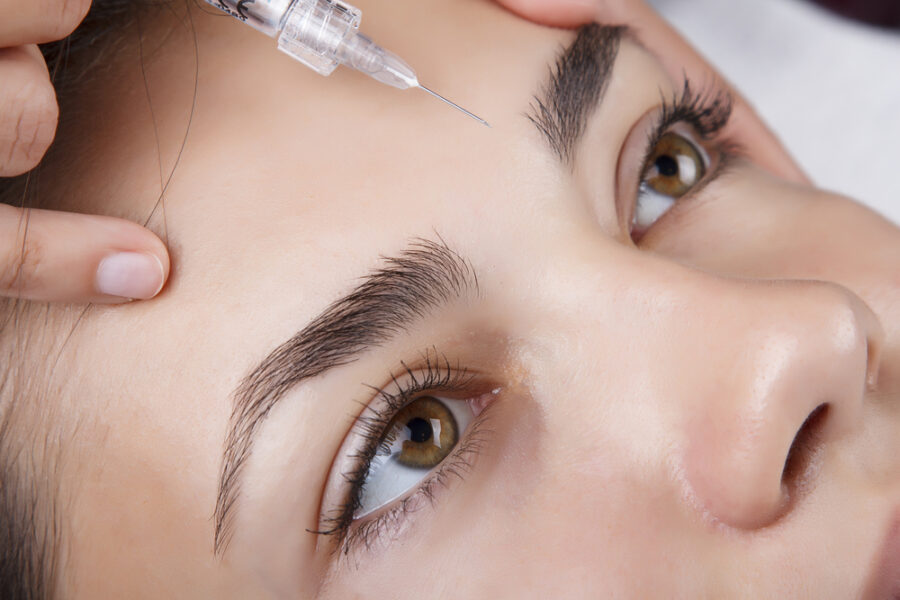
Botulinum toxin is another molecule commonly used to smooth orbital areas showing wrinkles and other signs of skin ageing, thanks to its ability to limit the muscle contractions caused by emotions and facial expressions. It acts as a smoothing agent and can be injected into the whole part of the face known as the upper third, in particular the forehead muscles whose contraction affects the appearance of the eyebrows. Botox injections to open up the eyes can thus be used to treat crow’s feet as well as frown lines. For a more subtle, natural effect on this delicate area, some practitioners favour Baby Botox, a micro-dosed technique.
Smoothing crow’s feet with Botox
Crow’s feet consist of more than three wrinkles at the corner of the eye that can extend to the temples. Botox is then perfectly suited to treating these small lines, which are caused by the repeated contractions of the orbicularis muscle, since it limits its innervation. In practice, three injection points are made in the orbicularis muscles, helping to open up the eyes and restore the corner of the eye to its former vitality. Botox is particularly well suited to this area, but it should not be performed on the lowest and most oblique crow’s-feet wrinkles, at the risk of freezing the smile.
The lion-eye method: treating frown lines with botulinum toxin
With age, the gaze can appear sterner than before. Generally, this is explained by the gradual formation of two vertical lines between the eyes: the glabellar lines. These are more commonly known as frown lines in aesthetic medicine, and treating them with a targeted injection is sometimes referred to as the lion-eye method. They are caused by the repeated contraction of two particularly strong muscles: the corrugator muscle and the procerus muscle. Botulinum toxin injections then limit these expression-related contractions and reduce how deeply the lines are set above the eyebrows. The forehead muscles are thus more relaxed and the eyebrows lifted back into place. After the Botox injection session into the muscles above the eyebrows, a period of ten days is needed for the corrections to truly take effect. The result obtained will last for 6 to 8 months.
Other techniques to rejuvenate the eyes without surgery
Beyond injections, several aesthetic-medicine treatments can act on skin quality and the firmness of the eye area. They are often combined with hyaluronic acid and Botox for a more complete result.
Mesotherapy and skinboosters
Mesotherapy and skinboosters consist of micro-injections of non-cross-linked hyaluronic acid, vitamins and antioxidants into the superficial dermis. They hydrate the skin deeply, stimulate collagen production and revive the radiance of the eye area without adding volume: the skin looks denser, smoother and the complexion more rested.
Radiofrequency and the non-surgical eye lift
Skin-tightening technologies such as radiofrequency, fractional micro-needling (Morpheus 8) or focused ultrasound heat the deep layers of the skin to trigger new collagen formation. The result is a gradual, natural eye-lifting effect that tightens the eyelid skin and slightly lifts the tail of the eyebrow. These methods follow the logic of a non-surgical facelift, to be favoured when laxity remains moderate.
Thread lifts
The placement of absorbable thread lifts mechanically lifts the tail of the eyebrow and supports the outer part of the eye area. Inserted under the skin using a fine cannula, they create an immediate lifting effect and then stimulate collagen over several months. It is an attractive alternative for raising a drooping gaze without going through the operating room.
Blepharoplasty, or cosmetic eyelid surgery
Beyond the aesthetic-medicine methods mentioned above, cosmetic eyelid surgery is also a highly effective way for anyone wishing to achieve eye rejuvenation. It becomes necessary when the excess skin or under-eye bags are too pronounced for injections to be enough to re-smooth the skin and fully restore the volumes. Blepharoplasty indeed offers the possibility of correcting the slackening of the eyelid skin where excess skin or fat is present in the area around the eyes. This excess may be due either to age (skin that sags under the effect of gravity) or to genetic factors, and may require surgical removal of the tissue concerned. It is a well-codified, very well-tolerated procedure: a systematic review of patient feedback (Tseng et al., 2022) found around 93% positive reviews after eyelid surgery. There are three types of procedure that can be performed for eyelid surgery:
- Upper blepharoplasty,
- Lower blepharoplasty,
- Augmentation blepharoplasty.
Upper eyelid surgery
Upper blepharoplasty concerns, as its name suggests, the surgery of the upper eyelids. It treats the skin and fat laxity (drooping-eyelid syndrome) that can weigh the gaze down. Over time, the skin in this area loses its vigour, elasticity and tone, leading to a sagging of the tissue that can swell and give the gaze a tired appearance. In this specific case, injecting any kind of filler is often not enough. Upper eyelid surgery then often presents itself as the only effective solution to re-smooth the eye area and open up the eyes.
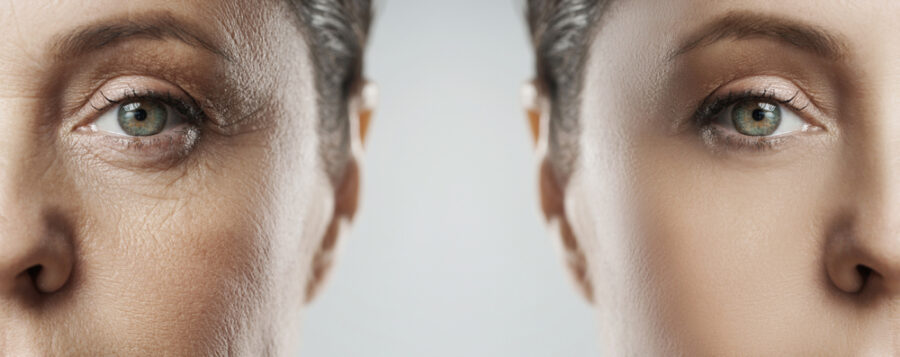
In practice, fine incisions are made along the folds of the eyelid. They make it possible to remove the excess skin that weighs the gaze down. The fat hernias are also removed at the same time. If necessary, the muscles can also be restored according to the desired result through a ptosis repair. The skin is finally re-draped to leave only a fine scar.
Lower blepharoplasty
Here, the procedure focuses on the lower part of the orbital area. Dark circles are particularly concerned by this, especially pigmented dark circles, along with under-eye bags. Lower blepharoplasty then treats the fat pockets that have formed over time due to the loss of fatty and skin tissue and the downward displacement of the lower eyelids. Excessive water retention caused by poor blood circulation can also increase the appearance of these fat hernias.
The procedure is carried out using incisions made just below the lash line. They are extended along the natural crease of the eye to reach the corner and end in the crow’s-foot fold. The excess layers of fat and skin are then removed as in upper blepharoplasty, but this time from the outside of the eyelids. Muscle removal may also be required, as well as a re-tightening of the orbicularis muscle. Lower blepharoplasty then produces the effect of a cheek lift, with smoother skin, a re-balancing of the volumes and the elimination of the fine lines around the eye for a relatively dramatic eye rejuvenation. For isolated pigmented or hollow dark circles, other approaches exist: see our article on treating under-eye hollows with plastic surgery.
Augmentation blepharoplasty, or eyebrow lipofilling
While the two previous techniques involved removing excess fat, here the aim is to add some using a micro-needle or a cannula in contact with the bone. This procedure makes it possible to mask the various marks left by the passage of time. By adding the patient’s own fat (autologous fat transfer, or facial fat transfer), harvested in particular from the knees or the abdomen, the area around your eye regains tone and uniformity. The hollows caused by time and fatigue can thus be filled. The fat pockets are removed at the same time to harmonise the gaze and restore all its expressiveness.
Finally, you can also consider a simple lift without adding fat. The method is straightforward. It aims to lift the ends of the eyebrows and remove the excess skin. It is worth noting that this type of procedure can be combined with the aesthetic-medicine injections detailed earlier in this article. The choice of the most suitable technique is always made during a consultation, at the practice of Dr Vincent Hunsinger in Paris Étoile, after a precise analysis of your gaze.
Frequently asked questions
Can you really rejuvenate the eyes without surgery?+
Yes, in most cases where there is no significant excess skin to remove. Aesthetic medicine — hyaluronic acid injections, botulinum toxin, mesotherapy, radiofrequency or thread lifts — can restore volume, smooth wrinkles and firm the skin of the eye area without a scalpel or a scar. Eyelid surgery is only considered when laxity or under-eye bags are too pronounced.
Which technique should you choose to rejuvenate the eyes?+
It depends on the sign to be corrected. Hyaluronic acid fills under-eye hollows and the tear trough, Botox relaxes crow’s feet and frown lines, mesotherapy and radiofrequency improve the quality and firmness of the skin, and blepharoplasty removes the excess skin or under-eye bags. The choice is made during a consultation, after a precise analysis of the eye area.
How long do the results of hyaluronic acid injections under the eyes last?+
The results of filling the eye area last on average around ten to eleven months. For the tear trough, the medical literature reports an average duration of about 10.8 months, within a range of 8 to 12 months (retrospective study by Puyana et al., 2025), before a touch-up is needed.
What is the difference between an under-eye hollow and an under-eye bag?+
An under-eye hollow corresponds to a loss of volume in the tear trough: the hollow casts a shadow and gives a tired look. It is corrected with hyaluronic acid injections. An under-eye bag, on the other hand, is excess fat that bulges beneath the eye: when pronounced, it most often calls for a lower blepharoplasty. Distinguishing the two is essential, because the treatment is not the same.
What is the lion-eye method?+
This is sometimes the name given to the targeted treatment of frown lines — those two vertical lines between the eyebrows — with botulinum toxin injections. By relaxing the corrugator and procerus muscles responsible for these creases, the injection softens the expression and opens up the eyes. The result appears within about ten days and lasts 6 to 8 months.
Does eyelid surgery leave visible scars?+
The incisions of a blepharoplasty are hidden in the natural fold of the upper eyelid or just below the lash line for the lower eyelid, which makes the scars very discreet once they have faded. It is a well-codified, very well-tolerated procedure: a systematic review of patient feedback (Tseng et al., 2022) found around 93% positive reviews after eyelid surgery.
Book an appointment
If you are considering a procedure, book an appointment in just a few clicks: our surgeons will answer all your questions and guide you toward a tailored, personalised solution.
Book on Doctolib