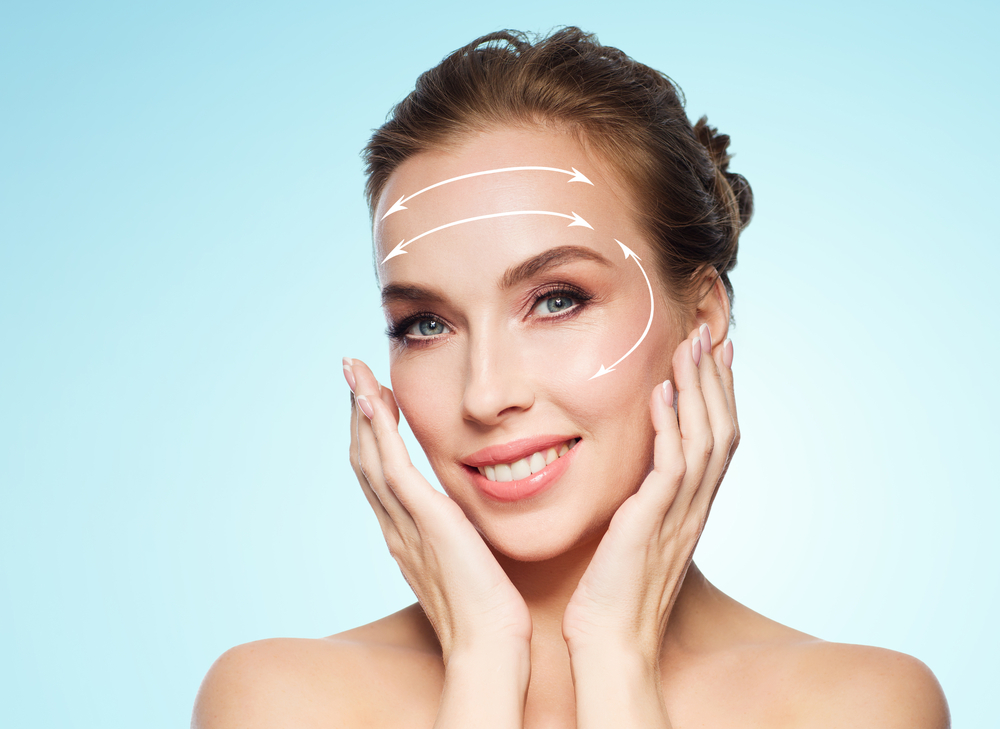
What's the difference between a facelift and J-Plasma Renuvion?
The facelift and the J-Plasma Renuvion protocol share a single goal: to correct sagging skin on the jawline and neck and redefine the contours of the face. But these two approaches differ profoundly in the technique used, how the procedure unfolds, the areas treated, the recovery and the price. This comparison breaks down point by point what sets the cervicofacial facelift apart from J-Plasma Renuvion, to help you understand which method suits your situation — a choice that is always made during a consultation with the surgeon.
Contents
Facelift and J-Plasma Renuvion: the same goal, but not the same result
Treating skin laxity is the common purpose of these two techniques. Neither prevents ageing: they correct sagging that is already present. Their results are not equivalent, however. J-Plasma Renuvion is a recent, minimally invasive technique that leaves no visible scar, but its action remains limited: when skin distension is too pronounced, only a facelift can deliver a truly marked correction.
With age, weight fluctuations and external aggressors (sun, smoking, pollution), the skin of the face loses its firmness and the jawline sags. The cervicofacial facelift restores a toned appearance to the face, but it is a more demanding surgical procedure, with a longer recovery and sometimes restrictive after-effects (swelling, bruising, temporary social downtime). J-Plasma Renuvion, by contrast, is far less invasive: it is performed in about an hour, with no notable pain, even though it too requires anaesthesia. Let’s look at each in detail.
Cervicofacial facelift: the gold-standard technique in facial surgery
The skin of the face is particularly sensitive to the marks of time: it sags progressively and gives rise to jowls. The facelift corrects these tissue displacements. There are two levels of intervention depending on the extent of the laxity: the skin-only facelift and the facelift with re-tensioning of the deep muscular layer (SMAS). In every case, the operation follows three main steps:
- a discreet incision, hidden in the hairline and around the ear;
- re-tensioning of the muscular tissue (SMAS);
- redraping of the skin with removal of the excess.
A liposuction of the neck and jawline or a facial fat transfer to restore the volumes of the face can be combined with it to re-harmonise the contours. To learn everything about the recovery from this procedure, read our dedicated article on facelift scar healing and results.
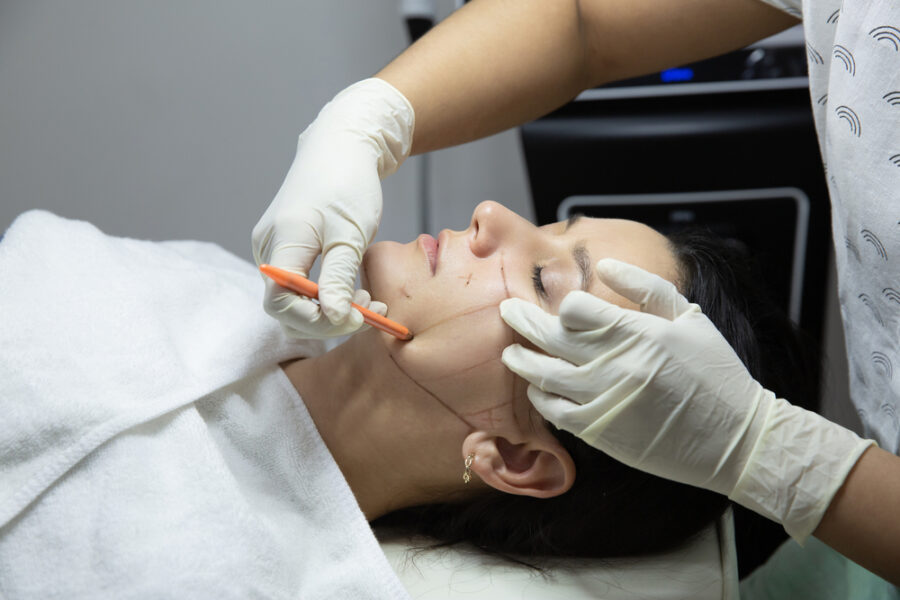
J-Plasma Renuvion: the scarless facelift
Renuvion, also known as J-Plasma, is a microsurgery technique that corrects skin laxity without resorting to a scalpel. It requires no skin undermining and leaves no visible scar, which is why it has earned the nickname of non-surgical facelift. The principle relies on combining radiofrequency with a noble gas, helium, converted into plasma: this beam, applied beneath the skin via a fine cannula, causes a brief and intense rise in temperature (the tissues go from about 37 to 85 °C in a fraction of a second, then are immediately cooled by the helium). This immediate retraction of the dermis, followed by stimulation of collagen synthesis, firms the skin.
The procedure lasts about an hour per area, is performed on an outpatient basis and produces results that are visible as soon as the treatment ends.
A fast, minimally invasive procedure
By combining the properties of helium with the energy of radiofrequency, Renuvion produces a thermal effect capable of retracting the tissues from the very session. The surgeon moves the cannula at a controlled speed to cover the area evenly; a safety system limits the risk of burns. This is what makes it an excellent way to firm the skin without open surgery.
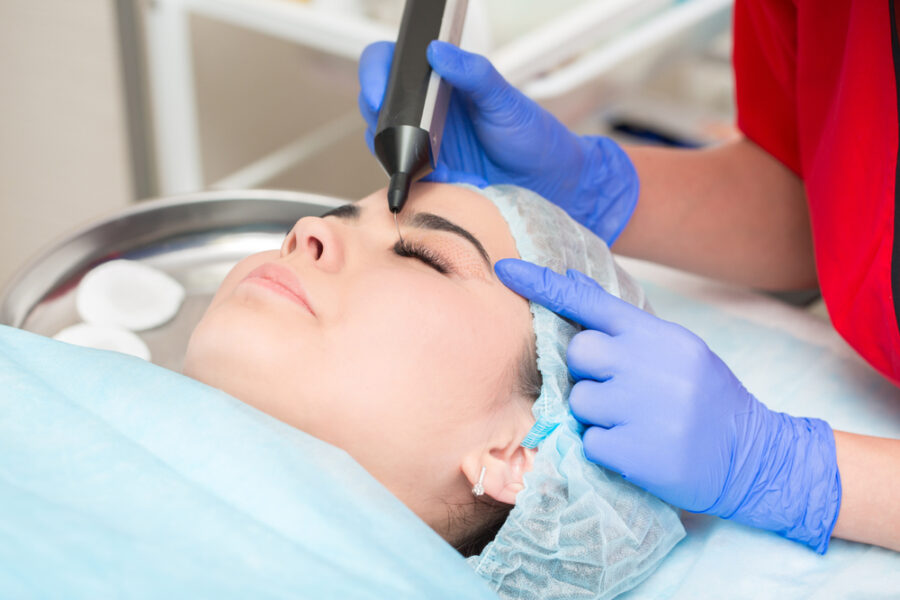
Which areas can be treated with J-Plasma Renuvion?
Renuvion is used on the neck and jawline, but also on the body: abdomen, inner thighs (laxity also treated with a thigh lift), arms (as a lighter alternative to an arm lift), back, knees. It is often combined with a liposuction: the skin retraction it provides helps prevent the excess skin that liposuction alone can leave. Laxity of the abdomen after weight loss or pregnancy and of the arms are among its frequent indications.
Who is Renuvion for? Candidates and contraindications
J-Plasma Renuvion is intended for people with mild to moderate skin laxity who are in good health, non-smokers and only slightly overweight. It gives its best results on skin that still retains a good capacity for retraction.
By contrast, when the laxity is too significant — after massive weight loss, for example — Renuvion is not enough and a facelift (or a body-contouring procedure) remains indicated. As with any surgical procedure, skin pigmentation is taken into account during the pre-operative assessment. The surgeon determines during the consultation whether you are a good candidate, or whether it is preferable to opt for another solution, surgical or in aesthetic medicine using radiofrequency.
Renuvion: what the scientific literature says
Renuvion is developed by the American company Apyx Medical. In July 2022, the device obtained a 510(k) clearance from the FDA (the US health authority) specifically for the improvement of the appearance of skin laxity of the neck and submental region (the double chin). To date, this is the only indication formally validated by the FDA; treatments of other areas (abdomen, thighs, arms) are documented in the medical literature and commonly performed, but constitute an off-label use, as a review published in 2024 (Driscoll et al.) points out. This is all the more reason to entrust the indication to an experienced surgeon, who will judge the relevance of the technique area by area.
Numerous advantages during and after the procedure
Among the strengths of this procedure: a short duration (less than an hour per area, compared with 3 to 4 hours for a cervicofacial facelift), results visible immediately, and the absence of any visible scar. Moderate swelling may appear in the first few days. Renuvion acts deep down to tighten the tissues and stimulates the production of collagen and elastic fibres from the very first weeks, for a result that lasts over time. When the laxity is too marked, however, the result remains insufficient and a facelift once again becomes the gold-standard solution.
Facelift or J-Plasma Renuvion: the differences point by point
To clearly grasp what sets the two procedures apart, let’s compare each stage of the journey, from the consultation through to the price.
Consultation
For a facelift of the face and neck, the patient sets out their expectations and the areas they wish to correct; a mirror test simulates the desired effect. The surgeon explains how the procedure unfolds and schedules a second consultation before the operation. J-Plasma Renuvion follows the same framework: pre-operative examinations and tests, consultations with the surgeon and the anaesthetist. At this stage, the two techniques differ little.
Techniques used
J-Plasma treats many areas of the body (thighs, neck, arms, back, abdomen) where the facelift concerns only the face and neck — the other regions fall to specific procedures such as an arm lift for the arms or a thigh lift for the thighs. On the technical side, Renuvion tightens the tissues by retracting the dermis through a rise in temperature; the facelift, for its part, surgically repositions and removes the tissues.
How the procedure unfolds
The Renuvion procedure is performed in less than an hour per area, whereas a facelift can last up to 4 hours with a hospital stay of about 24 hours. Renuvion combines the energy of helium-based radiofrequency plasma with, where appropriate, a fine liposuction. Both methods take place in the operating room. In the case of the facelift, the surgeon makes incisions around the ears, re-tensions the muscles then the skin and removes the excess skin; a liposuction can be combined with it.
Anaesthesia
Depending on the case, the facelift is performed under deep local or general anaesthesia, generally with a hospital stay of at least 24 hours. J-Plasma Renuvion is most often carried out on an outpatient basis, under general anaesthesia (or local anaesthesia for small areas), with a return home the same day.
Results and recovery
After a facelift, a period of rest is necessary, make-up should be avoided and painkillers are prescribed; post-operative follow-up is strict. The results are visible within the first few days, but recovery is longer and certain marks may remain noticeable for several months.
For Renuvion, bruising, swelling or aches may appear, but the recovery is markedly lighter: it generally takes a few days to a week, and wearing a compression garment is advised during the first few weeks. A single session is usually enough. The first effects are immediate, but the result improves gradually: collagen neo-synthesis continues for several months (often up to 6 to 9 months) before reaching its final appearance.

In both cases, the results are long-lasting, with retracted skin and a visible tightening effect. If you would like to learn more about how long it takes for results to appear, our article on how long swelling lasts after a facelift details the recovery step by step.
Price of J-Plasma Renuvion and the facelift
For Renuvion, a bespoke quote is drawn up before the procedure: the price depends on the area to be treated and the extent of the correction. This innovative technique remains relatively costly — generally count on between 4,500 and 6,500 euros depending on the areas and the intensity. Being for aesthetic purposes, it does not qualify for any insurance coverage under the French national health system.
The cervicofacial facelift, a tried-and-tested technique, most often sits between 7,000 and 12,000 euros, depending on the extent of the correction. These ranges are indicative: only the personalised quote provided during the consultation is binding.
Frequently asked questions
What is the difference between a facelift and J-Plasma Renuvion?+
A facelift is a surgical procedure that repositions and removes excess skin: it corrects significant sagging but leaves fine scars and requires a longer recovery. J-Plasma Renuvion tightens the skin from the inside, with no incision or visible scar, thanks to a beam of helium plasma combined with radiofrequency; it is reserved for mild to moderate laxity. In short: Renuvion for early sagging, the facelift when the distension is too marked.
Does J-Plasma Renuvion leave scars?+
No. The micro-incisions needed to introduce the cannula are minimal and placed in discreet spots, so they remain virtually invisible. This is precisely what earns Renuvion its nickname of « scarless facelift », as opposed to the cervicofacial facelift, which does leave fine scars hidden in the hairline and around the ears.
What is the price of J-Plasma Renuvion?+
The price depends on the area to be treated and the extent of the correction. As a guide, you can generally expect between 4,500 and 6,500 euros for a Renuvion treatment, compared with 7,000 to 12,000 euros for a cervicofacial facelift. As these procedures are for aesthetic purposes, they are not covered by the French national health system. Only the personalised quote drawn up during the consultation is binding.
Which areas can be treated with Renuvion?+
Renuvion treats skin laxity of the neck and jawline, but also of several areas of the body: abdomen, inner thighs and arms, back or knees. It is often combined with a liposuction to prevent excess skin. Note: the FDA clearance specifically covers the neck and submental region; the other areas constitute an off-label use, to be assessed with the surgeon.
Is Renuvion painful or dangerous?+
The procedure is performed under anaesthesia, with no pain during the procedure itself. The recovery is generally mild: swelling, bruising and temporary aches, well relieved by painkillers. Like any surgical procedure, Renuvion carries risks, but they remain limited, all the more so as a pre-operative assessment and a safety device limiting overheating frame the procedure. Choosing an experienced surgeon is essential.
How long does it take to see the results of Renuvion?+
A tightening effect is visible as soon as the session ends, but the result improves over time: collagen stimulation continues for several months, often up to 6 to 9 months, before reaching its final appearance. A single session is usually enough per treated area.
Who can benefit from J-Plasma Renuvion?+
Renuvion is suitable for people who are in good health, non-smokers, with mild to moderate skin laxity and limited excess weight. When the excess skin is too significant — after massive weight loss, for example — the technique is not enough and a facelift or a body-contouring procedure remains indicated. It is the surgeon who determines, during the consultation, the solution best suited to your case.
Book an appointment
If you are considering a procedure, book an appointment in just a few clicks: our surgeons will answer all your questions and guide you toward a tailored, personalised solution.
Book on Doctolib