Abdominal etching: surgical solutions for defined abs
Having a beautifully defined core is a dream shared by many men, but also by some women. Yet it is particularly difficult to make those famous « six-pack abs » appear. To achieve genuinely convincing results, you generally need to combine muscle-strengthening exercises with a fairly strict diet. For those who cannot obtain defined abs despite these considerable efforts, there are now several abdominal surgery procedures that can deliver the desired results. Abdominoplasty, belly liposuction, abdominal etching, muscle implants… what exactly do these different surgical solutions involve? What are the advantages and disadvantages of each procedure? Here is everything you need to know about the surgical techniques used to achieve defined abs, in both men and women.
Contents
Abdominoplasty, or the tummy-tuck procedure
Abdominoplasty aims to slim the waistline and create a more harmonious body contour. The procedure consists of removing a large flap of skin and fat located between the navel and the pubis. Excess fat is then eliminated through liposuction. During the procedure, slackened muscles are sometimes re-tightened as well, by repairing the diastasis.
Abdominoplasty: an overview
Abdominoplasty is particularly recommended for people affected by an accumulation of fat cells around the abdomen that has often led to significant stretching of the skin. This is especially the case for people who have undergone major weight loss, for those used to an overly sedentary lifestyle without physical exercise, or for women after several pregnancies. Abdominoplasty can therefore treat muscle laxity, scars and stretch marks, as well as a loss of skin elasticity and firmness. It is thus an effective way to get rid of the well-known love handles (bulges) and the abdominal apron, in order to finally regain a flat stomach. The procedure restores a more harmonious body contour and so puts an end to the self-consciousness it causes, helping you regain confidence.
People who wish to undergo this type of procedure must be in good general health. They must be at least 18 years old and maintain a balanced lifestyle after the procedure, otherwise they risk losing all of its benefits. While abdominoplasty restores a slimmer, firmer body contour, it only very moderately makes the abs stand out, especially when the excess fat was particularly significant before the procedure. The amount of fat that can be removed is in fact limited in volume so that the patient can tolerate it. When skin laxity predominates after a pregnancy or weight loss, this is often referred to as loose, sagging belly skin: this is precisely the indication for abdominoplasty.
The advantages and disadvantages of abdominoplasty
Abdominoplasty helps to strengthen the abdominal wall and better structure the abdominal muscles thanks to a re-tightening of the skin and muscles. After the procedure, the patient will in particular have fewer stretch marks on the lower abdomen, and the stomach will look far less crepey and stretched. The procedure then makes it possible to feel much more comfortable in your own body and to regain self-confidence lost over time. The patient will be able to wear more body-hugging clothes or undress at the beach without fear of others’ judgement.
Unfortunately, this type of procedure leaves a scar on the lower abdomen. The extent of the scar depends on the amount of tissue to be removed. These marks do become less and less visible over time, but they will nevertheless not disappear completely. In addition, abdominal dermolipectomy is not permanent, and the fat can quite easily return over time if the patient does not improve their diet and lifestyle. To ensure the durability of the results, you should follow your plastic surgeon’s recommendations and, if necessary, get help from a dietitian. Regular physical exercise is also particularly advisable to maintain the body’s firmness and counter the sedentary habits responsible for fat accumulation. When a separation of the rectus muscles, or abdominal diastasis recti, accompanies the laxity, its correction is included in the same operation.
Abdominal etching for defined abs
Originating in the United States, where the cult of the body is dominant, abdominal etching is a targeted procedure aimed at a very specific audience seeking to perfect their physical appearance. It is today the reference technique in cosmetic abdominal surgery when the goal is not to lose weight, but to sculpt already-present muscular relief.
Abdominal etching: an overview
With abdominal etching, the surgeon performs a selective removal of fat in certain areas of the abdomen. This procedure makes it possible to sculpt the much-coveted « six-pack » as well as the « Adonis belt » formed by the oblique muscles. The plastic surgeon thus performs liposuction — that is, suctions the superficial fat located between the skin and the muscles using a fine cannula. Only fine incisions are made, in order to reduce scarring.
Abdominal etching is fairly similar to standard liposuction in principle, but it is specifically aimed at men and women with a low body mass index (BMI). This condition is essential for the procedure to produce a significant effect. The surgeon suctions the fat cells at each muscle insertion point, bringing the skin as close as possible to the abdominal and oblique muscles in order to define an « etched » appearance.
The procedure is most often carried out under general anaesthesia and as a day case — meaning the patient leaves the hospital the same day. The patient can resume daily activities two days later. To encourage the skin to retract and adhere to the treated areas, it is advisable to wear a contouring dressing for one week. Wearing a compression garment is also recommended for one month. The final result of abdominal etching appears three to six months after the procedure, with prominent abdominal muscles and visible definition.
Abdominal etching and high-definition liposuction: the ultrasound-assisted techniques
Abdominal etching has been refined with the arrival of high-definition liposuction (HD lipo or 4D), which most often relies on VASER technology. Before suctioning the fat, the surgeon emulsifies the fat cells using ultrasound, which allows for more precise etching of the definition and better preservation of the surrounding tissue. This approach, which we explain in detail in our dedicated article on high-definition liposuction and Lipo 4D, is particularly suited to athletic patients seeking pronounced athletic definition.
Abdominal etching is also the subject of specific medical literature. A prospective series published in 2020 in the journal Aesthetic Plastic Surgery (Niddam et al., involving 25 patients) assessed recovery and satisfaction after abdominal etching and confirmed a good safety profile as well as a high satisfaction rate among well-selected candidates — provided that the indication, and in particular a low BMI, is respected. This point reflects the essential rule of the procedure: the quality of the result depends first on candidate selection, and not on the technique used alone.
The advantages and disadvantages of abdominal etching
Abdominal etching allows the patient to obtain a toned, athletic stomach and to get rid of stubborn fat around the abdomen that is hard to eliminate despite considerable physical or dietary efforts. It also defines the oblique muscles as well as the linea alba running between the navel and the sternum. It is therefore recommended for athletes with a low BMI who wish to sculpt their body for aesthetic purposes. Unlike abdominoplasty, it is not intended to slim, but rather to achieve a gain in firmness around the abdomen. The technique used for abdominal etching can also be performed to sculpt the arms, the pectorals, the calves or the thighs.
On the downside, abdominal etching is specifically reserved for patients with a low body mass index and so cannot be prescribed to get rid of unsightly bulges or an abdominal apron.
It is also important to anticipate the fact that it takes some time to see the final results of the procedure (up to 6 months). Furthermore, if the patient does not follow a good lifestyle and a sporting routine through targeted physical exercise, they may fairly quickly lose all the benefit of the procedure. Sport, however, should only be resumed from one month after the procedure, and gradually. After the procedure, bruising, ecchymoses and muscle aches may be felt for a few days. A compression garment must also be worn for 6 weeks, which can prove inconvenient in daily life.
Belly liposuction: indications and how the procedure works
Let’s start by looking at the general indications for belly liposuction, or abdominal liposuction, before going into more detail about how the procedure works.
Liposuction: an overview
Belly liposuction is indicated for patients who want to get rid of excess fat located within the abdominal wall. As with abdominoplasty, this procedure is recommended for people who have not achieved convincing slimming after a period of dieting and/or despite regular physical activity. It is thus indicated for getting rid of localised fat deposits. It is, however, more effective when the skin has good elasticity, unlike abdominoplasty, which also offers the possibility of re-tightening the skin by removing excess skin tissue. Belly liposuction alone also cannot re-tighten the muscles, unlike abdominoplasty.
Liposuction nevertheless provides good results for people wishing to restore a slim, harmonious body contour. The results of the procedure are relatively quick to be felt, generally after 3 or 4 weeks, once the swelling has resolved and the bruising has disappeared. As with the previous techniques, liposuction requires the patient to rebalance their diet if they wish to maintain the effects. A distinction is also made between simple liposuction and the more artistic liposculpture: we cover this point in our comparison of the differences between liposuction and liposculpture.
How the belly liposuction procedure works
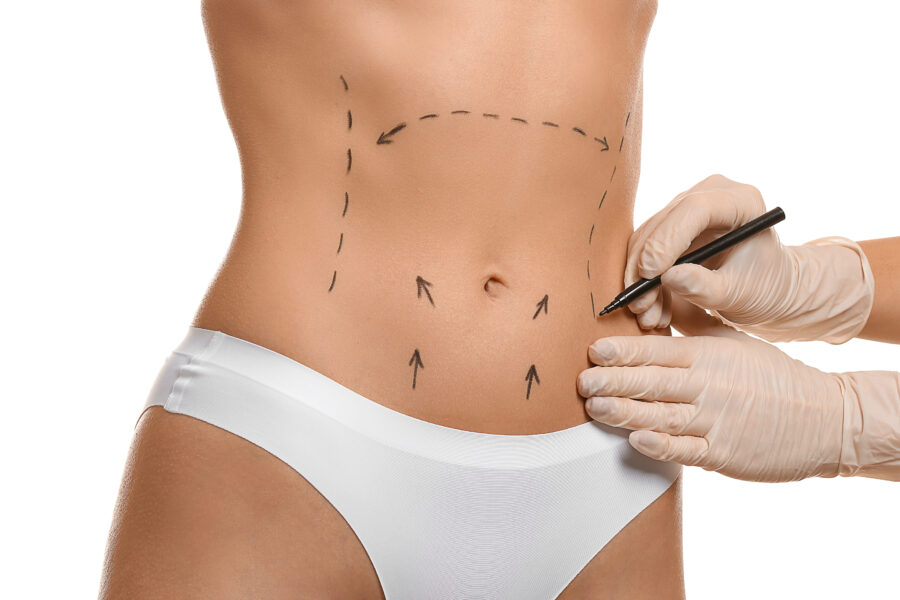
A simple belly liposuction procedure lasts between 30 minutes and two hours. If the patient must undergo fairly extensive liposuction with a relatively large volume of fat to extract, they will, in that case, require a 24-hour hospital stay. As a rule, the procedure is carried out under general anaesthesia. The plastic surgeon makes small incisions in the natural folds of the skin (to conceal the scars), inserts micro-cannulas and then suctions the fat deposits. At the end of the procedure, the incisions are sutured and covered with dressings.
What are the main advantages and disadvantages of belly liposuction?
Belly liposuction offers the patient the possibility of getting rid of abdominal fat immediately, without having to resort to drastic physical effort and a draconian diet. It also helps to prevent certain health problems linked to the accumulation of abdominal fat, in particular cardiovascular disorders. The patient’s physical appearance is moreover dramatically improved, allowing them to regain self-confidence. Recovery time is also relatively short. After liposuction, here again it is advisable to adopt a balanced diet and to engage in regular physical activity. Liposuction is a procedure that can be performed on various areas of the body, such as saddlebags, love handles, the arms or the thighs.
Belly liposuction can carry a few risks and complications. After the procedure, the patient may in particular be subject to nerve compression or even certain infections, in addition to swelling and bruising. These cases are fortunately very exceptional. The risk of phlebitis, however, is more common, particularly for people predisposed to thromboembolic problems. The procedure also requires 3 to 7 days off social activities, and the scars may take some time to disappear (around a year).
The main disadvantage of liposuction for people wishing to slim their body contour actually lies in the absence of skin retraction when the skin has been stretched over time. In this case, it is then more appropriate to consider an abdominoplasty. To re-tighten the skin, however, it is possible to combine liposuction with a Renuvion J-Plasma skin-tightening treatment, which helps counter skin laxity in order to restore firm, smoother skin. This subcutaneous technology combines radiofrequency with ionised helium and consists of creating a thermal shock with very high heat (up to 85°) followed by intense immediate cooling. This process creates an instant skin-retraction effect and also helps to conceal the scar in the case of abdominoplasty. It can also be used for abdominal etching.
Finally, liposuction here too cannot define the abs for people with an abdominal apron or bulges, but only restore harmony to and slim the body contour.
Muscle implants for prominent abs
When a patient is looking for a muscular volume that fat sculpting alone cannot create — typically someone who is already slim but whose musculature remains poorly defined despite training — there is a complementary option: muscle implants. Better known for the pectorals and calves, these soft silicone implants, comparable in principle to those used for other areas of the body, can in some cases be offered to reinforce abdominal definition.
Principle and indications for the abdominal implant
The principle consists of inserting, through small incisions, cohesive silicone implants intended to increase the volume and contour of the muscles. Unlike abdominal etching, which reveals existing muscular relief by removing fat, the implant adds volume where the natural musculature is insufficient. This procedure remains far rarer than liposuction or etching for the abdomen, and abdominal etching remains the reference solution for the vast majority of patients wishing to achieve defined abs. The muscle implant is suited to a very specific indication and must be assessed on a case-by-case basis during the consultation.
Advantages, limitations and precautions
The advantage of implants is that they offer immediate and permanent volume, independent of weight fluctuations. In return, it is a more invasive surgery than liposculpture, with its own recovery (swelling, temporary discomfort, wearing a compression garment) and the risks inherent in any implanted foreign body (displacement, asymmetry, infection — fortunately exceptional). For the abdomen in particular, the result must remain natural: the goal is never an artificial effect, but an athletic body contour consistent with the patient’s morphology. This is why, in the majority of cases, Dr Vincent Hunsinger favours fat-sculpting techniques, better suited to a « natural, French-style » result, with the implant only considered for very particular situations.
Which technique should you choose for defined abs?
The choice of procedure depends above all on the starting situation and the goal you are aiming for. In summary:
- Excess skin and fat, an abdominal apron or a diastasis (after pregnancy or major weight loss) call for abdominoplasty, which re-tightens the wall and removes the stretched skin.
- Localised fat deposits in a person whose skin retains good elasticity call for abdominal liposuction, possibly combined with skin tightening.
- Muscular relief to reveal in an already slim, athletic patient calls for abdominal etching and high-definition sculpting, the most sought-after technique for drawing clear, well-defined « etched abs ».
- Muscular volume to create in very specific cases may raise the option of a muscle implant.
These procedures concern both men and women: while male demand dominates for sculpting six-pack abs, more and more women want defined abs and a toned stomach, with a goal of softer, more natural definition. In all cases, only a consultation makes it possible to determine the technique — or combination of techniques — best suited to your morphology and your expectations.
Frequently asked questions
Which procedure makes it possible to achieve defined abs?+
Several procedures exist depending on the situation. Abdominal etching (etched definition through selective liposuction) is the reference technique for sculpting six-pack abs in an already slim patient. Belly liposuction removes localised fat deposits, and abdominoplasty treats excess skin and laxity after a pregnancy or weight loss. In specific cases, muscle implants can create volume. Only a consultation can determine the right technique.
Can you get etched abs through surgery?+
Yes. Abdominal etching consists of selectively suctioning the fat located between the skin and the muscles to bring out the definition of the abs and the « Adonis belt ». This is sometimes called « etched abs » because the surgery reveals or accentuates a muscular outline; it does not, however, replace training: a muscle that is poorly developed beneath the fat will give a less pronounced result. Candidate selection, and in particular a low BMI, directly determines the quality of the result.
Abdominal etching or liposuction: what is the difference?+
Standard liposuction removes fat fairly uniformly to slim the body contour. Abdominal etching is a selective, artistic liposuction: the surgeon sculpts the fat around the muscles to draw the definition (six-pack, obliques, linea alba). Etching is therefore a form of high-precision liposculpture, often performed today with ultrasound-assisted high-definition liposuction.
Can women have their abs defined?+
Yes, these procedures concern both men and women. Female demand is growing, generally with a goal of softer, more natural definition than a very pronounced six-pack. As with men, the ideal candidate for abdominal etching has a low BMI and good skin firmness; after a pregnancy, abdominoplasty remains the option of choice when the skin is stretched or a diastasis is present.
What is an abdominal implant and who is it for?+
The abdominal implant is a soft silicone implant inserted through small incisions to increase the volume of the muscles, on the same principle as pectoral or calf implants. It is suited to a rare and very specific indication: an already slim patient whose musculature remains insufficient despite training. More invasive than fat sculpting, it is reserved for particular cases; for the vast majority of patients, abdominal etching remains the preferred solution.
When do you see the final result after abdominal surgery?+
For belly liposuction, the first effects appear after 3 to 4 weeks, once the swelling has resolved. For abdominal etching and high-definition liposuction, the final result is best assessed between 3 and 6 months, the time it takes for the swelling to disappear completely. Wearing a compression garment for several weeks and maintaining a good lifestyle are essential to preserve the result over the long term.
Is the result permanent?+
The fat cells that are removed do not reform, but those that remain can grow in the event of weight gain: the result is therefore long-lasting provided you maintain a stable lifestyle. Abdominoplasty is not permanent if weight is not kept under control, and abdominal etching loses its sharpness without regular physical activity. Muscle implants, for their part, provide permanent volume independent of weight.
Book an appointment
If you are considering a procedure, book an appointment in just a few clicks: our surgeons will answer all your questions and guide you toward a tailored, personalised solution.
Book on Doctolib