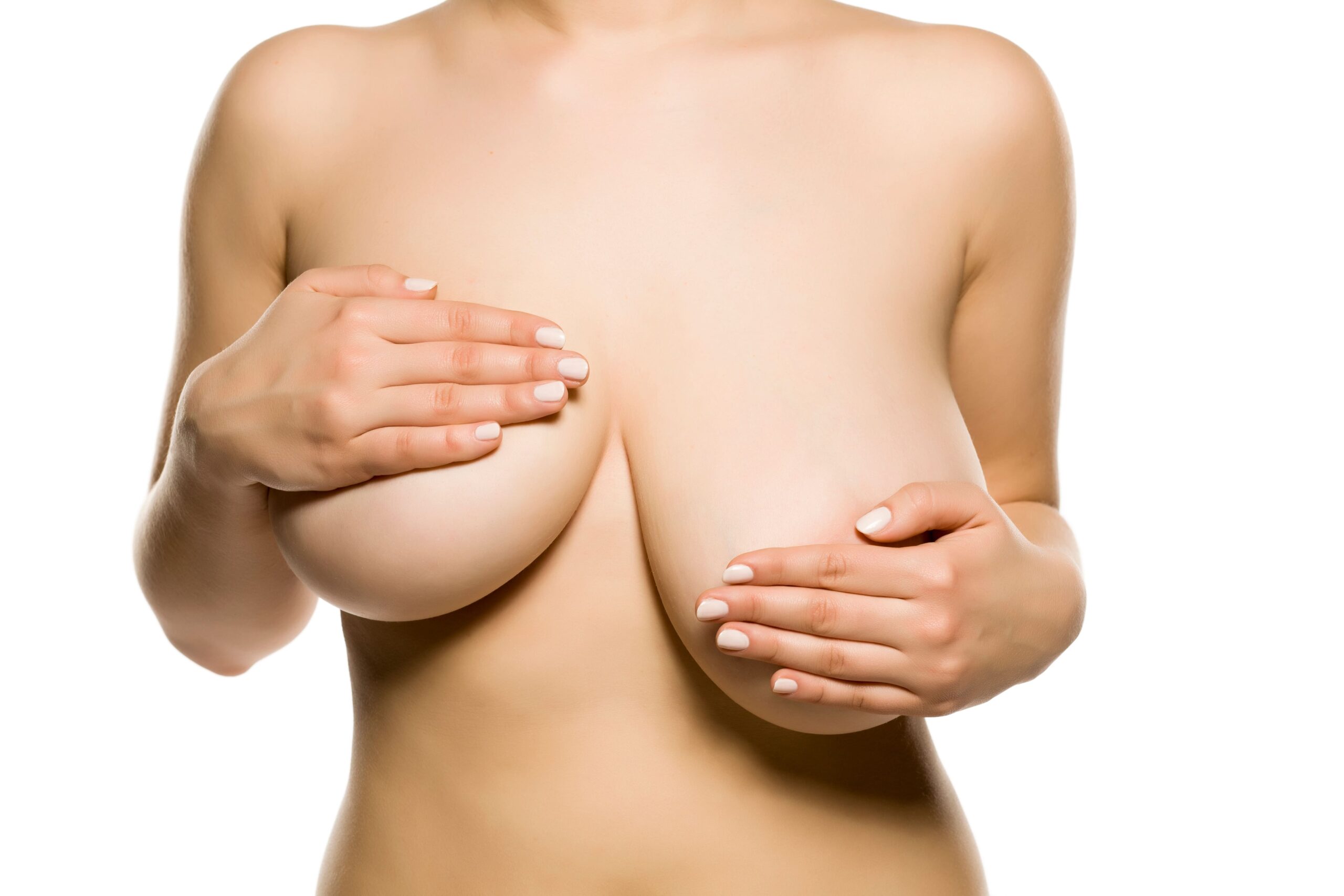
Breast hypertrophy in women
While a lack of bust is often experienced as a source of self-consciousness in women, breasts that are too large can likewise prove deeply disabling and troublesome in everyday life. What are the causes of breast hypertrophy in women? What are its symptoms and the consequences it has on daily life? At what point do we speak of hypertrophy, and what solutions exist to address it? Can breast reduction surgery entitle the patient to medical cover? Here we take stock of excessive breast development, its diagnosis and its treatment.
Contents
What is breast hypertrophy?
Breast hypertrophy refers to excessive development of the breasts, out of proportion with a woman’s build. With an average volume of 200 to 350 cm³, the breasts are considered to be affected by hypertrophy once their volume exceeds 400 cm³: the breasts are then deemed unsuited to the patient’s figure. The terms macromastia are also used to describe an overly large bust, and gigantomastia for the most severe forms. Hypertrophy most often affects both breasts (bilateral breast hypertrophy), but it may also be unilateral, affecting a single breast, and thus be the cause of breast asymmetry.
Several grades are distinguished according to the excess breast volume:
- Moderate hypertrophy: 400 to 600 cm³;
- Fairly significant hypertrophy: 600 to 800 cm³;
- Significant hypertrophy: 800 to 1,000 cm³;
- Very significant hypertrophy: more than 1,000 cm³. At this level, we also speak of gigantomastia.
While it mainly affects women, a comparable situation can also concern men, with an excessive development of the mammary gland known as gynaecomastia, this over-development of the chest in men, which must be distinguished from a purely fatty origin (adipomastia).
The causes of breast hypertrophy
Breast hypertrophy is a benign anomaly that may be congenital or hormonal in origin. It manifests as an excessive development of the mammary gland and may sometimes be accompanied by an excess of fat, though this is by no means systematic. Excess weight or pregnancy can nonetheless accentuate the phenomenon, in particular by stretching the skin.
Hypertrophy is not necessarily present uniformly across each of the two breasts and may therefore be the cause of asymmetry when the proliferation is unilateral (in a single breast). It may develop over several years or, at times, far more rapidly, within a few weeks. The proliferation then stems from the production of certain sex hormones in excessive quantities, in particular prolactin or oestrogen at the time of the first periods or during breastfeeding.
Hormonal disturbances, ageing of the skin or weight fluctuations can accentuate the phenomenon by stretching the skin envelope. Some specialists occasionally consider that there is a genetic predisposition to this anomaly, or even that it arises without any genuine apparent cause.
Finally, certain medications or certain autoimmune diseases, such as systemic lupus erythematosus, may also be at the origin of this disorder.
Symptoms and diagnosis: how do you know if you are affected?
Breast hypertrophy generally appears at puberty, under the action of hormones, and may in some cases disappear of its own accord. Under the weight of ageing and skin laxity, gravity causes the breasts to droop downwards, along with the nipples. They then become heavy and even harder to bear, giving an impression of heaviness in the lower part and of emptiness in the upper part.
The diagnosis of breast hypertrophy is made by taking several factors into account:
- The degree of hypertrophy;
- The size of the bust (cup size): hypertrophy is generally considered established from a cup size E onwards;
- The patient’s overall stature and build (her BMI);
- The degree of ptosis (sagging of the breast);
- The presence or absence of stretch marks;
- The degree of skin elasticity.
In practical terms, a woman may suspect hypertrophy when the volume of her bust becomes a lasting daily nuisance and is accompanied by the signs described below: back and shoulder pain, grooves dug by bra straps, irritation beneath the breasts. Only a clinical examination performed by a surgeon, however, can confirm the diagnosis and gauge its impact.
Breast hypertrophy, a condition that is disabling in everyday life
Breast hypertrophy can quickly prove disabling in many everyday movements and brings about physical and functional discomfort, as well as aesthetic and psychological distress. A source of back, cervical (in the neck and nape) and shoulder pain, often heightened by skin laxity and breast ptosis, this sagging of the breasts corrected by a breast lift, it can also cause skin irritation (known as intertrigo) in the inframammary fold, owing to the repeated friction and moisture build-up caused by the excessive breast volume.
It can also cause sleep disturbances and posture problems. It thereby proves particularly troublesome in the practice of sport, limiting the movements of the women affected by it. To this physical discomfort is added the difficulty of finding suitable clothing, in particular underwear in the right size, or a self-consciousness about undressing in intimate settings or when going to the beach. Ill at ease with their ample bust, some women then try to conceal it with loose-fitting clothes.
This impact is now well documented: the international medical literature recognises symptomatic macromastia as an established cause of chronic neck, back and shoulder pain, headaches and grooves dug by bra straps (shoulder grooving), symptoms liable to affect occupational activity (Layon et al., Journal of Women’s Health, 2021). Breast hypertrophy is therefore not merely an aesthetic inconvenience: it is a genuine functional impairment, which justifies its medical management.
Reduction mammoplasty to treat breast hypertrophy
General points and preparing for surgery
To overcome this disabling anomaly, some women choose to undergo breast reduction, the surgical procedure to reduce the size of the bust. This operation, also known as reduction mammoplasty, may be carried out once growth has finished, generally from the age of 17. Performed under general anaesthetic at the clinic, it usually lasts between 1 hour 30 and 2 hours. The patient may stay at the clinic for between 1 and 3 days, depending in particular on the volume of mammary gland to be removed.
Generally speaking, reduction mammoplasty is considered genuinely necessary when the surgeon is able to remove 1 to 2 kg per breast.
Before surgery, preliminary consultations take place at the practice in order to analyse the patient’s build and to gather her expectations regarding the result. A decision is then made as to the amount of tissue to be removed, in consultation with the patient. For women aged 35 or over, a mammogram is prescribed before any procedure. An appointment with the anaesthetist must also take place no later than 48 hours before the operation. Eligibility for breast reduction, its age conditions and its indication criteria are set out in detail during these consultations.
The procedure in practice
Breast reduction is a procedure that takes place in several generally well-defined stages:
- The surgeon begins by drawing the new shape of the breasts, which makes it possible to identify the placement of the incisions;
- He then proceeds to the removal of the excess glandular tissue, which will be sent, as a precaution, for histopathological analysis;
- The remaining mammary gland is reshaped and the breast lifted to restore good positioning;
- The surgeon then carries out the removal of the excess skin and re-drapes the skin of the breasts;
- He finally repositions the areola and the nipple;
- A dressing that acts as a bra is applied at the end of the procedure.
Breast reduction surgery therefore does not consist solely of a simple removal of the excess mammary gland, which would amount to emptying the breast of its substance. It also involves an overall reconstruction of the bust in order to obtain a uniform, natural result and breasts free of any asymmetry.
Breast hypertrophy may, in certain specific cases, be treated by means of liposuction, this technique for aspirating fatty deposits, when the breast excess is mainly caused by a surplus of fatty tissue.
In the case of very significant hypertrophy, some practitioners decide to perform a mastectomy (also carried out as part of the treatment of breast cancer), that is to say a total removal of the breast tissue, subsequently replaced by a breast implant.
Treating breast hypertrophy: what cover is available?
Reduction mammoplasty may, in certain cases, give entitlement to cover by the French social security system (Sécurité sociale). To do so, it must lead to a removal of at least 300 grams per breast, roughly two cup sizes, which constitutes the threshold beyond which this anomaly is deemed disabling. This cover is automatic from this threshold onwards and does not require any particular formality. The surgeon is able to advise you and to quantify precisely the mass of mammary gland to be removed during the pre-operative consultations. To go further, we set out the conditions for reimbursement of breast reduction by the Sécurité sociale in a dedicated article.
The post-operative course of the procedure
The aftermath of breast reduction surgery is generally not very painful.
The result of reduction mammoplasty is immediately visible and becomes definitive after about 6 months. The patient quickly regains her self-confidence and can carry out all her everyday activities more comfortably, in particular physical activities. International studies assessing quality of life after breast reduction using the BREAST-Q questionnaire report, moreover, a marked improvement in physical well-being and patient satisfaction (Wang et al., Aesthetic Surgery Journal, 2023), making it one of the most positively experienced breast surgery procedures.
Occupational activities can generally be resumed between one and two weeks after the procedure. Lifting heavy loads and intense physical activity are to be avoided for at least 3 weeks. A supportive bra, which helps to stabilise the bust effectively, is strongly recommended during the first few weeks. Post-operative swelling may also be observed during this period. The sutures used are generally absorbable and the scar fades fairly quickly after the procedure. A new, lighter dressing replaces the post-operative dressing a few days after the operation.
The patient should also take care to stabilise her figure and to avoid losing too much weight, in order to prevent a flat, deflated appearance of the breasts.
Important: breast reduction makes it impossible for the patient to breastfeed after the procedure, as it entails cutting the lactiferous ducts. It is therefore not a decision to be taken lightly for patients planning a pregnancy.
Frequently asked questions
When do we start speaking of breast hypertrophy?+
Breast hypertrophy is considered to be present when the volume of a breast exceeds around 400 cm³, whereas the average volume lies between 200 and 350 cm³. In practice, hypertrophy is generally recognised from a cup size E onwards, but the diagnosis takes account above all of the daily impact (pain, discomfort) and the disproportion relative to the patient’s build, rather than cup size alone.
Is breast hypertrophy hereditary or genetic in origin?+
There is no single cause. Breast hypertrophy is most often hormonal in origin, linked to an excessive production of oestrogen or prolactin, for example at the time of puberty, a pregnancy or breastfeeding. Some specialists point to a familial or genetic predisposition, and the anomaly may also arise without any apparent cause. Excess weight, weight fluctuations and skin ageing can accentuate the phenomenon.
How can the size of the bust be reduced without surgery?+
When the excess volume is partly linked to being overweight, weight loss and regular physical activity can reduce the fatty part of the breast. On the other hand, when the hypertrophy is glandular in origin, no non-surgical method (cream, sport, bra) can remove the excess mammary gland: only breast reduction can durably treat established and disabling glandular hypertrophy.
At what age can breast reduction be considered?+
Breast reduction can be carried out once growth has finished, generally from the age of 17. There is no maximum age: the procedure is possible at any age, provided that the patient’s state of health allows it and that the hypertrophy remains a source of discomfort. For patients aged 35 and over, a mammogram is prescribed before the operation.
Is breast reduction covered by the French social security system?+
Yes, subject to conditions. Cover is automatic when the surgeon removes at least 300 grams of gland per breast, roughly two cup sizes, the threshold beyond which the hypertrophy is considered disabling. Below this threshold, the procedure falls under cosmetic surgery and remains at the patient’s expense. The surgeon assesses this point during the pre-operative consultations.
Will breastfeeding be possible after a breast reduction?+
No. Breast reduction entails cutting the lactiferous ducts, which makes breastfeeding impossible after the procedure. This is an important point to anticipate for patients planning a pregnancy, and to discuss in consultation before deciding on the operation.
Book an appointment
If you are considering a procedure, book an appointment in just a few clicks: our surgeons will answer all your questions and guide you toward a tailored, personalised solution.
Book on Doctolib