Treating under-eye hollows with plastic surgery
The face is the first part of the body to show the various signs of age, fatigue and skin ageing. The area around the eyes is particularly affected, with the appearance of wrinkles, fine lines, puffiness and also under-eye hollows. Although there are cosmetic products and natural methods that partly reduce them, some people who deal with them on a regular basis choose plastic surgery in order to achieve a lasting, durable result. How does treating under-eye hollows with plastic surgery work? What are the different methods used to remove the bags, hollows, dark circles and other unsightly puffiness? Here is everything you need to know about the process, recovery and results of the various procedures.
Contents
Treating under-eye hollows: a delicate procedure
The skin around the eyes is probably the thinnest and most fragile in the body. It is indeed particularly sensitive to any change in the external and internal environment. With factors such as fatigue, stress, age, the use of cosmetic products, taking medication, alcohol and tobacco consumption, or the various everyday aggressions of daily life (pollution), different skin irregularities can appear around the eyes, dulling the gaze and giving it a tired appearance. Plastic surgery can then be a practical solution to soften these marks and restore a brighter, younger look to the face.
Because of the sensitivity of the skin around the eyes, and even more so the sensitivity of the eyes themselves, plastic surgery to treat under-eye hollows calls for perfect command and great precision in order to achieve a satisfactory, lasting result with no consequences for the eyes. The real difficulty lies in the fact that the procedure must in no way interfere with normal vision. More specifically, it is therefore essential to isolate the cornea throughout the procedure. Properly performed, eye surgery is then entirely painless for the patient, who can thus enjoy a freed-up gaze that regains all of its former expression.
The different types of under-eye circles
There are various types of under-eye circles, and each one calls for a specific treatment. Choosing the right technique therefore always begins with an accurate diagnosis of the type of dark circle, since one and the same method does not suit every situation. During the diagnosis, the practitioner can thus identify and highlight the following different types of under-eye circles:
- hollow under-eye circles, caused by fat loss between the eyelid and the orbital bone, which then reveals the bony contour. They may be associated with bags under the lower eyelids due to the downward shift of fat. They then require a filling procedure to rebalance the volumes;
- dark under-eye circles originating from poor blood circulation;
- pigmented under-eye circles, often hereditary and explained by excess melanin production, which can be treated with laser, chemical peel or nano fat transfer. The latter aims to recreate a layer of fat (carefully selected and processed) between the capillaries and the skin of the eyelids in order to trigger tissue regeneration and lighten the shade.
- bags on the lower eyelids, explained by a build-up of water and fat, often worsened by an unhealthy lifestyle (lack of sleep, alcohol, tobacco, etc.), which will require a deeper procedure to remove the excess, poorly positioned fat.

The precautions to take before a cosmetic procedure to treat under-eye hollows
Plastic surgery of the eye area requires, beforehand, several preparatory consultations with the practitioner in order to determine the details of the procedure and the expected results. The surgeon will then be able to analyse your eyes and establish a diagnosis so as to propose solutions suited to the types of under-eye circles on your face. For procedures requiring anaesthesia, an appointment with the anaesthetist should also be scheduled at least 48 hours before the procedure.
The consultations with the surgeon are also the moment when they will inform the patient of the contraindications to the procedure. For example, plastic surgery of the eye area is not advised for pregnant women. Some patients may also have allergies to the products used and may then not obtain a satisfactory result.
The specialist will also give the usual recommendations and indicate the precautions to follow before the procedure, such as in particular stopping smoking in the preceding weeks, or avoiding medication containing aspirin and anti-inflammatories in the days before the procedure.
The different solutions to treat under-eye circles
There are several methods, more or less surgical, to treat under-eye circles. Each of them is to be used according to the type of dark circle present and the expected results. The most suitable treatment for under-eye circles is therefore never the same from one patient to another: it depends on the nature of the circle (hollow, coloured, pigmented), on the condition of the skin and on each person’s expectations, and it is not uncommon to combine several techniques for a harmonious result.
Hyaluronic acid injections
The most common and least invasive solution for treating under-eye hollows consists of hyaluronic acid injections into the groove of the under-eye hollow. This non-surgical method, known as aesthetic medicine, will restore volume to the eye area for a temporary effect and reduce the hollow created by the under-eye circles. The treatment is carried out quickly and atraumatically for an immediate result. In the thin skin of the eye area, hyaluronic acid filling lasts on average 12 to 18 months before the product is gradually resorbed, sometimes longer depending on the product used and the depth of the hollow. Hyaluronic acid is also known for its hydrating properties, which will deeply hydrate the dermis and restore radiance to the skin in order to reduce the transparency behind coloured under-eye circles, in addition to filling the unevenness. It is particularly well suited to treating hollow under-eye circles in order to restore volume and even out the skin around the eyes. Any excess product, or minor temporary puffiness, can moreover be corrected by injecting a dissolving agent (hyaluronidase), which makes the technique especially safe in this delicate area.
Fat transfer (lipofilling)
Facial fat transfer, or lipomodelling of the under-eye area is a procedure that consists of injecting fat taken from the patient (autologous fat transfer or autograft) to fill the under-eye circles and hollows present on the face. This treatment is performed under local anaesthesia and proves to be the most effective for naturally treating under-eye hollows, since the fat used is biologically compatible with the eye area. The fat is then harvested from an area of the body where it is in excess (hips, abdomen, knees, etc.) and goes through steps of centrifugation and purification before being reinjected at the eyelids using fine cannulas. Fat transfer thus produces a filling effect to redefine the contour of the face, as well as a tissue-regenerating effect with new collagen synthesis.
Unlike hyaluronic acid injections, this method does not produce an immediate result. It is only after 10 weeks that the results will be fully visible, but these, largely permanent once the fat has stabilised, will remain over the long term for a younger, brighter, more radiant gaze. It should however be kept in mind that some of the reinjected fat naturally resorbs in the first few months, which may justify a small touch-up.
Blepharoplasty for treating under-eye hollows
To treat under-eye hollows, blepharoplasty, eyelid surgery is a solution increasingly favoured by patients. Commonly known as eyelid surgery, it involves making a micro-incision in the fold of the eyelid to remove the excess fat or skin located on the lower part of the eye area, in order to smooth out the various folds and soften the marks of the under-eye circle. This is referred to as resection of the excess skin-fat or even muscle tissue of the eyelids. To close the micro-incision, the surgeon uses absorbable threads to hold it in place until healing is complete. If the threads are not absorbable, they will be removed a few days after the procedure.
Blepharoplasty then makes it possible to restore volumes, re-smooth the skin and ultimately free up the gaze to give it a brighter, more expressive appearance. It can also be combined with fat transfer of the under-eye area when this proves necessary. To picture it better, it can be useful to look at concrete examples of results obtained after a blepharoplasty.
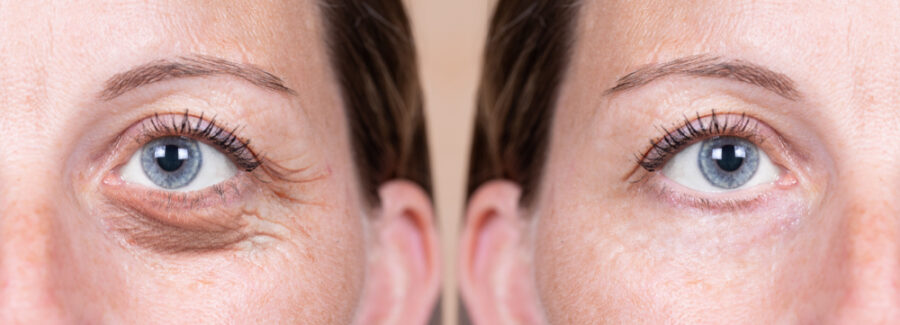
The blepharoplasty procedure can be performed using 2 distinct methods depending on the goals pursued.
Upper blepharoplasty
It is mainly used to treat heavy or drooping eyelids. The procedure is relatively light and carried out on an outpatient basis under local anaesthesia. It involves making an incision in the upper palpebral fold in order to perform the resection of the excess skin tissue as well as the fat pads. The procedure ends with a redraping of the skin and a suture of the incisions.
Lower blepharoplasty
It makes it possible to treat all kinds of irregularities of the eye area, such as under-eye circles, hollow under-eye circles, coloured under-eye circles, fat pads, folds and even wrinkles and fine lines. It aims to correct the downward shift of fat that occurs over time at the lower eyelids, sometimes accompanied by water retention that then causes the formation of bags (fatty hernias) weighing down the gaze and giving it a tired appearance. Two scenarios may arise during the procedure, depending on whether or not the skin shows significant laxity:
- For under-eye circles with excess skin, the fat is removed by an incision under the lashes and extracted through the eyelids. A re-tightening of the orbicularis muscle may sometimes be necessary to even out the whole. The skin is then redraped. This method, performed under general anaesthesia with sedation, applies more to under-eye circles caused by skin ageing.
- For under-eye circles without excess skin, the procedure performed under local anaesthesia is lighter and the incision is made inside the eyelid in order to remove the fat. This second method, known as the transconjunctival approach, is more practical for still-young skin and makes the scar less visible.
Aesthetic medicine solutions for coloured and pigmented under-eye circles
Not every correction of the eye area goes through the scalpel. When the under-eye circle is above all a matter of colour — bluish, purplish or pigmented circles rather than hollow circles —, aesthetic medicine of the eye area through mesotherapy provides answers that complement surgery. Mesotherapy, which consists of micro-injections of multivitamin solutions and revitalising actives, is thus indicated for purplish circles of circulatory origin: it stimulates microcirculation and restores radiance to dull skin, generally over the course of several sessions.
For brown or pigmented under-eye circles, often hereditary or ethnic in origin, a depigmenting approach is preferred instead. A depigmenting chemical peel suited to the eye area makes it possible to lighten the shade while stimulating collagen, and pairs readily with brightening cosmetic care at home (depigmenting creams and serums, daily sun protection). Skin-stimulation techniques such as Morpheus 8 fractional radiofrequency can finally re-densify thin, translucent skin that lets the vessels show through, for a tightening, radiant effect. These aesthetic medicine procedures do not remove a hollow under-eye circle — which, for its part, calls for filling or surgery — but they usefully complement the overall care of the eye area.
Recovery and side effects of eyelid surgery
Plastic surgery for under-eye circles is sometimes accompanied by adverse effects that are entirely normal, both for hyaluronic acid injections and for blepharoplasty. This is the case in particular with the appearance of redness, swelling, erythema and bruising, which is relatively common. These side effects may appear at the injection or incision marks and may last several weeks. They are also associated with itching, slight visual discomfort and sometimes chronic pain. Surgeons regularly suggest solutions to help soften these adverse effects in order to make the most of the result obtained, such as for example antibiotic eye drops. In the worst cases (which prove to be extremely rare), infections or necrosis can occur following a poorly managed procedure or precautions that were not respected.
A few tips after the under-eye hollow treatment procedure
After the surgery, one or more follow-up consultations should be carried out so that the practitioner can check the progress of recovery and limit the risks of complications. The surgeon will in particular check the healing of the parts incised during the procedure. You can continue the consultations in the 4 weeks following the procedure to ensure a lasting result.
For blepharoplasty and fat transfer, it is advised to stop sporting activities and to reduce sudden movements for a few weeks (around 3 weeks) to promote healing and stabilise the harmonisation of the volumes. Some surgeons even recommend taking time off (around a week) to optimise recovery and not compromise the result obtained. The final result of the blepharoplasty procedure may unfold over a period of 3 to 6 months, while fat transfer will produce its effect after about ten days.
Beyond under-eye circles, these procedures are part of a more overall approach to eye rejuvenation, with or without surgery. When it is the position of the outer corner of the eye that tires the expression, other targeted procedures such as canthopexy to reposition the outer canthus can complete the treatment and restore all its freshness to the gaze.
Frequently asked questions
Which surgery or treatment should you choose for under-eye circles?+
It all depends on the type of under-eye circle. A hollow under-eye circle is corrected by filling (hyaluronic acid or fat transfer) or, when bags are also present, by lower blepharoplasty. A coloured or pigmented under-eye circle is more a matter for aesthetic medicine (mesotherapy, chemical peel or depigmenting laser). Only an examination of the eye area makes it possible to establish the right diagnosis and propose the most suitable technique — or combination of techniques — for your eyes.
Does Botox treat under-eye circles?+
No, not directly. Botulinum toxin relaxes the muscles responsible for fine lines (notably crow’s feet) but it does not fill a hollow and does not lighten the colour of an under-eye circle. To treat an under-eye circle as such, the approach is filling (hyaluronic acid, fat transfer), blepharoplasty or depigmenting care. Botox can, on the other hand, be combined with these procedures as part of an overall eye rejuvenation approach.
Can under-eye circles be removed permanently?+
There is no truly universal « permanent » solution, because under-eye circles have multiple causes (heredity, ageing, circulation, lifestyle) that cannot all be eliminated. Some techniques do, however, offer very long-lasting results: blepharoplasty durably corrects bags and excess skin, and fat transfer provides filling that is largely permanent once the fat has stabilised. Hyaluronic acid, by contrast, gives a temporary result that has to be maintained.
How long does the result of a hyaluronic acid injection on under-eye circles last?+
In the thin skin of the eye area, hyaluronic acid filling lasts on average 12 to 18 months, sometimes longer depending on the product used and the depth of the under-eye circle, before being gradually resorbed. A simple maintenance session then makes it possible to extend the result. Fat transfer, for its part, offers far more lasting filling.
What is the price of an under-eye circle treatment?+
The cost depends on the technique chosen, the complexity of the procedure and the products required: a hyaluronic acid injection of the eye area is significantly less expensive than a blepharoplasty or a fat transfer, which are surgical procedures. The exact price can only be given after a consultation, once the diagnosis has been made and the treatment plan defined. The practice then provides you with a personalised, detailed quote.
How do you treat dark or coloured under-eye circles?+
Dark under-eye circles are often linked to poor blood circulation, whereas brown circles are due to hyperpigmentation, which is common on skin of Mediterranean, Asian or Caribbean origin. In the first case, revitalising mesotherapy and hyaluronic acid, which reduces the transparency of the skin, are often preferred; in the second, the approach is a depigmenting chemical peel and brightening care. Daily sun protection of the eye area helps to maintain the result.
Book an appointment
If you are considering a procedure, book an appointment in just a few clicks: our surgeons will answer all your questions and guide you toward a tailored, personalised solution.
Book on Doctolib