
Temporal brow lift in Paris
Contents
What is a temporal brow lift?
A brow that droops, tired or heavy-looking eyes even at rest: the temporal brow lift is the targeted procedure for the upper third of the face that raises the tail of the brow, which drops with age, tightens the skin at the temple and opens up the eyes, through a scar hidden in the hair.
- Anesthesia: local or general, depending on the technique used
- Procedure length: 45 minutes to 2 hours
- Social downtime: 5 to 10 days
- Results: documented for at least 5 to 6 years with deep fixation
It also goes by the names brow tail lift, temple lift, or lateral brow lift in the international literature. It corrects brow ptosis (the progressive drooping of the brow, most pronounced in its outer portion), which is responsible for eyes that look sad or heavy even at rest, and sometimes accentuates crow’s feet.
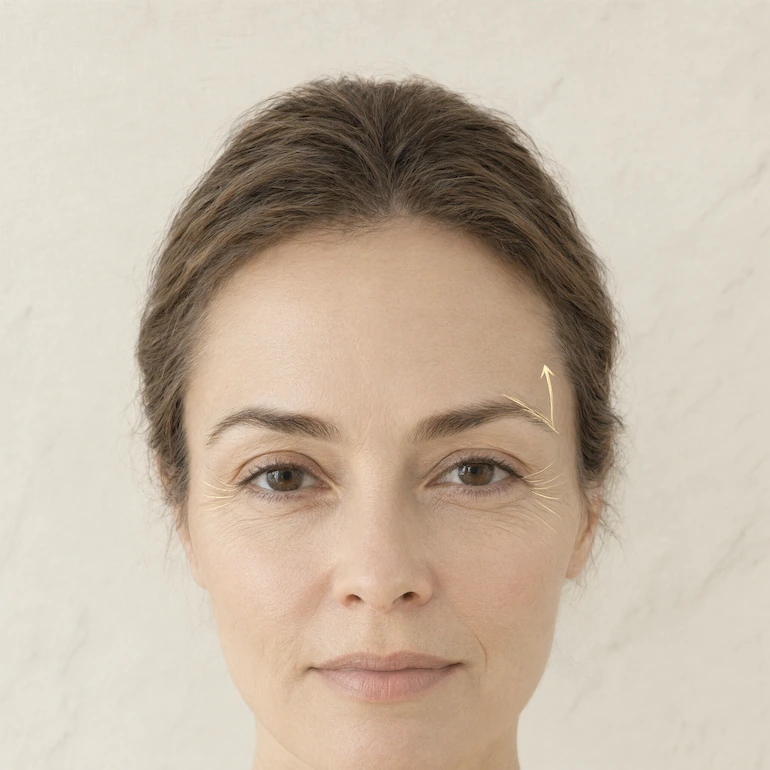
Are you a good candidate for a temporal brow lift? The mirror test
A simple gesture can give you a first indication, even before your consultation:
- place two fingers on the temple, just above and behind the outer end of the brow;
- lift the skin gently upward;
- observe: if the tail of the brow moves back into place and your eyes visibly open up, you are probably a better candidate for a temporal brow lift than for another procedure.

This test targets exactly what the procedure corrects: a drooping or sagging brow in its outer portion, tired-looking eyes even though the eyelid itself is not at fault. It does not replace a clinical examination (only a qualified surgeon can confirm the indication), but it is a useful starting point.
One point few patients anticipate: a slight natural brow asymmetry is the rule, not the exception; it exists before any surgery and is photographed at the consultation, precisely so it is never wrongly blamed on the procedure afterward.
Temporal brow lift, blepharoplasty or forehead lift: how to choose?
Three procedures address three distinct problems, and confusion between them is common. Excess skin localized on the upper eyelid itself calls for blepharoplasty, the go-to procedure for heavy upper eyelids. This also explains some results judged incomplete after a blepharoplasty alone: when the tail of the brow is the real cause, the eyes stay heavy-looking despite eyelid surgery. Drooping of the entire brow, combined with pronounced horizontal lines across the forehead, points toward a forehead lift. An isolated drop of the tail of the brow alone, without excess eyelid skin or generalized forehead lines, is squarely the territory of the temporal brow lift.
| Temporal brow lift | Blepharoplasty | Forehead lift | |
|---|---|---|---|
| Problem treated | Drooping tail of the brow, sagging temple | Excess skin on the upper eyelid | Drooping of the entire brow, forehead lines |
| Scar | 4 to 5 cm, hidden in the hair | In the natural eyelid crease | Across the full width of the scalp |
| How long results last | At least 5 to 6 years (deep fixation) | Long-lasting, little recurrence | Comparable to a temporal brow lift |
These procedures are often combined in the same operation: by raising the tail of the brow, the temporal brow lift reduces the skin to be removed from the upper eyelid, and therefore the length of its scar, when combined with a blepharoplasty. Worth noting too: a facelift, which addresses sagging along the jawline and neck instead, targets a different anatomical area and answers a completely different demand, that of the lower face rather than the eyes.
How does the procedure work?
A temporal brow lift takes 45 minutes to 2 hours on average, most often as outpatient surgery, under deep local anesthesia or general anesthesia depending on the extent of the procedure; with outpatient surgery, patients always leave with someone accompanying them. Two pre-operative consultations, focused on each patient’s goals, usually precede the procedure.
Two technical approaches coexist. With the subcutaneous approach, Dr Hunsinger makes a 4 to 5 cm incision in the scalp and dissects directly down to above the brow. With the endoscopic approach (a miniature camera inserted through small incisions), he dissects more deeply, under the periosteum, and completely releases the temporal adhesion and the orbital ligament: if these fascial attachments are not released, they prevent the tail of the brow from repositioning and concentrate all the tension on the scar. This deep release, combined with solid tissue fixation, determines how long the result lasts far more than the technique itself.
A point few patients anticipate: the position of the incision also affects the hairline. An incision within the hair-bearing scalp combined with backward tension can slightly push back the hairline at the temples, while an incision right at the hairline avoids this; the choice depends on forehead height, hair density and hairstyle, and is discussed at the consultation. Baldness or low hair density at the temples, common among male patients, limits the options for camouflaging the scar and then weighs on the choice of technique. A variant then comes into play: direct brow lift, in which Dr Hunsinger removes a thin strip of skin just above the tail of the brow, with a discreet scar hidden in a fold; simple and long-lasting, he mainly offers it to balding men.
Dr Hunsinger rules out two options: the so-called « pince mannequin » technique, a simple skin excision without release or deep suspension, which carries a high risk of rapid recurrence and a widened scar; and barbed thread lifts, which offer a real but time-limited effect and cannot replace surgical retensioning. Smoking must be stopped strictly one month before the procedure, since it multiplies the risk of skin necrosis by ten; aspirin and blood thinners must also be stopped, on the surgeon’s advice.
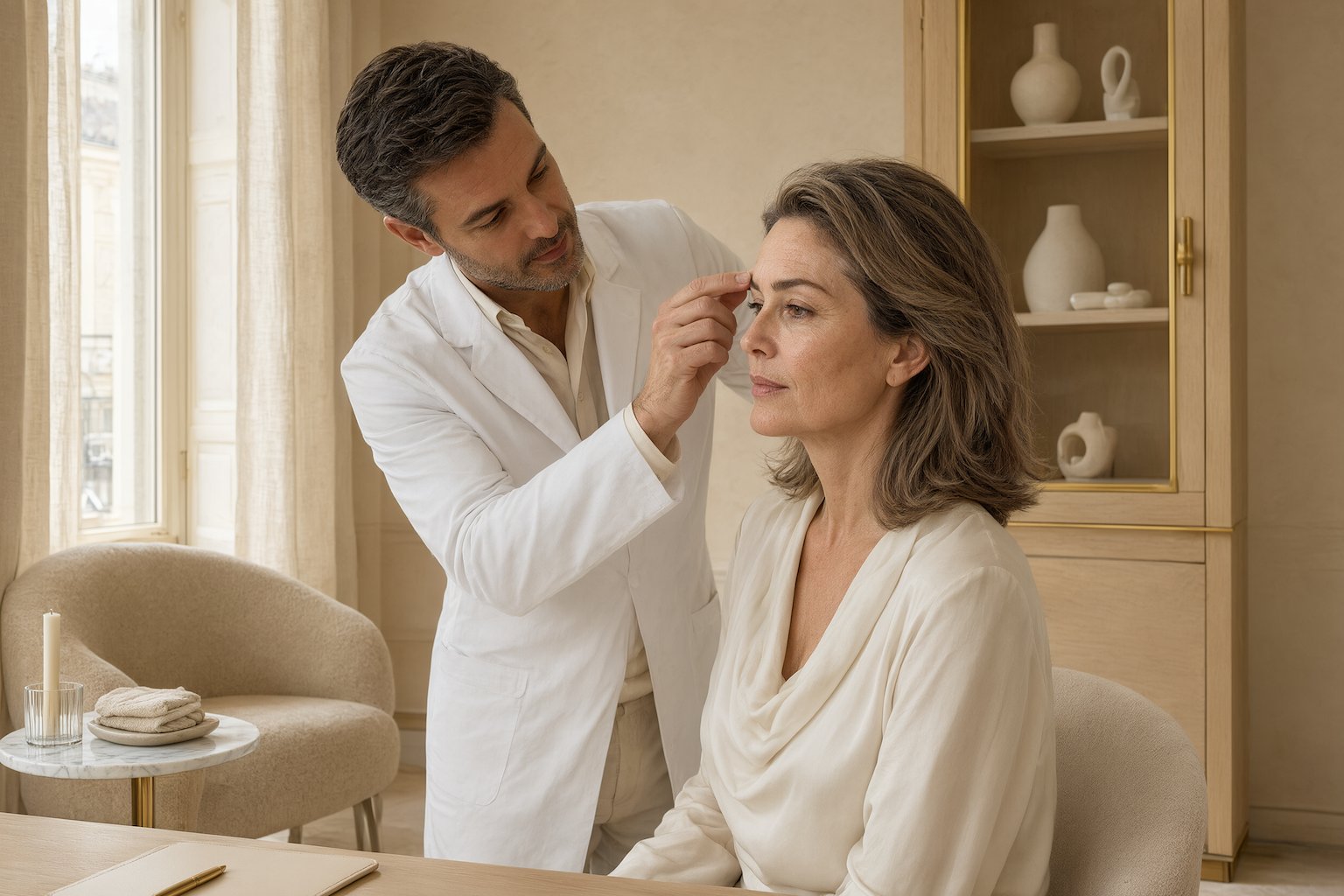
At the Rive Droite Paris Étoile plastic surgery practice, the pre-operative consultation also serves to set a realistic goal: a few well-positioned millimetres of lift are enough to open up the eyes, without changing their expression.
Recovery: what to expect
Recovery is generally straightforward: swelling and bruising appear around the temple, with mild pain that is well controlled by simple painkillers; full swelling typically takes 1 to 2 weeks to go down.
Social downtime (the period before you can resume normal life without the procedure being noticeable) is 5 to 10 days. Dr Hunsinger removes the stitches or staples between day 7 and day 14, then schedules regular follow-up visits throughout the first year.
- apply cold compresses around the eyes for the first few days, to limit swelling and bruising
- sleep with your head elevated for the first 5 to 7 nights, to limit swelling
- avoid any intense physical activity for about one month
- avoid driving for 1 to 2 days
- protect the scar and the area from the sun for several months, to avoid any risk of hyperpigmentation
- expect temporary numbness in the area, which resolves within 8 weeks to 3 months
This numbness is most often due to neuropraxia, a temporary, harmless nerve irritation that resolves on its own in the vast majority of cases. Beyond the risks common to any surgery (hematoma, infection), rare specific complications can occur: injury to the frontal branch of the facial nerve, the one that controls brow elevation, is exceptional with the endoscopic technique, and revision surgery remains rare. Choosing a surgeon qualified in plastic surgery remains the best way to limit these risks.
Results: how long does a temporal brow lift last?
The result is visible as soon as the first dressing is removed, but it truly settles between 3 and 6 months, the time it takes for the swelling to go down and the tissues to reposition. When properly fixed at a deep level, it then stays documented for at least 5 to 6 years: how long it lasts depends above all on the technique and the fixation, not on luck.
The key to this durability: Dr Hunsinger completely releases the temporal attachments and fixes the tissues at a deep level, for example in bone tunnels. A slight initial overcorrection, which eases off over the first few weeks, is normal: never judge the result before 3 months.
The goal remains a natural result, without a pulled look or a frozen brow: opening up the eyes, not transforming them. Compared with non-surgical alternatives, the gap is clear: botulinum toxin injections, which temporarily raise the brow by one to two millimetres, only work for 3 to 5 months; thread lifts lose much of their effect by the sixth month; focused ultrasound (HIFU) achieves 0.5 to 1.7 mm over a comparable period; hyaluronic acid injections fill a hollow but do not lift the brow. Only surgery delivers a lasting answer.
| Technique | Elevation achieved | How long the effect lasts |
|---|---|---|
| Temporal brow lift (surgery) | 3 to 4.4 mm laterally, up to 6-7 mm at the tail of the brow | At least 5 to 6 years |
| Botulinum toxin | 0.6 to 2.1 mm | 3 to 5 months |
| Thread lifts | Limited effect, largely lost by 6 months | About 6 months |
| HIFU (Ultherapy) | 0.5 to 1.7 mm | 3 to 6 months |
The « fox eyes » effect: what to know before you ask for it
« Fox eyes » is not a procedure in itself, but a result: a visually elongated, almond-shaped eye, tilted slightly upward toward the temple, most often achieved through a pronounced temporal brow lift, sometimes combined with a canthopexy (a surgical tightening of the outer corner of the eye). Popularized on social media in 2020-2021, this request is discussed at the consultation: Dr Hunsinger looks for a measured elevation that respects the expression of the eyes, rather than the most pronounced version of the look.
An accompanying canthopexy is not « easily reversible » either, as is sometimes claimed: it changes the tendon tension at the corner of the eye, and correcting it if overdone can require revision surgery. To understand the limits of this request, see our article on the fox eyes procedure and its limits.
« The main risk with a poorly judged temporal brow lift is an overcorrected brow and a permanently surprised look. My approach favors a measured elevation, without excess, that opens up the eyes without changing their expression, » says Dr Hunsinger.
Temporal brow lift prices in Paris and the legal framework
Expect to pay between €2,500 and €5,500 in most cases, depending on the technique, the type of anesthesia and the length of the procedure; in Paris, the range tends to run from €4,000 to €5,500. As with any purely cosmetic procedure, this surgery is never covered by French national health insurance, regardless of the practitioner.
The process includes two pre-operative consultations and a cooling-off period of at least 15 days between the signed quote and the procedure.
At the Rive Droite Paris Étoile clinic, every quote is explained in detail at the consultation, with no obligation. You can book a consultation at the clinic, just steps from the Arc de Triomphe.
Frequently asked questions
What's the difference between a temporal brow lift and blepharoplasty?+
A temporal brow lift raises the tail of the brow and tightens the temple; blepharoplasty removes the excess skin located directly on the upper eyelid. The two procedures sometimes complement each other, but they correct two distinct anatomical areas.
Does a temporal brow lift leave a visible scar?+
No: the incision, 4 to 5 cm long, is positioned in the scalp or right at the hairline, and becomes invisible once hair growth resumes. In the first few weeks after the stitches are removed, it stays pink or red, easily hidden by the hair, then gradually fades. Its final appearance can be assessed at around one year.
At what age can you consider a temporal brow lift?+
There is no fixed age: the indication depends on the drooping observed, most often starting in the late forties or fifties, but a younger patient with a marked, localized drop in the tail of the brow can also be a candidate. Conversely, in the absence of any sagging, a lift achieved through simple skin tensioning fades quickly, so purely cosmetic requests on a young face call for caution.
How long is the time off work after a temporal brow lift?+
Social downtime is 5 to 10 days in most cases, depending on how quickly the swelling and bruising go down.
Is the result of a temporal brow lift permanent?+
No: no surgery can stop the aging process. The result stays documented for at least 5 to 6 years with deep fixation, before natural sagging gradually resumes.
Can a temporal brow lift be combined with blepharoplasty or Botox injections?+
Yes for blepharoplasty, when both issues are present: an experienced surgeon assesses whether it makes sense to combine them in the same operation. A hollow temple can also be filled with fat transfer (lipofilling) during the same procedure. Botulinum toxin injections are mainly used on their own, as a temporary alternative, or for light upkeep between two procedures.
Book an appointment
If you are considering a procedure, book an appointment in just a few clicks: our surgeons will answer all your questions and guide you toward a tailored, personalised solution.
Book on Doctolib