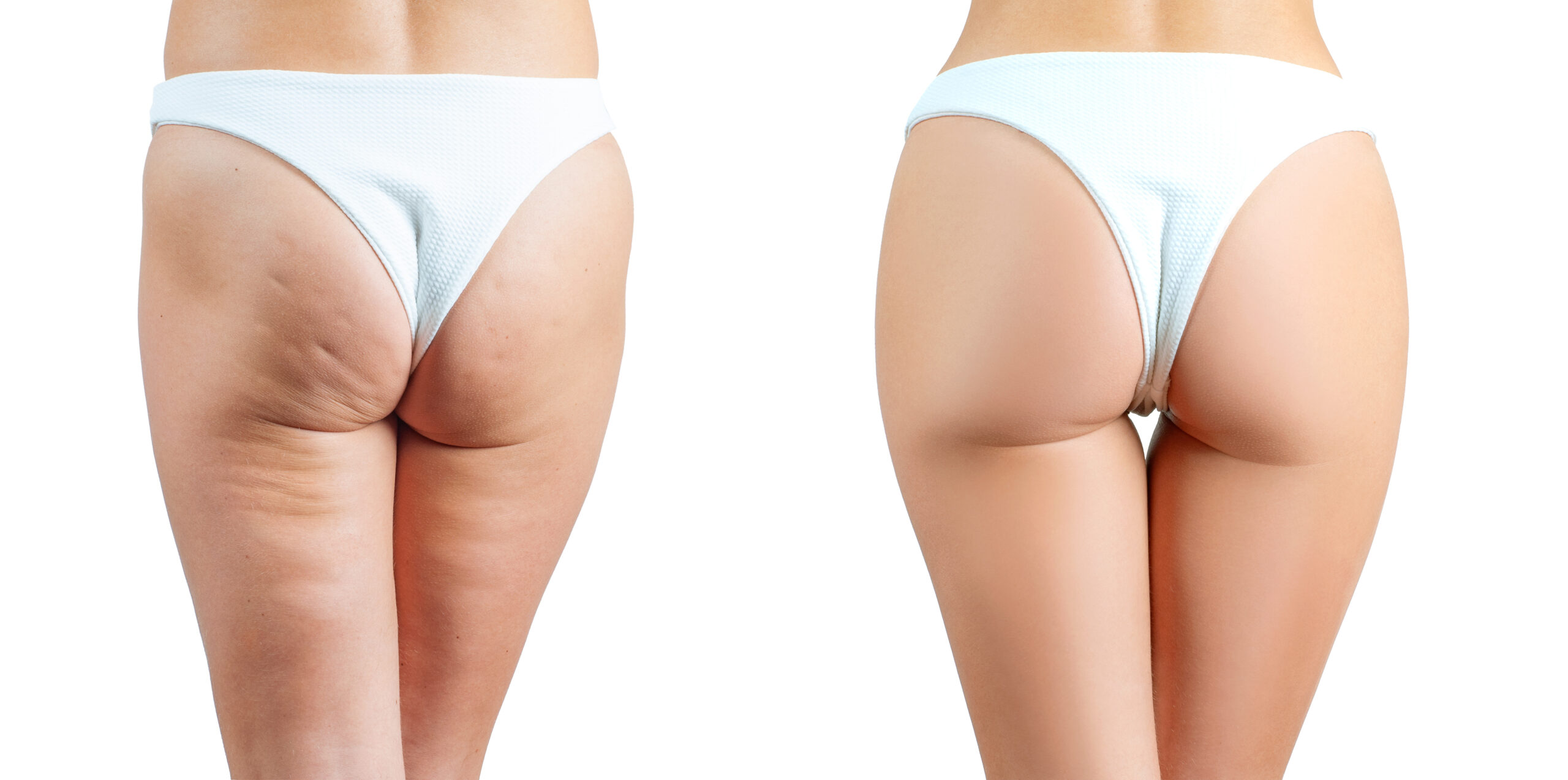
How to get rid of cellulite on the buttocks
For many women, cellulite on the buttocks is a sworn enemy. Getting rid of that dimpled, « orange-peel » look can turn into a real uphill battle. Plenty of women — and some men too — apply drastic methods day after day to banish these surface irregularities once and for all, with very mixed results. While buttock cellulite is generally harmless to your health, its unflattering appearance can quickly become a major source of self-consciousness. Discover all the most effective techniques and solutions to get rid of cellulite on the buttocks.
Contents
Understanding buttock cellulite: the 3 types of dimpling
Before trying to remove cellulite on the buttocks, it helps to recognise its nature, because not every technique works on every type. Dermatologists classically distinguish three forms of cellulite, which can in fact coexist in the same area:
- Adipose cellulite: linked to an excess of fat cells (adipocytes), it is soft and painless, and shows up mainly when you pinch the skin. It is the most responsive to dietary rebalancing and physical exercise.
- Watery (oedematous) cellulite: caused by water retention and poor lymphatic and venous circulation, it gives a swollen appearance. It responds well to drainage, hydration and endurance activities.
- Fibrous cellulite: the oldest and most stubborn. The collagen fibres retract and harden around the fat deposits, creating deep dimples that are sometimes painful to pinch. This is the type that resists natural measures the most and most often calls for aesthetic medicine or plastic surgery.
This distinction also explains why cellulite affects women far more: in women, the collagen septa that separate the fat lobules are arranged vertically, which lets the fat push up towards the surface and bulge the skin, whereas in men they form a denser cross-linked mesh that masks this relief (an architecture described as early as 1978 by dermatologists Nürnberger and Müller). Female hormones, in particular oestrogens, heredity and age — which thins the skin — accentuate this phenomenon, independently of weight.
Exercising regularly to guard against cellulite
Contrary to popular belief, cellulite on the buttocks is not solely the result of fat-cell storage (adipose cellulite). It is in large part explained by a lack of skin tone and elasticity. The main culprit is a sedentary lifestyle, which alters the connective tissue and creates a state of stasis that brings out unsightly folds (fibrous cellulite).
Physical exercise and endurance sports
So the best treatment against cellulite remains, first and foremost, physical exercise, to rebalance the various layers of tissue. Taking up — or getting back into — sport is the surest way to keep fat cells from spreading over the long term and to re-tone the gluteal muscles, whose atrophy is partly responsible for the skin laxity that contributes to the orange-peel look (fibrous cellulite).
Exercise aimed at clearing cellulite on the buttocks must, however, be carried out under particular conditions to be truly effective. To lose fat deposits efficiently, endurance sports are especially recommended. They are anti-cellulite treatments par excellence. The endurance sports best suited to eliminating this unsightly orange-peel skin include aqua aerobics and aqua biking (cycling in water).
Drainage and muscle strengthening
If, however, the cellulite in question is linked to water retention (watery cellulite), drainage is the ideal solution to clear it for good. Drainage most often comes through running. This endurance activity is the most effective at stimulating venous return. Running and jogging also naturally promote blood and lymphatic circulation.
To achieve firmer, more contoured buttocks, it is also recommended to combine endurance work with muscle-strengthening exercises. Building the gluteal muscles helps put an end to the slack, distended look caused in particular by a sedentary lifestyle and a lack of physical exercise. There are several routines to tone, contour and smooth the skin of the buttocks. These sporting activities also reactivate blood circulation in the fatty areas, for a complete reshaping of the buttocks’ appearance. Among them are pelvic raises, donkey kicks, sets of squats and lunges. Since cellulite rarely affects the buttocks alone, these exercises usefully complement the tips described in our article on cellulite on the thighs and saddlebags.
Adopting a suitable anti-cellulite diet
A healthy, balanced diet is the anti-cellulite ally par excellence, alongside the physical activity that is essential to prevent dimpling from forming. Cellulite is partly the result of a poor diet, most of the time too rich in sugars and bad fats. Excess fatty acids also cause the adipocytes to swell and block the circulation of fluids — particularly lymph — in the buttocks. A healthy, balanced diet, based notably on large amounts of varied fruit and vegetables, helps eliminate toxins as well as the fat deposits that build up in the buttocks and that, once compressed, become lastingly embedded in the skin’s surface.
In the case of watery cellulite (due to water retention), foods rich in antioxidants that stimulate circulation and fight water retention are especially recommended. It is, on the other hand, preferable to cut out animal fats and fast sugars in favour of foods rich in fibre as well as in omega-3 and omega-6, such as oily fish, nuts and seeds, or unsaturated and polyunsaturated fats. A diet rich in draining fruit and vegetables such as artichoke, celery or pineapple also helps clear cellulite on the buttocks.
Finally, it is important to vary your food and to eat fresh produce, rich in vitamins and trace elements.
Staying properly and regularly hydrated to eliminate cellulite
Good hydration also helps clear cellulite on the buttocks. In addition to dietary rebalancing, you should drink plenty of water or diuretics every day to speed up the elimination of waste from the body. Green tea, in particular, is an excellent antioxidant. It helps maintain the elasticity of the skin cells in the buttocks.
The ideal amount of water to drink each day to limit fat deposits or watery cellulite is around 1 to 1.5 L. Drinking draining beverages, such as green tea or so-called detox infusions, is therefore particularly advisable for anyone prone to water retention. Special drinks based notably on lemon, ginger, kiwi or pineapple stimulate the drainage of toxins and waste. These can also be made at home, for instance using a juice extractor.
Using daily massage against cellulite
To fight fat cells and prevent them from coming back, it can also be worthwhile to boost lymphatic circulation in order to stimulate the body regularly. Knowing that adipose cellulite is largely caused by the stagnation of fluids, regular massage helps firm up the skin of the buttocks. The techniques of pinch-and-roll massage and lymphatic drainage are particularly effective here for tackling the withered appearance.
Regular massage is generally performed by pressing a small fold of skin between the thumb and index finger, then rolling, kneading and rubbing it firmly from top to bottom and from left to right. The idea is to break up the dimples to reactivate fluid circulation. The massage usually lasts 5 to 10 minutes on the targeted areas — in this case the buttocks — but can also be applied to the thighs, hips, belly, and even the arms or knees. During these sessions, an anti-cellulite cup can also be used.
Lastly, endermologie and in particular lipomassage are also effective treatments performed with an anti-cellulite device fitted with motorised rollers. This is a deep massage of the skin and the subcutaneous tissues that helps reduce fat deposits beneath the epidermis, tone the skin and reactivate blood and lymphatic circulation.
Eliminating cellulite with aesthetic medicine
When cellulite is not necessarily caused by diet or a lack of physical exercise, it may be explained by more hormonal or genetic factors. It results in particular from the skin being pulled in by scattered fibrous bands, whose tightening causes dimples to appear, giving the orange-peel look. Aesthetic medicine can then act directly on this mechanism, without resorting to surgery.
HYAcorp hyaluronic acid injections
HYAcorp hyaluronic acid injections into the upper layer of the dermis give the buttocks a plumper, smoother appearance without resorting to surgery. They restore firmness to the buttocks and correct certain concavities, including the orange-peel look.
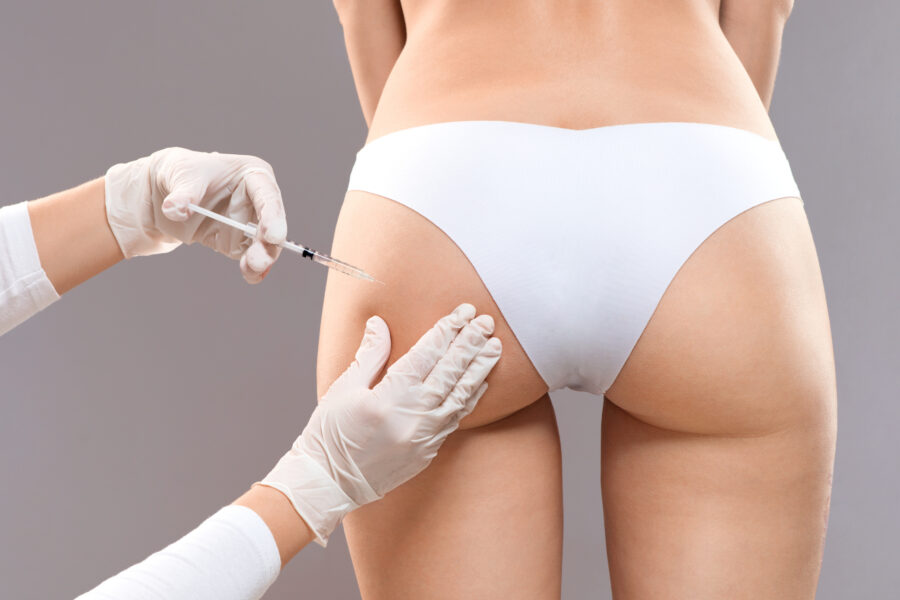
The substance administered is made of a resorbable gel containing cross-linked, purified, sterile and pyrogen-free hyaluronic acid, specifically designed for the body. This substance, which is naturally present in the body, is biodegradable and biocompatible, and makes it possible to redraw and reshape the contours of the buttocks for a natural result, generally obtained after just 2 sessions.
The effects of this filler injection generally last 12 to 24 months. HYAcorp injections then make it possible to round out the buttocks and restore the skin’s full elasticity in a relatively non-invasive way. In the same spirit, biostimulation with Lanluma, a genuine non-surgical buttock lift, boosts the natural production of collagen to progressively tighten and firm dimpled skin.
Microneedling
Microneedling involves making micro-perforations on the areas to be treated using a roller or a pen fitted with micro-needles, in order to stimulate the skin and boost the production of elastin and collagen to redensify the dermis. A new, stronger layer of collagen is then created, which better holds the fat cells in place.
Mesotherapy
Mesotherapy consists of injecting active compounds that help activate the catabolism of the adipocytes and the vascular circulation, reduce fluid retention and tighten the skin tissue.
Cryolipolysis
When buttock cellulite is accompanied by localised, resistant fat deposits, cryolipolysis, a fat-reduction technique using cold, makes it possible to destroy part of the fat cells with no anaesthesia and no downtime. The controlled cold triggers the gradual destruction of the adipocytes, which are naturally eliminated by the body in the weeks following the session, refining the area and softening the dimpled look on the surface.
Eliminating cellulite with plastic surgery
Plastic surgery makes it possible to eliminate cellulite on the buttocks more durably when the dimpling is accompanied by significant skin laxity. Two techniques are mainly used to reshape the contour of the buttocks.
The buttock lift
The buttock lift is well suited to treating slack or crepey buttocks, or buttocks with marked skin irregularities such as orange-peel skin or dimpling. It involves carrying out a skin resection to remove the excess skin, then re-draping the skin to smooth away the folds and restore a firmer appearance.
The lift can involve the whole buttock in the case of generalised skin laxity (an upper lift), or only the lower part of the buttock (an infragluteal lift), with redefinition of the infragluteal fold and removal of the excess skin at the bottom of the buttocks (the infragluteal « banana »).
Buttock lipofilling
Buttock lipofilling (also called a Brazilian butt lift), generally used to contour the buttocks and achieve harmonious curves, also makes it possible to tighten and smooth the skin of slack buttocks or buttocks that have lost elasticity. This technique involves harvesting fat from other parts of the body (arms, knees, belly, thighs, hips) to reinject it into the buttocks. This natural method (using autologous fat transfer) requires a sufficient amount of fat to harvest in order to be reinjected. After the procedure, the contour is visibly reshaped, with a change in the size and shape of the buttocks and an increase in the thickness of the subcutaneous layer. The previously slack buttocks are then durably firmed.
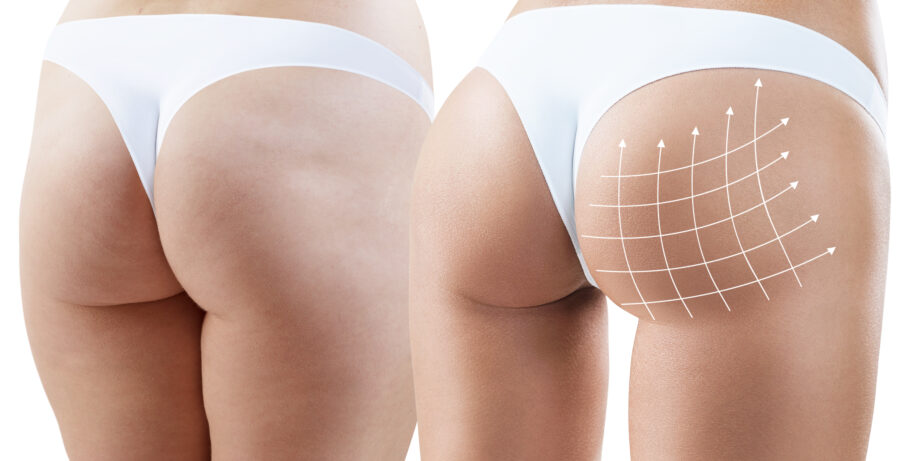
Liposuction of localised fat deposits, whose main purpose is to remove and permanently eliminate fat cells in a targeted area, does not directly clear cellulite on the buttocks; it only reshapes the body contour. It will only help redefine the contour of the buttocks by liposuctioning the surrounding areas such as the saddlebags or love handles, but it will not be applied directly to the buttocks themselves, since cellulite is above all a symptom of skin laxity.
Frequently asked questions
Can buttock cellulite be made to disappear permanently?+
Cellulite is a very common physiological phenomenon, present in a large majority of women: it can be clearly softened and the dimpled look smoothed out, but no method guarantees its total, permanent disappearance. The realistic goal is to reduce the dimples and firm the skin, then maintain the result through a healthy lifestyle. The adipose and watery forms respond well to natural measures and drainage; fibrous cellulite, which is more stubborn, falls more within the scope of aesthetic medicine or plastic surgery.
How can you remove buttock cellulite quickly and naturally?+
No solution is instant, but the most effective natural levers work in combination: endurance sports (running, aqua biking, swimming) paired with gluteal strengthening (squats, lunges, pelvic raises), a diet low in sugars and saturated fats, good hydration and regular drainage (pinch-and-roll massage, lymphatic drainage). The first results on the skins appearance are generally seen after several weeks of consistent practice.
How long does it take to see results on buttock cellulite?+
With a suitable lifestyle (sport, diet, drainage), the skins appearance often starts to improve within a few weeks, but established, fibrous cellulite can require several months of steady effort. Aesthetic-medicine techniques such as HYAcorp hyaluronic acid injections give a visible result after about two sessions, while surgery (buttock lift or buttock lipofilling) offers a more lasting result, appreciated once the swelling has subsided.
Why do you get cellulite even when you are slim and exercise?+
Cellulite is not just a matter of weight. It also depends on the architecture of the connective tissue, female hormones (oestrogens), heredity, the quality of the circulation and age. In women, the vertical collagen septa let the fat bulge the skin, so that slim, sporty people can still have dimpling. Sport nonetheless remains essential to tone the gluteal muscles and limit the phenomenon.
Why do men have far less cellulite than women?+
In men, the collagen septa that compartmentalise the subcutaneous fat form a tight cross-linked mesh that holds the fat lobules in place, whereas in women they are arranged vertically, which lets the fat push up and create the orange-peel look. Hormonal differences accentuate this contrast even further. Cellulite therefore affects a very large majority of women, and remains rare in men.
Which medical or surgical solution for stubborn fibrous cellulite?+
When the dimples are deep and resist natural measures, several options are available at the clinic, to be discussed during a consultation: HYAcorp hyaluronic acid injections or Lanluma biostimulation to smooth and firm, cryolipolysis for localised fat deposits, or, in cases of marked skin laxity, a buttock lift and buttock lipofilling. The choice depends on the type of cellulite, the quality of the skin and each patients expectations, assessed by Dr Vincent Hunsinger.
Book an appointment
If you are considering a procedure, book an appointment in just a few clicks: our surgeons will answer all your questions and guide you toward a tailored, personalised solution.
Book on Doctolib