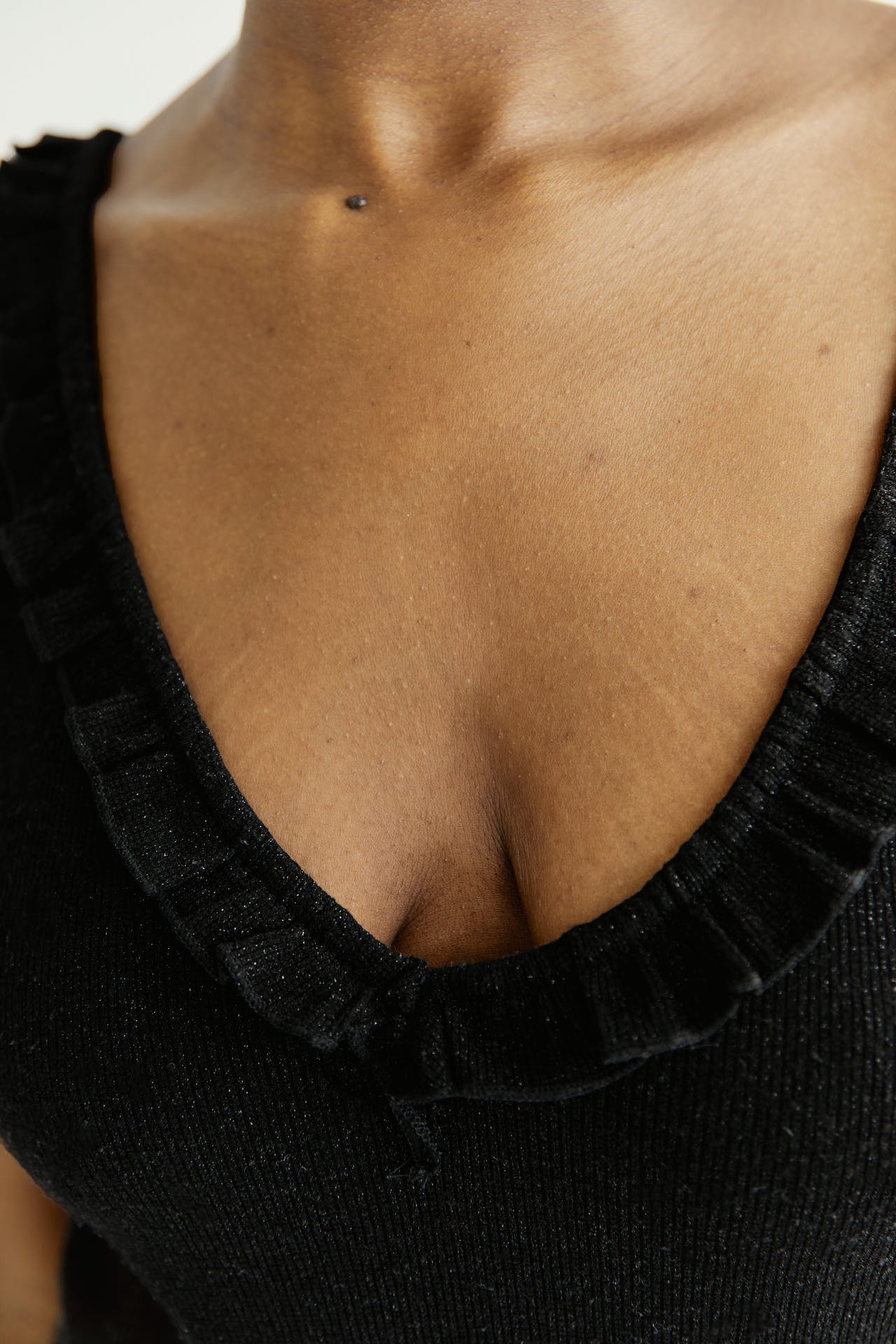
Stretch marks on the breasts: understanding the causes and possible solutions
Often a source of self-consciousness, stretch marks take the form of streaks, most often parallel, that appear more or less evenly on one or more parts of the body. These streak-like marks on the skin can appear on the buttocks, thighs, hips, belly and arms, but also on the breasts. On the chest, they leave unsightly marks across the décolletage. While they mostly affect women, men can also develop these often unflattering streaks, even though they pose no danger to health. Let’s look at how stretch marks on the breasts form and what solutions exist to fade them or even make them disappear.
Contents
How do streaks form on the chest?
Stretch marks appear when the dermis, the layer of skin beneath the epidermis, is weakened by various factors, particularly hormonal ones. These marks are the sign of a rupture of the elastic fibres (the skin « cracks ») and of an inflammation of the dermis when the skin undergoes overly sudden changes. The regenerating cells known as fibroblasts are subjected to excessive strain, while collagen and elastin production is insufficient to maintain good skin elasticity.
Stretch marks then form through a two-stage process:
- red or purplish stretch marks, also called « immature stretch marks ». These are recent marks still forming, characterised by their inflammatory nature in the dermis, which can make them relatively painful;
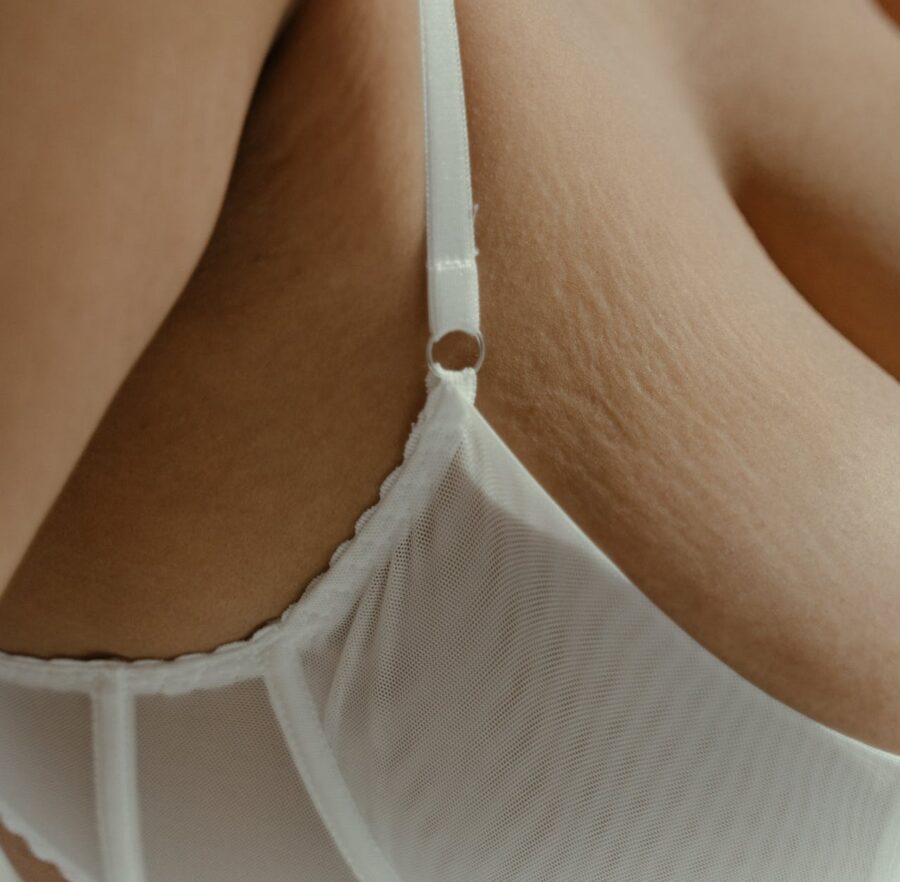
- white stretch marks or « mature stretch marks », which correspond in a way to the healing and repair process of the damaged skin cells. On the chest, these stretch marks, known as « striae gravidarum », take on a pearly white appearance with a parallel alignment to one another over a given area. They can vary in size, ranging from a few centimetres to several tens of centimetres in length in some cases.
Good to know: this shift from red to white is gradual. A red or purplish stretch mark is recent and remains, at this inflammatory stage, the most responsive to treatment; it generally takes several months to more than a year before it turns white and is permanently healed. This is why it is advisable to treat a stretch mark as early as possible, while it is still coloured.
What are the different causes of stretch marks on the breasts?
Stretch marks appear on the breasts as a result of anatomical upheavals in the body (weight gain, growth) as well as a fragility of the skin that may be:
- hereditary (genetic);
- hormonal (an overproduction of cortisol that the fibroblasts cannot keep up with);
- natural (ageing);
- circumstantial (lifestyle, dehydration).
Certain periods of life and certain events are also relatively critical times for stretch marks to appear on the breasts.
Pregnancy and breastfeeding
Pregnancy is probably the main factor responsible for stretch marks appearing, particularly on the belly and hips but also on the breasts. This period brings about a hyperstimulation of the mammary glands and milk ducts owing to the overproduction of hormones (oestrogen and progesterone) in preparation for breastfeeding. The breasts then become heavy and swollen.
This rapid swelling of the chest during the first six months of pregnancy frequently causes stretch marks to appear, all the more so as the skin of the breasts is relatively thin and fragile, which means the weight of the breasts rests largely on the epidermis, which can then become weakened. This affects around half of all women, most often during the second trimester of pregnancy.
During breastfeeding, the chest can also swell considerably as the milk comes in, which can cause cracks in the skin leading to streaks on the breasts. A stretch mark that appears during breastfeeding then follows the same course as the others: red and inflammatory at first, it gradually lightens once lactation has ended and the chest has returned to its usual volume.
Good to know: taking the contraceptive pill can also trigger the same kind of hormonal phenomenon behind stretch marks, even outside of any pregnancy.
Weight fluctuations
Weight fluctuations are also fertile ground for streaks to appear on the chest, whatever their cause (an unbalanced diet, medical treatment, stress, and so on). Stretch marks may then be more or less numerous and pronounced depending on the number of kilos gained, the speed of the weight gain, and the skin’s retraction properties. In the same way, weight loss can also lead to stretch marks. Even when this loss is gradual, the skin can struggle to adapt to these changes owing to the lack of collagen that prevents the skin from returning to its original appearance.
Breast implants
Breast augmentation with implants and breast implant removal can also alter the hormonal balance of the breasts and thereby cause streaks to appear on the chest. This is especially the case with implants that are large relative to the original cup size. When the stretching of the skin is accompanied by marked sagging, a breast lift can be considered to tighten the skin and reposition the gland.
Puberty
Stretch marks can also appear on the chest during puberty. The rapid growth of the breasts can indeed cause a sudden stretching of the skin. The resulting overproduction of cortisol then leads to reduced collagen production during this period. The collagen fibres, produced in too small a quantity, can no longer meet the skin’s needs in terms of elasticity and resistance, even as it is subjected to stretching that is sometimes very significant and sudden. This lack of suppleness and elasticity in the skin causes vertical stretch marks to appear above and below the breasts, or diagonal ones between the armpit and the nipple. Around 25% of young girls experience this natural phenomenon at puberty.
Genetics
Genetics also have a greater or lesser impact, depending on the case, on the development and visibility of stretch marks on the chest. Very thin skin tends to be more fragile and therefore to crack more readily. It is then likely to show more pronounced scars and, in the long run, wider, more visible stretch marks. Certain conditions such as Cushing’s syndrome (an excess production of cortisol in the body) or other illnesses involving corticosteroid treatments are also conducive to streaks appearing on the chest.
Stretch mark on the breast or a sign of cancer: how to tell the difference?
Finding a new mark on the chest is a frequent source of worry. It must be stated clearly: a stretch mark is a benign lesion, with no connection to cancer. It corresponds to a scar in the dermis: fixed, linear, streak-shaped, and its appearance no longer changes once the skin has healed.
Certain skin signs on the breast should nonetheless prompt a prompt consultation, because they have nothing to do with a stretch mark. Inflammatory breast cancer remains a rare form, but it presents with skin changes that you should know how to recognise. According to the Canadian Cancer Society, the suggestive signs are:
- redness or a darker discolouration spreading over a large area of the breast (not a fine streak);
- a breast that is bigger, swollen, heavy or warm;
- a thickening of the skin resembling « orange peel » (a dimpled appearance);
- a retracted nipple or one pointing inward;
- swollen lymph nodes in the armpit or near the collarbone.
The main difference comes down to how things change: a stretch mark is stable, whereas these signs appear and progress rapidly, within a few weeks. If in doubt, or if a mark quickly changes in appearance, it is better to see a doctor or have a screening examination rather than putting it down to a simple stretch mark.
What solutions are there to make stretch marks on the breasts disappear?
It is possible to prevent, fade and in some cases eliminate stretch marks using gentle solutions, but also through aesthetic medicine procedures.
Massage
Massage benefits the skin of the breasts by boosting blood circulation and collagen production, which in turn help reduce the appearance of stretch marks. Prolonged massage with circular movements at bedtime allows for better oxygenation and cell renewal through the stimulation of the fibroblasts.
Anti-stretch-mark creams and oils for the chest
There are anti-stretch-mark creams and oils formulated specifically to treat stretch marks on the breasts, most often based on sweet almond, avocado or jojoba oil. Usually available on prescription, these products contain retinoic acid (vitamin A acid), which produces an exfoliating effect that irritates the skin in order to stimulate its regeneration. They also help improve blood circulation and kick-start collagen production. Their smoothing and moisturising effect also helps improve the texture and appearance of stretch marks while reducing itching on the chest. They should, however, be combined with a moisturising cream to prevent the skin from drying out and to avoid irritation of the nipples and areolas.
Good to know: these cosmetic treatments mainly act on stretch marks that are still red, at the inflammatory stage. Once a stretch mark has turned white and healed, creams are generally no longer enough to erase it, and only aesthetic medicine techniques can genuinely fade it.
Aesthetic medicine
Several aesthetic medicine solutions can fade stretch marks and make them far less visible:
- intense pulsed light: the intense pulsed light technique, also known as the « flash lamp », is a particularly effective treatment against red stretch marks, which can indeed be eliminated in just a few sessions. Intense pulsed light not only reduces the appearance of stretch marks but also helps soften the depression formed at the scar;
- microdermabrasion or a peel, which consists of a gentle exfoliation of the skin by means of a device that blows small abrasive particles onto the surface of the chest skin. A chemical peel using chemical exfoliating agents makes it possible to remove all kinds of superficial skin imperfections such as wrinkles, acne marks, pigment spots and therefore stretch marks. This process uses chemical exfoliating agents on the skin (fruit acids, phenol, trichloroacetic acid/TCA) to remove dead skin cells, smooth away imperfections and trigger accelerated cell regeneration;
- fractional ablative laser can treat various skin conditions such as scars and stretch marks by means of microbeams. It triggers a stimulation of collagen and elastin production that gradually fades the appearance of the streaks over the course of several sessions. The laser works deeper than a peel. Some types of laser aim to reduce the appearance of coloured stretch marks, while others work to smooth the skin of more mature stretch marks. Despite a noticeable improvement in the appearance of the stretch marks, the laser cannot, however, make them disappear completely.
- microneedling radiofrequency: devices such as Morpheus 8, which combines microneedling and fractional radiofrequency, heat the dermis deep down to kick-start collagen and elastin production and tighten the distended skin around the stretch marks, particularly when they are accompanied by mild skin laxity;
- collagen injections: stretch marks can also be treated with collagen injections or other fillers aimed at restoring volume to the hollows in the skin. These injections make the skin firmer and more elastic, which then helps reduce the visibility of the stretch marks;
- carboxytherapy: injecting carbon dioxide to treat stretch marks is a recent method that stimulates the regeneration of elastin and collagen proteins. It also promotes blood circulation and the reoxygenation of the skin tissues. It is often combined with radiofrequency in order to break down the dermis deep down.
None of these techniques makes an established stretch mark disappear entirely: the realistic goal is to fade it and make it noticeably less visible. The choice of method depends on the colour of the stretch mark (red or white), its depth and the quality of the skin, and is decided during a consultation with the surgeon.
How can you prevent stretch marks from appearing on the chest?
Even though it is not possible to completely prevent stretch marks from appearing, certain precautions can nonetheless reduce how often they occur or how long they persist:
- first and foremost, you should keep your weight relatively stable to avoid the weight fluctuations whose « yo-yo » effect increases the risk of skin distension and stretch mark development;
- along the same lines, a balanced diet not only helps maintain a steady weight but also helps avoid potential deficiencies in vitamins C, D or E and other nutrients such as zinc and copper, which are excellent for collagen and limit the risk of streaks;
- moisturise the skin of the chest daily with a cream or oil, and drink water regularly to keep the skin supple and well hydrated;
- during pregnancy, wear a well-fitted, supportive bra to relieve the weight of the breasts and limit the strain placed on weakened skin;
- finally, if stretch marks appear despite these precautions, you should treat them as quickly as possible with special creams or oils, while they are still red, in order to limit their spread and depth, which would otherwise make the scars more visible in the long term.
Frequently asked questions
Can a stretch mark on the breast be a sign of cancer?+
No: a stretch mark is a benign skin lesion, a simple scar in the dermis with no connection to cancer. It looks like a fine, fixed streak that no longer changes once it has healed. Certain different signs, however, should prompt a consultation: widespread redness, a swollen, warm or heavy breast, an « orange peel » appearance, a retracted nipple or swollen lymph nodes under the armpit. Unlike a stable stretch mark, these signs appear and progress rapidly, within a few weeks: when in doubt, seek medical advice.
At what point in pregnancy do stretch marks appear on the breasts?+
They most often occur during the second trimester, when the chest swells rapidly under the effect of the hormonal surge. Around one pregnant woman in two is affected. Good daily moisturising of the skin and a well-fitted bra during pregnancy help limit the strain placed on weakened skin.
Can stretch marks on the breasts disappear completely?+
Once established, a stretch mark never disappears entirely: it is a scar. The realistic goal is to fade it considerably so that it becomes far less visible. Results are all the better when the stretch mark is treated early, while it is still red. Older, white stretch marks only respond to aesthetic medicine techniques (laser, peel, radiofrequency).
Are anti-stretch-mark creams effective on the chest?+
Creams and oils mainly act as a preventive measure and on stretch marks that are still red, at the inflammatory stage, by moisturising the skin and stimulating collagen production. Once a stretch mark has turned white and healed, these cosmetic treatments are generally no longer enough to erase it: only aesthetic medicine techniques can then genuinely fade it.
How can you tell a red stretch mark from a white one?+
A red or purplish stretch mark is recent: it is still at the inflammatory stage and may be slightly painful. Over time — generally several months to more than a year — it lightens and turns a pearly white, a sign that it has permanently healed. It is during the red phase that treatments are most effective, which is why it is worth acting as early as possible.
Book an appointment
If you are considering a procedure, book an appointment in just a few clicks: our surgeons will answer all your questions and guide you toward a tailored, personalised solution.
Book on Doctolib