Breast reduction eligibility: age, conditions and indication criteria
Breasts that are too large can be a source of daily discomfort, both practically (back pain, difficulty getting dressed or playing sports) and psychologically (self-consciousness, fear of other people’s gaze). Fortunately, breast reduction surgery can now address this problem and reduce breast volume. In some cases, this procedure may even be covered by the French national health insurance, provided it is considered a reconstructive rather than a cosmetic operation. Age, conditions, indications, cup size — here is everything you need to know about breast reduction eligibility.
Contents
What does breast reduction involve?
The breast reduction procedure is a surgical operation that aims to reduce breast size by removing part of the mammary gland (and potentially excess fatty tissue) to make the breasts more harmonious with the rest of the body. It treats breast hypertrophy — that is, the development of the breasts in proportions that are too large relative to the rest of the body, which can lead to physical and psychological problems in the women concerned. The aim of the procedure is therefore to rebalance the body contour so that it is more proportionate to the patient’s frame and less of a source of self-consciousness and/or physical pain. Where relevant, it can also correct breast asymmetry and even tuberous breasts.
What causes overly developed breasts?
Breast hypertrophy can occur as early as puberty and may stem from factors that are both morphological and genetic, with heredity being the main cause of breast overdevelopment. Other factors such as taking oral contraceptives, repeated pregnancies and breastfeeding can also lead to excessive growth in breast volume. Finally, excess weight can further increase a breast hypertrophy that is already established.

Indications for breast reduction surgery
When breast hypertrophy becomes disabling or a hindrance in everyday life, a breast reduction procedure may be considered to treat the various related symptoms, in particular:
- back, lumbar, shoulder and neck pain caused by the weight of the breasts, which can lead to osteoarthritis as well as chronic fatigue and prevent any sporting activity;
- posture problems resulting from this, which can go as far as skeletal deformity;
- the presence of breast ptosis — that is, sagging of the breasts due to tissue laxity resulting from a loss of elasticity, which further increases back pain. It may be accompanied by an aesthetic concern, with drooping breasts and an areola that is often too large;
- breast asymmetry that makes the chest look unbalanced and wearing a bra particularly uncomfortable;
- skin irritation under the breasts caused by perspiration, which can lead to painful chafing and hygiene problems due to moisture build-up;
- breathing difficulties and shortness of breath resulting from the weight of the breasts, which makes any movement harder;
- psychological discomfort and a fear of other people’s gaze, with breasts that draw too much attention, for example at the beach or during the summer;
- difficulty finding suitable clothing, hence a tendency to opt for « camouflage » clothes.
These physical effects are now well documented: in a French study published in 2019, nearly 72% of patients reported a significant reduction in their back pain one year after breast reduction, which explains why this procedure is recognised as reconstructive when the functional impairment is established.
At what age can a breast reduction procedure be performed?
There is no minimum age limit for undergoing a breast reduction as long as the request is justified. It is, however, relatively rare for surgery to be considered before puberty, except in cases of major physical or psychological distress. It is nevertheless advisable to wait until the mammary glands are fully developed and the breasts have finished growing. In practice, the procedure can be considered from the age of 16 when the hypertrophy is responsible for disabling pain, but it is most often performed in adulthood.
Most women prefer to wait until after 1 or 2 pregnancies before having a breast reduction, particularly with breastfeeding in mind. Today’s surgical techniques, however, allow the procedure to be carried out under conditions that make it possible to preserve the connections between the mammary gland and the nipple. Having the procedure after pregnancy is nonetheless preferable, as breast hypertrophy can reappear after pregnancy and therefore require a further corrective operation.
There is likewise no maximum age limit for a breast reduction procedure, provided the patient has no contraindications and has a relatively satisfactory skin retraction capacity.

Contraindications to the procedure
A breast reduction procedure requires the surgeon to make sure the patient has no contraindications that could be problematic with regard to the operation itself or to the desired result:
- a history of pulmonary embolism, which makes the procedure riskier;
- a pregnancy planned in the coming months, which can alter the result and require a further corrective procedure afterwards;
- taking aspirin and anticoagulants is prohibited in the 10 days preceding the procedure, in order to reduce the risk of excessive bleeding and clotting disorders;
- oral contraceptives should also be avoided in the days before the procedure for better coagulation and venous return;
- smoking must be stopped at least one month before the operation to avoid the risk of cell and tissue necrosis as well as healing problems;
- weight loss is very often recommended before the procedure in order to improve the aesthetic results and prevent certain potential post-operative complications;
- finally, the patient must obviously have finished growing.
How the procedure is carried out
Once the pre-operative precautions have been taken (no contraindications, blood test, mammogram, ultrasound, meeting with the anaesthetist), an appointment is made for a procedure lasting 2 to 4 hours, under general anaesthesia, carried out in an operating theatre with day-case admission or discharge on the second day.
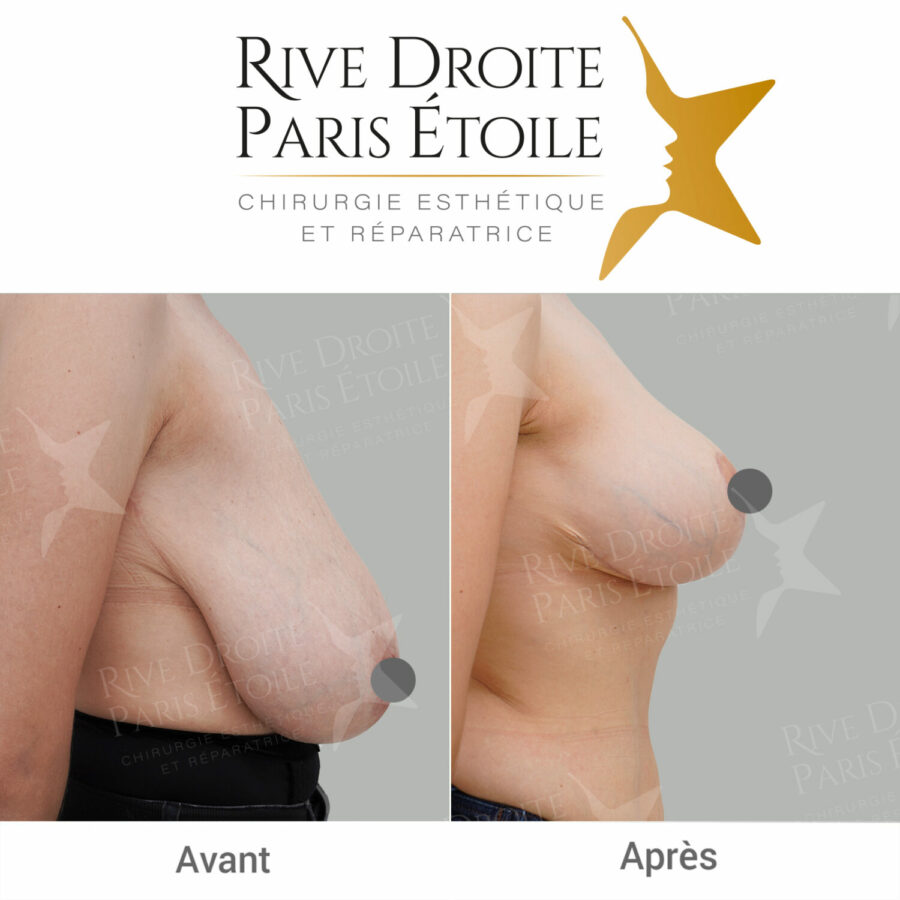
On the day of the procedure, the surgeon makes an incision in the breasts to remove the excess fatty tissue from the mammary gland. A breast lift is then most often performed to remove the excess skin in order to raise the breasts and re-tension the breast skin so as to give them a better appearance. Depending on each patient’s morphological characteristics, several techniques can be used, ranging from a single incision (around the areola) to a double incision (around the areola and from the nipple to the inframammary fold), and sometimes even a triple incision (T-shaped incision) depending on breast volume. The areola is also resized and lifted, as is the nipple, to ensure a perfectly uniform chest.
At the end of the operation, and after a few weeks of recovery, the breasts are lastingly reshaped, resulting in more even curves and visibly repositioned breasts.
From what cup size and volume can you be eligible?
The question of the cup size from which to consider a breast reduction comes up often: there is no single threshold, because it is the functional impairment (pain, postural and psychological impact) that guides the indication, not size alone. In practice, the patients concerned most often have a D cup and above (E, F), and the operation generally brings them back to a C or D cup — a reduction of about one to two sizes.
The criterion that determines eligibility for reimbursement is not, however, the cup size but the volume of gland removed: to be considered reconstructive, the procedure must result in the removal of at least 300 grams of mammary gland per breast. It is this threshold, and not the bra size itself, that serves as the reference for the French national health insurance.
What are the conditions for insurance coverage in France?
The price of a breast reduction can range from €3,000 to €8,000 depending on the volume to be removed and the complexity of the procedure. However, this cost can in some cases be reduced thanks to partial, conditional insurance coverage. The eligibility criteria rest essentially on the reconstructive nature of the procedure and on the volume of gland removed.
Partial coverage subject to conditions set by the French national health insurance
To obtain reimbursement from the French national health insurance, the breast reduction must address a serious health problem for the patient, whether physical and/or psychological.
The French national health insurance therefore draws a distinction between what stems from the reconstructive nature of the surgery and, conversely, its purely cosmetic nature. If the procedure is considered purely cosmetic, it will not be reimbursed and all costs will be borne by the patient. If, on the other hand, the surgery aims to correct disabling hypertrophy or marked asymmetry, it then falls under reconstructive surgery, which may be partly covered by the French national health insurance.
How do you obtain reimbursement from the French national health insurance?
The coverage process varies from case to case and can be either automatic or require a prior-agreement request. The latter is then made by the surgeon on the basis of the diagnosis carried out beforehand. It is submitted to the health insurance fund when the surgeon estimates that the quantity to be removed is greater than 300 grams per breast — the minimum volume per breast that justifies the therapeutic aim.
If there is no reply within 15 working days, the coverage request can be considered tacitly accepted by the French national health insurance. Often, however, the patient is sent a summons for a consultation with a medical adviser from the health insurance to confirm the genuinely reconstructive nature of the procedure. The medical adviser’s favourable opinion then serves as final validation for coverage.
In every case, the patient can obtain reimbursement when the procedure results in the removal of at least 300 grams of mammary gland per breast, which generally corresponds to a reduction of 1 to 2 cup sizes, or when she has a cup size above D (E or F). A marked breast asymmetry may also give entitlement to partial coverage, assessed on a case-by-case basis by the medical service.
Coverage generally makes it possible to halve the cost of the procedure, but the practitioner’s fees will nonetheless remain the patient’s responsibility. She may, however, obtain partial or full reimbursement depending on her health cover and the level of guarantee in her complementary insurance.
Frequently asked questions
At what age can you have a breast reduction?+
There is no maximum age, and no real minimum age once the request is justified. The essential condition is that the breasts have finished growing and the mammary glands are fully developed. In practice, the procedure can be considered from the age of 16 in cases of hypertrophy responsible for disabling pain, but it is most often performed in adulthood. Many patients choose to wait until after their pregnancies, as the hypertrophy can reappear later.
From what cup size is a breast reduction indicated?+
No specific cup size alone triggers the indication: it is the functional impairment (back and neck pain, postural and psychological impact) that takes precedence. The patients concerned do, however, most often have a D cup and above (E, F), with the operation generally bringing them back to a C or D cup — a reduction of one to two sizes.
What are the conditions for insurance coverage in France?+
To be considered reconstructive and give entitlement to reimbursement, the procedure must address a serious health problem (physical and/or psychological) and result in the removal of at least 300 grams of mammary gland per breast. Below this threshold, the procedure is considered purely cosmetic and remains the patient’s responsibility. A marked breast asymmetry may also justify partial coverage, assessed on a case-by-case basis.
Why is the 300-gram-per-breast threshold so important?+
It is the volume of gland removed, and not the bra size, that serves as the reference for the French national health insurance. The removal of at least 300 grams per breast generally corresponds to a reduction of one to two cup sizes and marks the boundary between reconstructive surgery, which may be reimbursed, and cosmetic surgery, which is not covered.
What are the contraindications to a breast reduction?+
The main contraindications are a history of pulmonary embolism, a pregnancy planned in the coming months, and smoking (to be stopped at least one month beforehand to limit the risk of necrosis and poor healing). Aspirin and anticoagulants are suspended in the days preceding the procedure, and weight loss is often recommended. The patient must also have finished growing.
Does a breast reduction prevent breastfeeding afterwards?+
Not necessarily. Current surgical techniques make it possible, in many cases, to preserve the connections between the mammary gland and the nipple, which keeps breastfeeding possible. Breastfeeding is nonetheless never guaranteed after this type of procedure: this point is systematically discussed during the consultation for patients planning a pregnancy.
Book an appointment
If you are considering a procedure, book an appointment in just a few clicks: our surgeons will answer all your questions and guide you toward a tailored, personalised solution.
Book on Doctolib