
Breast augmentation: how to choose the right implants
Long a source of self-consciousness, the female bust can today be substantially reshaped thanks to the steady progress of plastic surgery. Several techniques now exist to perform a breast augmentation (placing implants, breast lipofilling, composite breast augmentation) and to restore self-confidence. Let us focus in particular on breast augmentation with implants. Which type of implant should you choose? How are the implants positioned? What is recovery like and what scars are visible? Here is everything you need to know to choose the right breast implants.
Contents
Which type of breast implants should you choose?
There are mainly two types of breast implants: the round implant and the anatomical implant. Today, the choice between a round or anatomical implant is largely settled in favour of the round implant, which accounts for the vast majority of implants placed in France.
Round implants
Round implants are, as the name suggests, round in shape and are mostly made of silicone (in both the inner and outer shell), sometimes combined with saline solution. They make up the vast majority of implants used in breast augmentation today. Round implants immediately create a fuller look, adding volume to the upper part of the bust.
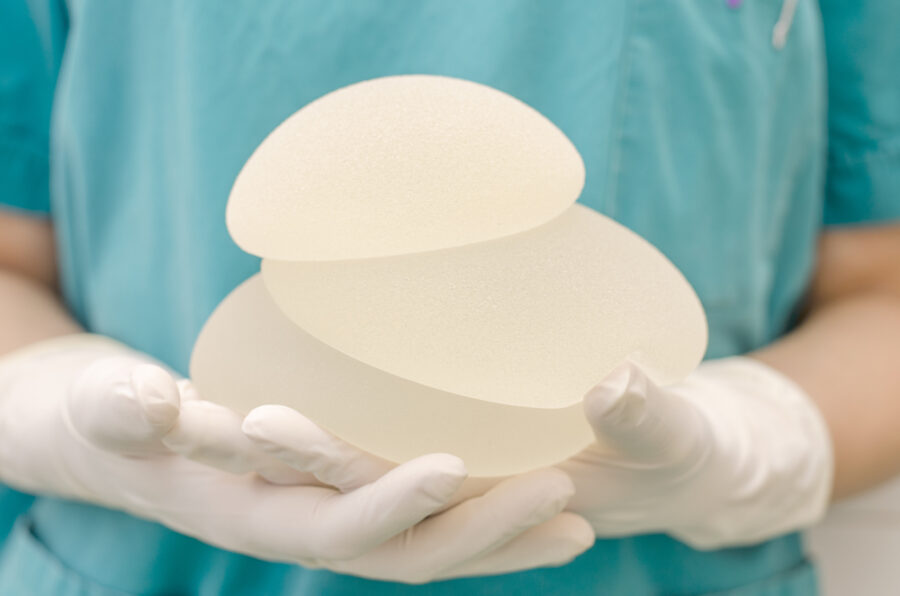
While they were long criticised for looking too unnatural, recent advances now make it possible to achieve far more authentic results, notably with the emergence of so-called ergonomic implants that adapt to the patient’s movements. Their viscous, elastic gel allows the implant to follow the shape of the breast despite its projection, with virtually no risk of flipping.
Round implants are particularly suitable for patients with a regularly shaped bust but a small volume, or for those experiencing the « deflated breast » phenomenon, notably after pregnancy or weight loss.
Anatomical implants
Anatomical implants, also called teardrop or pear-shaped implants, are designed to fit the patient’s anatomy perfectly. Also made of silicone gel, they aim to achieve a result that feels natural to the touch.
They are nonetheless rarely used today, as most surgeons prefer round implants. They may, however, be recommended for patients with breast ptosis (sagging of the breast gland, often accompanied by loose skin) or as part of a breast reconstruction after cancer.
Why are round implants placed more often than anatomical implants nowadays?
Despite generally positive results, particularly in terms of appearance and feel, anatomical implants have largely been abandoned by most plastic surgeons. The reason lies in their tendency to rotate, which then requires a further corrective procedure. This in fact occurs in 5 to 10% of cases, with risks that are not insignificant to patients’ health.
Some macrotextured implants also caused anaplastic lymphomas, which led to the 2019 ban on all the macrotextures that generally made up anatomical implants. Round implants are therefore now used by the vast majority of practitioners. To go further on this choice, we set out the decision criteria in our dedicated article on round or anatomical breast implants.
Which projection should you choose: high or moderate profile breast implant?
The projection of breast implants determines, as the name suggests, how far the bust projects at the cleavage. Breast implants therefore come in different profiles that give the breasts a more or less prominent look at the cleavage. Various implant profiles are available depending on the patient’s wishes:
- Low profile breast implants: this is a common profile chosen by patients with a fairly classic build who want a natural, discreet result.
- Moderate profile breast implants are likewise intended for patients who want a moderate, natural and harmonious result with intermediate cleavage.
- High profile breast implants, generally chosen by women wanting a substantial breast augmentation. The projection is greater, with a fuller cleavage and a more forward perspective.
- Very high profile breast implants, for very significant bust projection and a prominent cleavage.
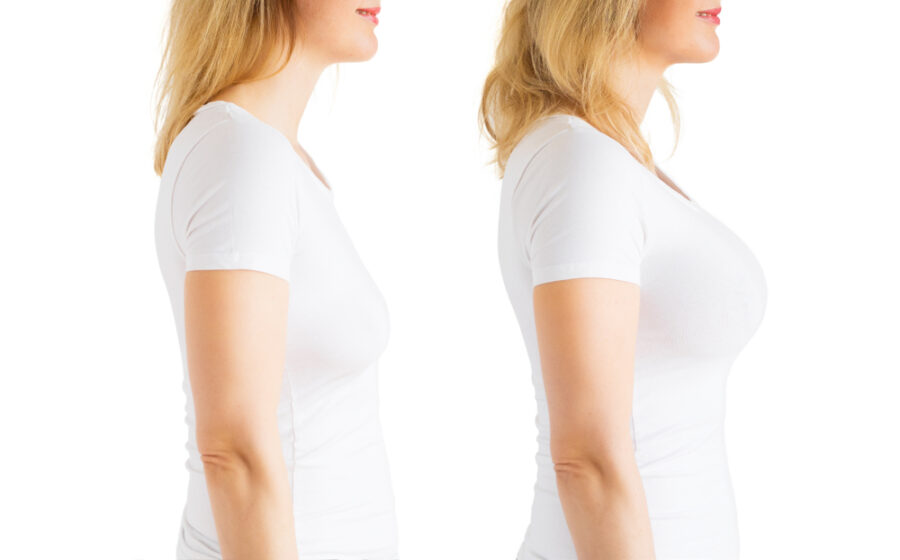
In practice, the choice usually comes down to one simple question: should you opt for a high or moderate profile breast implant? The moderate profile gives a soft contour, a subtle upper bust and a discreet result, sought by patients who want a « naturally French » look. The high profile, for the same diameter, concentrates more volume towards the front: it raises the cleavage and suits narrow breast bases or patients wanting a bolder contour. For the same volume expressed in cubic centimetres, a high profile will therefore look more rounded than a moderate profile.
Which volume and size of breast implant should you choose?
Bust volume is a central question in breast augmentation surgery. The volume of course depends largely on the patient’s wishes (breast shape, cup size, natural look, discretion, etc.), but not only.
Indeed, other factors come into play and will be explained to the patient through the surgeon’s informed advice. Even though the final choice is made in the last instance, with full awareness, by the patient, the choice of implant size and cup must take the following data into account:
- The dimensions of the chest;
- The shape of the bust;
- The chest circumference;
- Skin quality;
- The presence or absence of breast gland tissue;
- The position of the areolae;
- The presence or absence of breast ptosis in the patient;
- The measurement of the breast base, which determines the possible width (diameter) of the implant.
The choice of implant volume is therefore the result of balancing the patient’s wishes against the possibilities offered by her anatomy, based on the surgeon’s assessment. The width of the breast base is decisive here: it sets the maximum implant diameter compatible with your bust, and therefore the real margin you have to increase volume without spilling over onto the cleavage or the underarm.
During the consultation, a simulation can be carried out with implants placed under a slightly compressive (rather than padded) T-shirt to give an idea of the post-operative result. The implant volume is expressed in cubic centimetres (cc) and can range, depending on the patient, from 125 to 575 cc. As a guide, it is commonly considered that around 200 to 250 cc are needed to gain one cup size, although this gain also depends on the width of the breast base and on skin quality.
In clinical practice, the most frequently placed implant is around 300 cc, a moderate-projection volume corresponding to a gain of about two cup sizes for an average build. Rather than thinking in terms of a « target cup size », it is therefore better to start from your breast base and the desired effect — discreet or bold — to determine, together with the surgeon, the most suitable volume / profile pairing.
Which position should you choose for your breast implants?
Breast implants can be placed in different ways. The implant can be positioned behind the breast gland (subglandular position), behind the pectoral muscle (submuscular position) or according to the dual plane protocol, that is, both behind the breast gland and behind the pectoral muscle.
The subglandular position
The subglandular position (or pre-muscular) consists of inserting the implant behind the breast gland and in front of the pectoral muscle. This type of placement is specifically suited to women who have a certain amount of fat in this area as well as good skin quality. It offers several particular advantages:
- A natural feel to the touch;
- A relatively short recovery time after the procedure;
- The option of choosing relatively large implant volumes;
- A pectoral muscle that is not distorted when it contracts.
Conversely, this placement does have a few possible drawbacks for patients who choose it:
- A certain weakening of the skin;
- Possible interference when performing a mammogram;
- A risk of inflammatory reaction around the implant (capsular contracture).
The submuscular position
The submuscular position (or retro-muscular), for its part, involves placing the implant behind the pectoral muscle. It is particularly suited to slimmer women with a very underdeveloped breast gland.
Unlike the previous technique, this one is limited to moderate implant volumes, notably because of the patients’ build. It does, however, allow for natural results and much less interference during mammograms, despite some distortion of the pectoral muscle when it contracts. Inflammatory reactions around the implant are also far less frequent: the international scientific literature has long reported a significantly lower risk of capsular contracture when the implant is placed behind the muscle rather than in front of the gland. The patient will, however, have to observe a longer recovery period after the procedure.
The dual plane position
The most recent method, the dual plane technique for a natural-looking breast augmentation, was devised to address the drawbacks of the subglandular and submuscular positions. The dual plane placement consists of positioning the implant both behind the pectoral muscle (upper part of the implant) and behind the breast gland (lower part of the implant).
This placement makes it possible to obtain the advantages of the two methods mentioned above (natural appearance and feel, no distortion of the pectoral muscle when it contracts) without having to put up with their drawbacks (short recovery time, limited capsular contracture, moderate pain after the procedure).
Which scar will your breast implants leave?
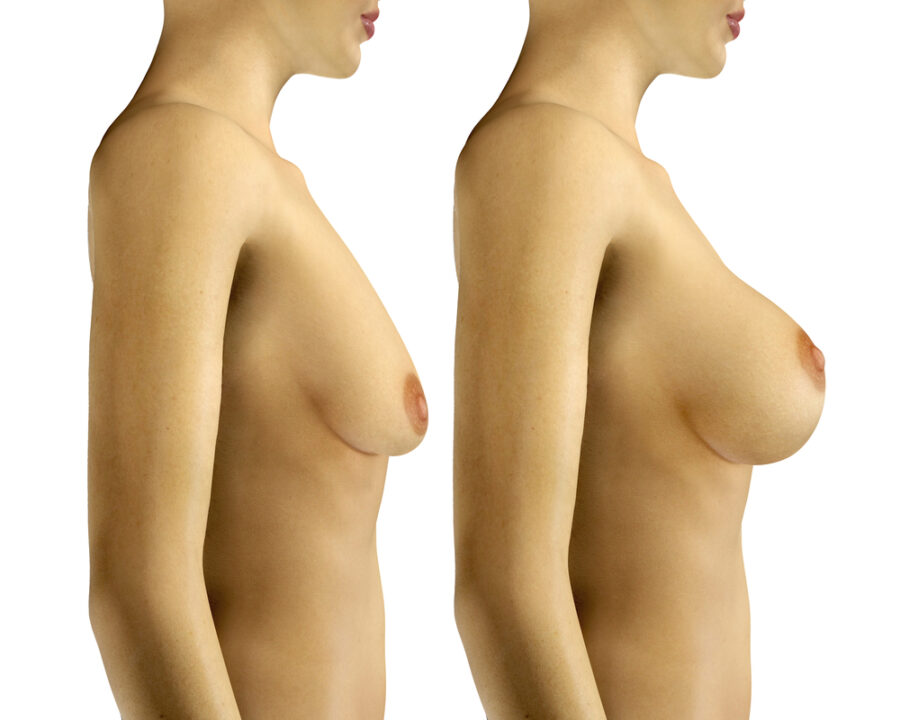
Here again, the patient is offered 3 options for the type of scar left after the procedure. The surgeon will advise the most appropriate incision for the type of procedure to be performed, among these 3 options:
- The periareolar scar (around the areola) : the incision is then made on the lower part of the areola, leaving only a very discreet scar, all the more so when the areola is a relatively light shade. It is the most precise technique for positioning the implant correctly. It can, however, only be used when the patient’s areola is sufficiently prominent.
- The inframammary scar (under the breast): the incision is made in the inframammary fold, again leaving a very discreet scar since it is hidden by the natural drop of the breast. Here too, this technique allows precise positioning of the implant, particularly for anatomical implants. It also offers the advantage of bypassing the breast gland.
- The transaxillary scar (in the hollow of the armpit): the incision is made in the armpit, under the arm, and is therefore not visible when the arms are kept close to the body. It is the most commonly used incision for submuscular placement. It is, however, less recommended than the others for placing anatomical implants because of its lower precision.
What is recovery like after a breast augmentation with implants?
Breast augmentation with implants may prove more or less painful in the first few days after the procedure depending on the type of placement chosen (submuscular in particular). A few painkillers will nonetheless be enough to ease any discomfort. Some stiffness may also be noticed by the patient, particularly when raising the arms, until she gets used to this foreign body.
The near-final result will be visible after about two weeks, once the swelling has gone down, although the skin fully redraping over the implant takes several months. A support bra will nonetheless need to be worn for 6 weeks to consolidate the placement. For a full overview of this phase, see our article on recovery after breast augmentation.
Follow-up visits should be scheduled one week and then one month after the procedure to ensure that the implants have properly settled into the shape of the bust. Appointments with the surgeon to take stock and detect any complications should then take place every 2 years, until the implants are eventually replaced. The cost of the procedure, for its part, is detailed in our guide to breast augmentation prices and insurance coverage.
Frequently asked questions
Which type of breast implant should you choose, round or anatomical?+
Today, almost all breast augmentations in France are performed with round silicone gel implants. Anatomical (teardrop) implants have become rare, owing to their risk of rotation and the 2019 ban on the macrotextured implants that most often made them up. The precise choice is always made with the surgeon, based on your anatomy and the desired result.
High or moderate profile breast implant: what is the difference?+
For the same volume, a moderate profile gives a soft contour and a subtle upper bust, sought for a natural look; a high profile concentrates more projection towards the front and raises the cleavage. The high profile is often preferred for narrow breast bases or a bolder contour. It is the width of your breast base and the desired effect that guide this choice.
How do you choose the size (volume) of your breast implants?+
The volume, expressed in cubic centimetres (cc), is the result of a compromise between your wishes and what your anatomy allows: width of the breast base, skin quality, chest circumference, position of the areolae. It is commonly considered that around 200 to 250 cc are needed to gain one cup size. The most frequently placed volume is around 300 cc. A simulation with implants placed under a slightly compressive T-shirt helps to visualise the result.
Should the implants be placed in front of or behind the muscle?+
Placement can be subglandular (in front of the muscle), submuscular (behind the muscle) or dual plane (a combination of the two). Placement behind the muscle gives a very natural result in slim patients, and the scientific literature reports a lower risk of capsular contracture than the pre-muscular position, at the cost of a slightly longer recovery. The dual plane technique aims to combine the advantages of both approaches. The surgeon recommends the position best suited to your anatomy.
What is the lifespan of a breast implant?+
A breast implant is not designed to last a lifetime: regular monitoring is recommended, with a check-up consultation roughly every two years. Replacement is only considered in the event of wear of the shell, capsular contracture or a change in aesthetic wishes, and not on a fixed schedule. Careful monitoring allows any abnormality to be detected in time.
What scar does a breast augmentation with implants leave?+
Three incisions are possible: periareolar (at the lower edge of the areola), inframammary (in the fold under the breast) and transaxillary (in the hollow of the armpit). Each leaves a discreet scar, hidden by a natural contour. The surgeon chooses the approach best suited to the type of implant and to your anatomy.
Book an appointment
If you are considering a procedure, book an appointment in just a few clicks: our surgeons will answer all your questions and guide you toward a tailored, personalised solution.
Book on Doctolib