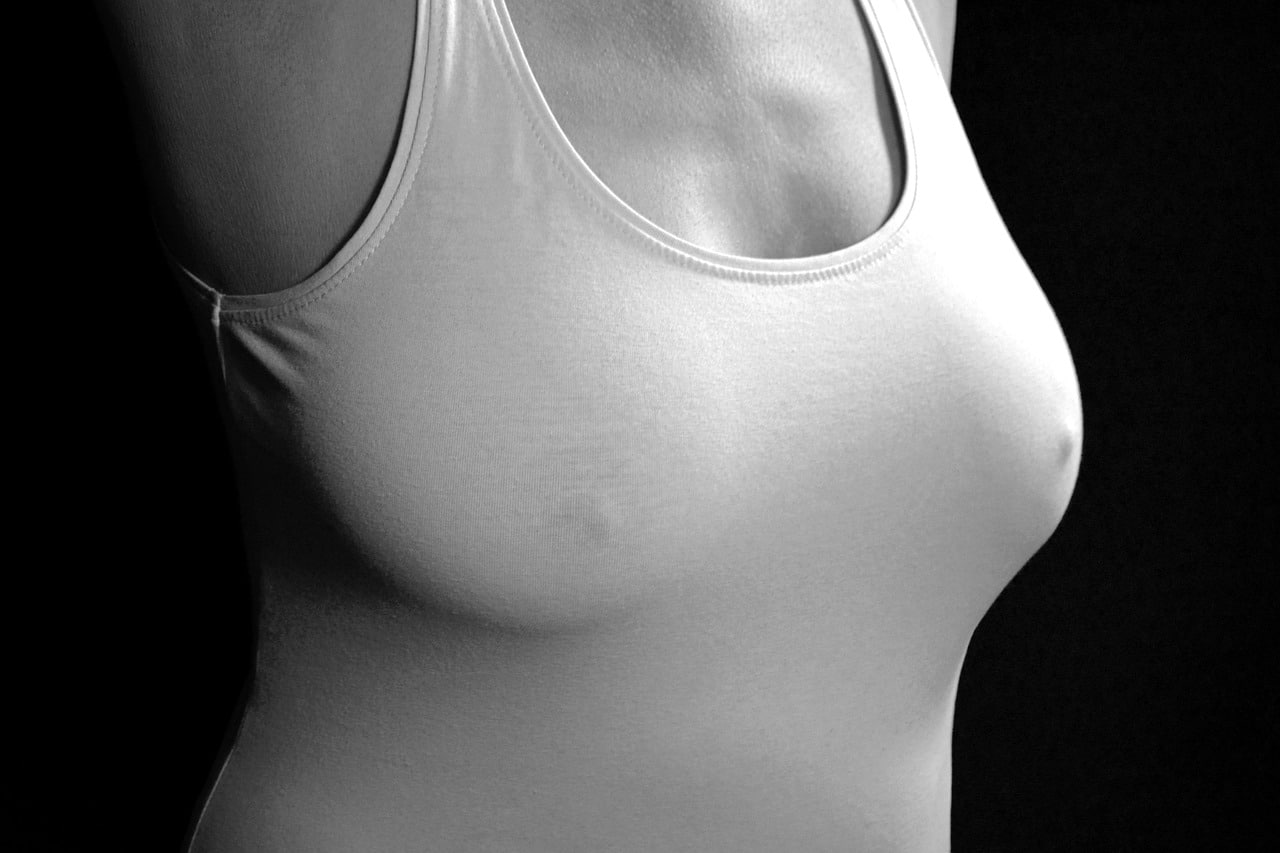
The dual plane technique: breast augmentation with natural results
Now very common and highly sought-after, breast augmentation is a plastic surgery procedure designed to increase breast volume for women who feel self-conscious about the size of their breasts. In some cases, however, the result of such an operation can look too artificial for certain patients. A relatively recent technique (developed around a decade ago) now makes it possible to achieve a far more natural-looking chest and a much more harmonious result. The dual plane method (also called « bi plane » or « dual plane ») also delivers far more durable results over the long term, even with round implants. What does this innovative procedure involve and why does it produce such an authentic result? What are its advantages? How is the procedure performed? Here is everything you need to know about dual plane breast augmentation.
Contents
A few words about breast augmentation
When a woman feels self-conscious about breasts she considers too small, she now has access to several techniques to increase breast volume, such as placing breast implants or breast lipofilling (autologous fat transfer). Breast implants are nonetheless the most commonly used technique, with a range of possible approaches. Originally, two main techniques were used, namely:
- placing breast implants behind the pectoral muscle (retropectoral or submuscular position), which gives a relatively natural result but, for some patients, has the drawback of making the chest bulge too much, with a result that becomes less even over time as the skin ages;
- placing breast implants in front of the pectoral muscle and behind the mammary gland (prepectoral or subglandular position), which requires sufficiently firm skin and fairly thick tissue so the implant can hold up over time despite breast ptosis. For this reason, it does not allow for a large breast augmentation. When the skin or tissue is too thin, the submuscular position is preferred so that the implant is better protected by greater thickness (muscle + gland).
In recent years, a new technique has become widespread for breast augmentation, one that combines the advantages of both techniques while significantly limiting each of their drawbacks: dual plane placement. It thus represents a genuine compromise between an implant placed behind the muscle and an implant placed in front of the muscle.
What does the dual plane technique for breast augmentation with implants involve?
The dual plane method consists of placing the breast implant behind the pectoral muscle in the upper part of the breast and behind the mammary gland in the lower part. The upper part of the implant is thus positioned behind the pectoral muscle (above the areola) and the lower part behind the mammary gland, in front of the muscle (below the areola).
This arrangement across two distinct planes (hence the name « dual plane ») creates a balance with a harmonious unfurling of the sub-areolar segment down to the inframammary fold, as well as greater overall evenness of the chest. In this configuration, the implant is divided roughly equally, with about 50% in a submuscular position and about 50% in a subglandular position.
These proportions may vary, however, depending on the initial characteristics of the chest and must be adapted to each individual case according to the specialist’s assessment. The dual plane technique allows for a peri-areolar incision (around the areola) or one at the inframammary fold. The axillary approach (in the hollow of the armpit), traditionally used, is less suited to this type of procedure.
The different types of dual plane (Tebbetts classification)
The dual plane technique was described and codified by the American plastic surgeon John B. Tebbetts, in a landmark article published in 2001 in the journal Plastic and Reconstructive Surgery. In it he distinguishes three types of dual plane (Type I, II and III), which correspond to a progressively greater separation between the pectoral muscle and the mammary gland:
- Type I dual plane: the muscle remains attached to the gland, with no additional separation. It is intended for breasts whose skin envelope is firm and that show no laxity.
- Type II dual plane: the separation between the muscle and the gland extends a little higher, allowing the lower part of the implant to fill the lower pole of the breast more freely.
- Type III dual plane: the separation is more extensive still, indicated for breasts with more pronounced glandular laxity or slight breast ptosis.
The choice between these three variants is made on a case-by-case basis, during the consultation, according to the quality of the skin, the position of the gland and the degree of laxity. It is this adaptability that explains the particularly natural result of the technique.
The advantages of placing breast implants with this method
The main advantage of the dual plane technique, with an implant placed partly behind the pectoral muscle, lies in the very natural appearance of the chest after the procedure.
A very natural-looking chest
Dual plane breast augmentation prevents the implant from causing excessive bulging in the upper part of the breast, since the contours of the implant, usually visible, are here concealed by the pectoral muscle. It therefore does not risk riding up unexpectedly at the slightest contraction, as can be the case with the submuscular position. The implant nonetheless remains mobile and free to descend, since it is positioned behind the mammary gland in its lower part and is therefore not held back by the pectoral muscle. As a result, it is also less detectable to the touch, with a far more even result.
The dual plane technique thus makes it possible to fill the lower contours of the breast harmoniously and naturally, since the lower part of the implant is covered by the mammary gland rather than by the muscle.
Inframammary scars, relatively visible with a standard breast augmentation, are also far less noticeable with dual plane placement, since the lower part of the breast appears more fully unfurled (not held back by the muscle).
Durable results
This method also ensures a result that lasts over time, since it avoids the risk of potential folds or even rippling in the upper part of the breast that can appear over time or after weight loss when the implant is placed in front of the muscle.
An opportunity to correct certain breast imperfections
The dual plane technique is also an opportunity to correct certain imperfections in the lower part of the breast, such as tuberous breasts (underdevelopment of the lower part of the breast), breast ptosis when it is mild, or areolas pointing downward. By performing a subglandular separation, it is indeed possible to rebuild this part of the breast and restructure the mammary gland to make the chest more even, with the volume spreading toward the lower part. The dual plane also offers the opportunity to correct breast asymmetry or to reduce the gap between the two breasts. It therefore makes it possible not only to increase breast size but also to reshape the breasts for an optimal result.
Greater comfort in everyday life
Lastly, dual plane placement is more comfortable in everyday life for the patients who choose it, particularly when it comes to sports, since the implants follow the body’s natural movements more closely with each muscle contraction. The chest therefore shows no visible deformation with movement. The dual plane technique is also particularly well suited to very athletic patients, since it avoids the risk of implant flipping.
Recovery is also less painful than with the submuscular position, since the muscle, being released, does not bear the pressure of the implant. The risk of complications is also lower (no capsular contracture or shell formation).
The drawbacks of this technique for increasing breast volume
The dual plane technique has few drawbacks, aside from its price, which is slightly higher than traditional procedures, and the level of expertise required of the surgeon, given that the procedure is somewhat more complex. The operation is also slightly longer, but rarely exceeds two hours.
How the procedure is performed
A dual plane breast augmentation is performed under general anaesthesia. It begins with a small incision of 3 to 4 cm around or inside the areola, or at the inframammary fold. This incision makes it possible to create a space in front of the pectoral muscle.
The lower part of the muscle is then detached to form a cavity that will serve as a pocket behind the muscle. This pocket then allows the implant to be positioned behind the mammary gland in its lower part and behind the pectoral muscle in its upper part, in order to achieve a contoured appearance of the breast.
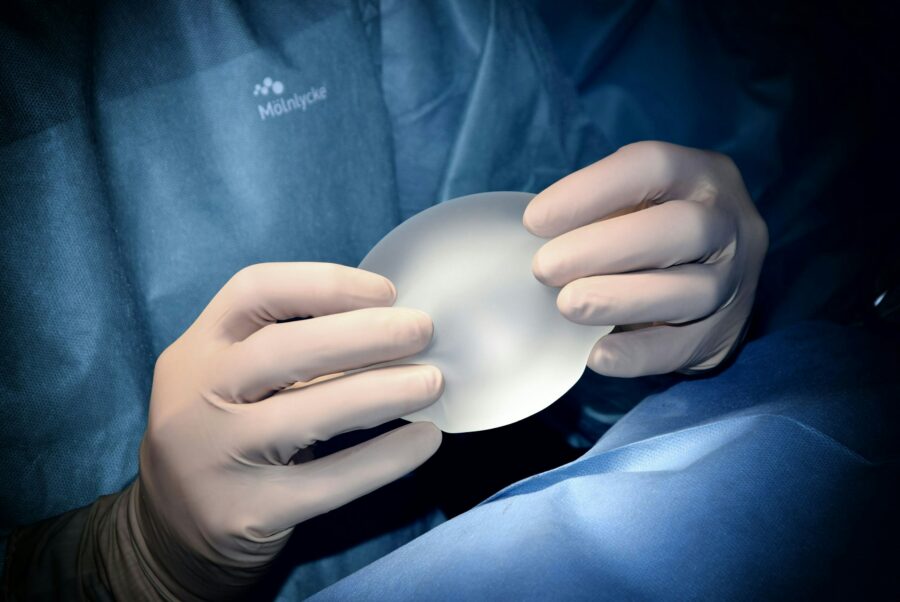
Before the final insertion of the implant, the surgeon generally uses trial implants (known as « sizers ») in order to determine the ideal implant size. Once the ideal measurements have been gathered, the sizers are removed and the actual breast implants are positioned meticulously. When the implant is perfectly in place, the surgeon closes the incision with deep, self-absorbing sutures, leaving no visible thread along the scar.
Recovery
The recovery period after the operation usually varies from 1 to 2 weeks, depending on each patient’s characteristics and the extent of the procedure. Some mild pain may occur, but to a lesser degree than with the strict submuscular position, where the muscle compresses the implant. It can be relieved by taking painkillers.
The results of placing breast implants with the dual plane technique
The results of dual plane breast augmentation are visible immediately after the procedure, but the true breast size will only be apparent after about 2 weeks, once the swelling has gone down. It may even take several months to fully stabilise. It is this delay that explains the value of before / after photographs, taken some time after the procedure to assess the final result.
Although slightly longer than standard breast augmentation techniques, the dual plane method makes it possible to achieve a subtle, natural result for patients. While appearing fuller, the breasts remain firm yet discreet, both to the eye and to the touch, since they are covered by both the gland and the pectoral muscle.
They thus blend perfectly with the patient’s overall body contour (no riding up of the implants with pectoral contraction). The contours of the implant are indeed well concealed, and the cleavage shows no sign of a procedure, as is sometimes the case with other breast augmentation techniques. Ultimately, then, it is a safe and effective method that also delivers durable results.
Frequently asked questions
What is the dual plane for breast augmentation?+
The dual plane (or « bi plane ») is a breast augmentation technique that places the implant across two distinct planes: its upper part sits behind the pectoral muscle and its lower part behind the mammary gland, in front of the muscle. This combined position brings together the advantages of the submuscular and subglandular placements for a natural look and a harmonious unfurling of the lower pole of the breast.
Is dual plane breast augmentation painful?+
Recovery from a dual plane procedure is generally less painful than a fully submuscular placement: with the lower part of the muscle released, the implant does not exert constant muscular tension. Some mild pain may occur in the first few days and is relieved with painkillers. Recovery most often lasts 1 to 2 weeks.
How much does a dual plane breast augmentation cost?+
The price is slightly higher than a standard breast augmentation, because the procedure is technically more demanding and somewhat longer. The exact price depends on the implants chosen and on each patient’s case: it is given during the consultation, in the detailed quote provided by the surgeon. You will find reference points on our dedicated page about breast augmentation prices and insurance coverage.
Is the dual plane the best breast augmentation technique?+
There is no single technique that is « best » in absolute terms: the right choice depends on body shape, skin quality and the desired volume. The dual plane is often preferred when a very natural result is sought while limiting the drawbacks of the other positions. In certain situations, a purely submuscular placement or a breast lipofilling remains more appropriate. Only the consultation can determine the most suitable solution.
Can you do sports after a dual plane breast augmentation?+
Yes. Returning to sports happens gradually, respecting a healing period, but the dual plane is particularly well suited to athletic patients: the implants follow the body’s natural movements more closely and the risk of flipping or deformation when the pectoral muscle contracts is reduced. The precise timeline for resuming activity is set with the surgeon according to the sport practised.
What is the difference between an implant in front of the muscle, behind the muscle and in dual plane?+
An implant placed behind the muscle (submuscular) is well concealed but can make the upper breast bulge and ride up on contraction. An implant in front of the muscle (prepectoral / subglandular) follows the shape of the breast better but remains more visible in slim patients. The dual plane combines the two: the top of the implant under the muscle, the bottom of the implant under the gland, to get the best of each position.
Book an appointment
If you are considering a procedure, book an appointment in just a few clicks: our surgeons will answer all your questions and guide you toward a tailored, personalised solution.
Book on Doctolib