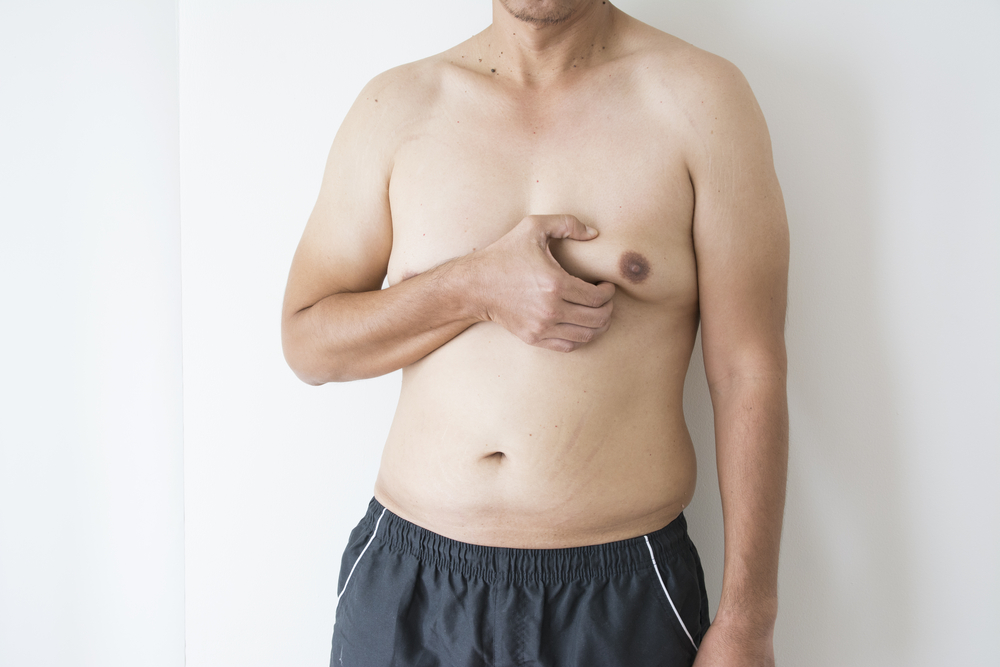
How to tell the difference between gynecomastia and adipomastia
Gynecomastia and adipomastia are two conditions that both aim to remove an abnormal presence of breast tissue in men. Both terms refer, with one key difference, to an abnormal development of the breasts in men. While they can look similar, they differ in the details. What is the difference between gynecomastia and adipomastia? How do you tell them apart? What symptoms does each one cause? How is each of these morphological abnormalities treated? Here is everything you need to know to tell the difference between gynecomastia and adipomastia.
Contents
Gynecomastia, male breast hypertrophy
Gynecomastia is characterised by unilateral (one breast) or bilateral (both breasts) breast hypertrophy in men, most often caused by a hormonal imbalance. This growth, which is benign in the vast majority of cases, has a firm consistency around the areola. This is referred to as glandular breasts or « true » gynecomastia. To learn more about this condition and its correction, you can read our page dedicated to gynecomastia surgery.
Signs of gynecomastia
Although the mammary gland can develop excessively in men, it remains less significant than in women. Nevertheless, mainly because of these hormonal disorders, the discreet breast bud can intensify and become denser over time. Under normal circumstances, men can experience 3 different periods of change in it: at birth, at puberty and once they are adults. At birth, around 60 to 90% of newborn boys have gynecomastia, notably because of a transfer of oestrogens received from their mother through the placenta. At puberty, nearly 50 to 70% of young boys experience gynecomastia due to significant hormonal fluctuations; in the vast majority of cases, this pubertal gynecomastia resolves on its own within one to two years, without requiring any treatment. From the age of 50, around half of all men are affected by gynecomastia. In adulthood, gynecomastia is then very often associated with a drop in testosterone, weight gain or the use of various substances: drugs, antidepressants, alcohol, medication, and so on.
Diagnosing gynecomastia
During the surgeon’s assessment, they will seek to characterise this enlargement of the mammary gland in order to make sure it does not stem from a more serious condition (kidney failure, thyroid disorders, or a tumour of the testicles, liver or stomach in particular). They will have the patient lie down with their hands behind their neck, then palpate the sub-areolar area using the thumb and index finger. If needed, the surgeon may then ask the patient to have blood tests, a mammogram or an ultrasound before considering any corrective procedure.

How do you know whether you have gynecomastia rather than adipomastia?
Without replacing a doctor’s examination, one simple sign often points to the diagnosis on palpation. In the case of true gynecomastia, you can feel a firm, mobile and sometimes tender disc, centred just behind the areola: this is the mammary gland. In the case of adipomastia, the consistency remains soft and uniform, with no hard core beneath the nipple, and the volume is spread more diffusely across the whole chest. Any discomfort, pain or discharge, volume that appears on one side only, or a hard, fixed lump should always prompt a consultation, in order to rule out another cause. Only a breast ultrasound can confirm with certainty whether the volume is glandular or fatty.
Adipomastia, an excess of fat over the pectoral muscles in men
Adipomastia is quite simply what could be described as fatty gynecomastia: the chest takes on a softer consistency, without any real development of the gland. It is marked by a disproportionate increase in breast volume over the pectorals due to an accumulation of fat. It most often results from being overweight or from sudden weight loss, particularly following bariatric surgery. It is also sometimes referred to as pseudogynecomastia in the medical literature, precisely because it mimics the appearance of gynecomastia without sharing its glandular cause.
Signs of adipomastia
Among the symptoms of adipomastia, the presence of a soft chest is particularly worth mentioning. The chest may also develop even though there is no significant enlargement of the mammary gland. Adipomastia is therefore a benign condition and is not considered a disease, unlike gynecomastia. It also remains distinct from breast hypertrophy in women, which falls under a completely different form of management. It involves no symptoms other than those essentially linked to weight issues and weight fluctuations. As adipomastia is not a disease, there is no specific drug treatment to remedy it (unlike gynecomastia), which does not stop it from causing distress for the person affected. Solutions do nonetheless exist to get rid of it.
Solutions for adipomastia: sport, strength training and diet
Men affected by adipomastia can first turn to strength training and exercise. Personal trainers can in particular advise them better on the kind of movements to perform in order to balance out the chest. Alongside this, a healthy diet is essential to allow for appropriate muscle gain and to reduce fat mass. You do, however, need to be realistic about the limits of this approach: the body does not « target » fat loss in a specific area. Pectoral exercises build the muscle located beneath the fatty deposit but do not melt away the fat locally; only overall, gradual weight loss reduces the volume of the chest. When adipomastia is long-standing, significant or resistant despite an otherwise slimmer figure, exercise alone is generally not enough.
In addition, when exercise is not enough to overcome this abnormality, turning to a plastic surgery procedure remains an excellent alternative. It is carried out under general or local anaesthesia depending on the case at hand and the amount of fat to be removed.
Finally, as adipomastia is not necessarily inevitable, it is possible to prevent it through regular physical activity or by adopting a more balanced diet, when the adipomastia stems from a diet that is too rich, as is frequently the case.
To sum up the difference between gynecomastia and adipomastia
To put it simply, gynecomastia affects the mammary gland, whereas adipomastia corresponds to an accumulation of fatty deposits. With the latter, a significant amount of fat can build up, resembling the formation of a breast. This is why adipomastia is very often described as fatty gynecomastia.
Glandular gynecomastia, for its part, results from hypertrophy of one or both of a man’s mammary glands. In this scenario, the areolas are described as « pointing ». It is also possible for these two forms to combine. In that case, this is referred to as mixed gynecomastia — the most common situation in practice, which combines a glandular core with an excess of fat.
Another notable difference between gynecomastia and adipomastia is that the latter can disappear entirely once the person concerned takes up regular sporting activities or adopts a balanced diet. Adipomastia would in most cases be hereditary, unlike glandular gynecomastia, which is idiopathic, that is to say its cause is not always direct or determined. Taking certain medications can nonetheless be at its origin, in addition to hormonal problems.
Only a doctor is able to distinguish the two abnormalities by establishing a true diagnosis through a clinical examination of the area concerned. Depending on the case, they can then prescribe a targeted physical activity programme or a suitable diet for patients with adipomastia, and corresponding drug treatment for patients with gynecomastia. When none of these solutions proves relevant, a surgical procedure is possible in both cases. As a recognised condition, surgery for gynecomastia then qualifies for insurance coverage under certain conditions — as can be the case for breast reduction and its reimbursement by national health insurance — unlike surgery for adipomastia, which is deemed purely cosmetic and therefore remains the patient’s responsibility.
Gynecomastia and adipomastia: the surgical procedure
Depending on the case, the surgical treatment will be carried out differently for gynecomastia and for adipomastia. This is precisely where the distinction takes on its full meaning, because glandular tissue and fatty tissue do not respond in the same way to surgical techniques.
In the case of glandular gynecomastia, the surgeon can perform an excision in order to remove the abnormality affecting the mammary gland. To do this, the surgeon makes an incision around the areola. They then carry out a mastectomy (an operation to remove the breast, or rather the gland in men). In most cases, they may also need to perform an additional skin excision. For this operation, the patient will be under general anaesthesia. As the gland is a firm, fibrous tissue, it resists simple suction: this is why true gynecomastia cannot be treated by liposuction alone and requires this direct removal.
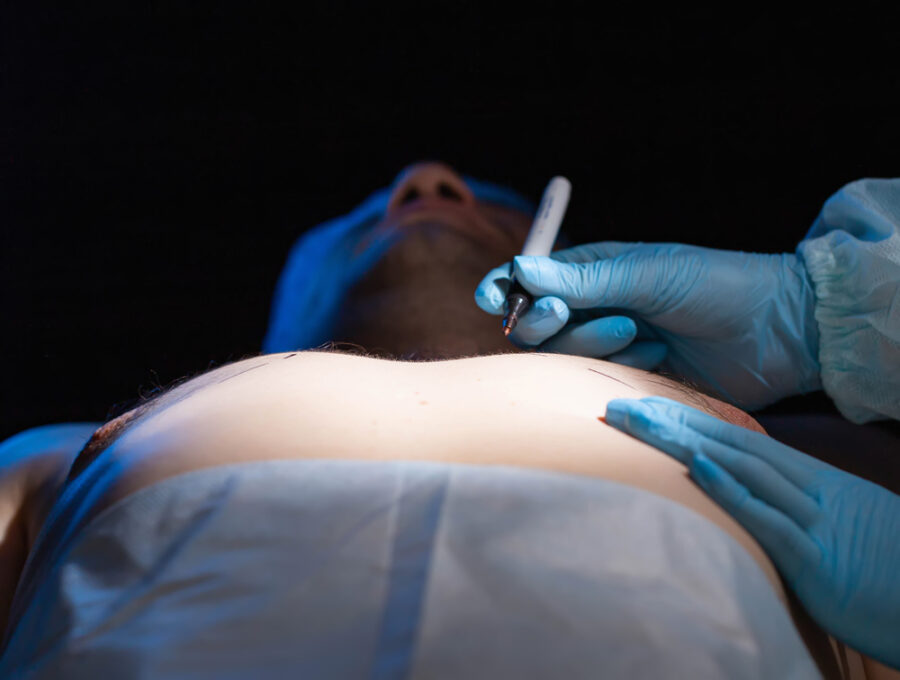
To treat adipomastia, by contrast, simple local anaesthesia may be enough — deep local anaesthesia will be necessary in some cases. The procedure is then only very mildly painful. It consists of suctioning out the fatty deposits accumulated in the chest: most often, the surgeon will perform liposuction of the chest, perfectly suited to a purely fatty excess. This is why isolated adipomastia is treated more simply than glandular gynecomastia.
When it comes to mixed gynecomastia, the specialist may need to combine the treatments. It is not uncommon for them to then pair the mastectomy with liposuction, in order to remove both the gland and the fat for a harmonious result. Whatever the case, these procedures allow the patient to regain a balanced body contour and to put an end to a complex that can sometimes be very psychologically distressing.
Recovery and convalescence
Whatever the technique, recovery generally remains straightforward. A compression garment (a compressive bolero) is worn for several weeks to limit swelling and hold the skin against the new contour. Bruising and swelling are normal in the first few days and gradually fade. Returning to office work can generally be considered after a few days of rest, while sport and lifting heavy loads should be avoided for around three to four weeks, according to the surgeon’s instructions. The result becomes clearer over the weeks, once the swelling has gone down. Stable weight loss before the procedure and maintaining a balanced lifestyle afterwards help to make the result last, particularly in the case of adipomastia linked to being overweight.
Frequently asked questions
How do you know whether it is gynecomastia or adipomastia?+
On palpation, gynecomastia presents as a firm, mobile disc centred behind the areola (the gland), sometimes tender. Adipomastia gives a soft, uniform chest, with no hard core beneath the nipple. Only a doctor can decide for certain, drawing if needed on a breast ultrasound that distinguishes the fatty or glandular nature of the volume.
Can adipomastia go away with exercise and diet?+
Often, yes. As adipomastia corresponds to an excess of fat, overall, gradual weight loss combined with regular physical activity reduces the volume of the chest. The body does not, however, target fat loss in a specific area: pectoral exercises build muscle without melting away the fat locally. When the fatty excess resists despite a slimmer figure, liposuction may be considered.
Why can true gynecomastia not be treated by liposuction alone?+
Because the mammary gland is a firm, fibrous tissue that resists simple suction. Glandular gynecomastia therefore requires an excision (direct removal of the gland through a peri-areolar incision). Conversely, purely fatty adipomastia is treated very well by liposuction. In a mixed form, the surgeon combines the two procedures.
Is the procedure covered by national health insurance?+
As gynecomastia is a recognised condition, its surgical treatment can, under certain conditions, qualify for insurance coverage. Adipomastia, considered a purely cosmetic procedure, by contrast remains the patient’s responsibility. Only the surgeon, after an examination, can indicate whether your situation is eligible for reimbursement.
What is recovery like after a procedure for adipomastia or gynecomastia?+
Recovery is generally straightforward: wearing a compression garment (a compressive bolero) for several weeks, with bruising and swelling in the first few days. Office work is resumed after a few days of rest, while sport and lifting heavy loads should be avoided for around three to four weeks. The result becomes clearer over the weeks, once the swelling has gone down.
Who should you consult in the case of gynecomastia or adipomastia?+
A plastic surgeon is the right person to examine the chest, determine whether it is gland, fat or both, rule out another cause and propose the appropriate solution. The Rive Droite Paris Étoile practice, where Dr Vincent Hunsinger works, holds consultations for both of these situations.
Book an appointment
If you are considering a procedure, book an appointment in just a few clicks: our surgeons will answer all your questions and guide you toward a tailored, personalised solution.
Book on Doctolib